
The Overwhelm Recovery ProtocolWellness & Routines · ~5 min
About this template · Updated November 2026
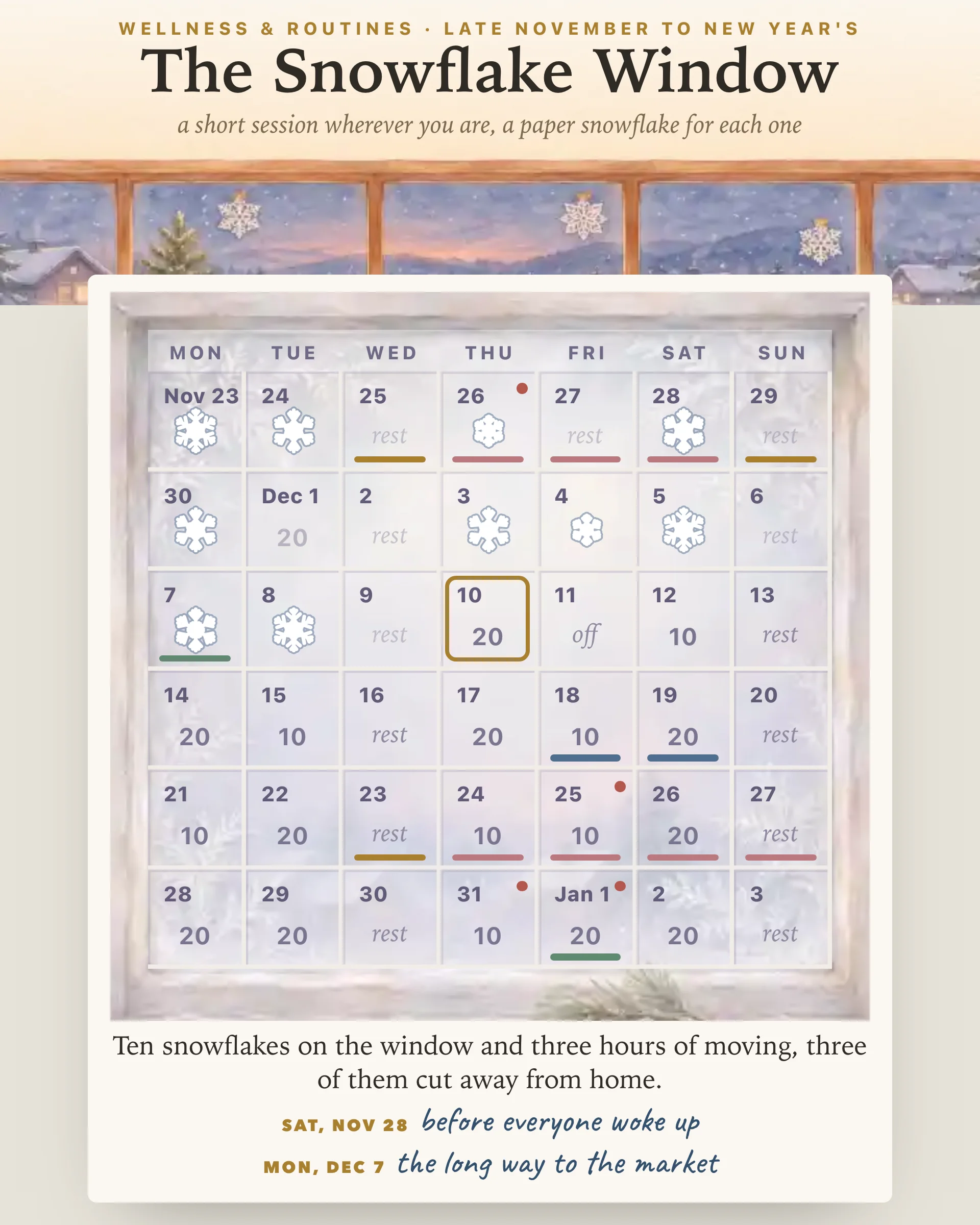
Late November to New Year's is when your usual week falls apart in the nicest possible way: visits, a long drive or two, a guest room with someone asleep on the other side of the wall. A holiday workout that expects your normal hour and your normal floor will not survive that. This page is built for the season you will actually have: short sessions planned around where you will sleep, and a window that fills with paper snowflakes as you go.
The aim is modest on purpose. You are keeping a thread, not chasing a personal best. The moves need no equipment, sessions run ten, twenty or thirty minutes, and none of it is about food. Dinner is part of the holidays, not a debt to pay off.
The World Health Organization's physical activity guidance sets a weekly target of at least 150 minutes of moderate activity for adults, and it also says plainly that any amount of activity is better than none. At the default length of twenty minutes, this plan asks for seventy to ninety minutes a week, which is below that target. That is a deliberate choice for a crowded season. Set the length to thirty and the weeks land between ninety and a hundred and thirty minutes.
Keeping what you have takes much less than building it. A 2021 review of the minimal dose of exercise needed to hold on to fitness, by Spiering and colleagues, found that endurance held for weeks when people trained only twice a week, and strength held with as little as one session a week in younger adults, as long as the effort stayed honest. The same review notes that older adults may need about two strength sessions a week to keep muscle size. So when a session is short, let it be a real one: slow, full sit to stands rather than a rushed handful.
Missed days matter less than they feel. In a study of how habits form in daily life, Lally and colleagues found that missing a single chance to do the behavior did not materially set back the habit. So nothing on the window marks a skipped day. A clear pane is just a clear pane.
The window holds six weeks, one pane a day, from a Monday in late November to the first Sunday of the new year, so New Year's Day always sits on it. Each week has a rhythm: full sessions at the length you choose, a few short ten-minute days, and two or three rest days. The busiest week, the one with Christmas in it, leans on short sessions on purpose.
Before a trip, pick where you will be and tap those days. A guest room gets quiet moves, with the bed edge as your chair. A hotel room uses the desk for slanted push-ups and a wall for a shallow wall sit. Outdoors becomes a brisk walk with a bench and a low step on the way, and a travel day gets ten minutes of standing stretches for a rest stop or a gate. If a party swallows a day, mark it as a day off.
Press start and the clock walks you through a warm-up, rounds of one-minute moves with forty seconds on and twenty easy, and a cool-down. It keeps true time, so a locked screen loses nothing, and pause holds it still. If you stop early, the minutes you finished still count.
Each finished session cuts a paper snowflake into its pane, shaped by what you did. Leg moves cut long branches, arm moves short ones near the tip, core work a small diamond, balance a bead at each tip, the warm-up little twigs and the stretches a ring at the heart. Longer sessions make bigger flakes. A count under the window tells you how many snowflakes you have, the minutes they hold and how many you cut away from home, and you can leave a few words on any of them.
Look at the space the night before: a sturdy chair or the edge of the bed, a clear stretch of wall, and a dresser or counter to hold for the balance moves. As a guest, morning tends to work best, before the house fills up. If everyone is heading out for a walk anyway, mark the day as outdoors and let the walk be the session. Keep a chair or counter within reach for anything on one leg, stop if something hurts, and if you have a heart or joint condition or have had a fall or dizzy spells, check with your doctor before you start.
Open it in November to plan around the trips you already know about. If you find it in the middle of December, start on today's pane; the earlier panes simply stay clear. Outside the holiday season the same six weeks run from the Monday of the week you begin. For a longer walk on a cold evening, The Living Room Mile turns your living room into a route, and The Wall Push-Up Ladder builds on one of the moves here. The 7-Minute Workout is another quick circuit that needs only a wall and a chair.
Make the sessions small and decide where they happen before the week starts. Ten minutes before the house wakes up, or a walk with a bench and a curb on the way, keeps the habit alive when the long workouts would not fit.
Use what any room has: sit to stand from a chair or the edge of a bed, push-ups against a wall or desk, step backs holding a chair, calf raises at a counter, knee raises and a few slow stretches. One minute per move, forty seconds on and twenty easy, adds up quickly.
Pick quiet moves that need no jumping and very little floor. A guest room works with the bed edge as your chair and soft marching for the warm-up. A hotel room has a desk for slanted push-ups and a wall for a shallow wall sit.
Yes. The window runs six weeks, from a Monday in late November to the first Sunday of the new year, so Christmas week and New Year's Day are both on it. The busiest week asks mostly for ten-minute sessions, which you can use as a short Christmas workout.
Nothing on the window marks a missed day. Panes you skip stay clear glass, and you pick up with the next one. If a party or a long drive takes a whole day, mark it as a day off and the week simply has one session fewer.
By the team behind Fabulous, the science-based self-care app used by over 30 million people.


