
The Overwhelm Recovery ProtocolWellness & Routines · ~5 min
About this template · Updated November 2026
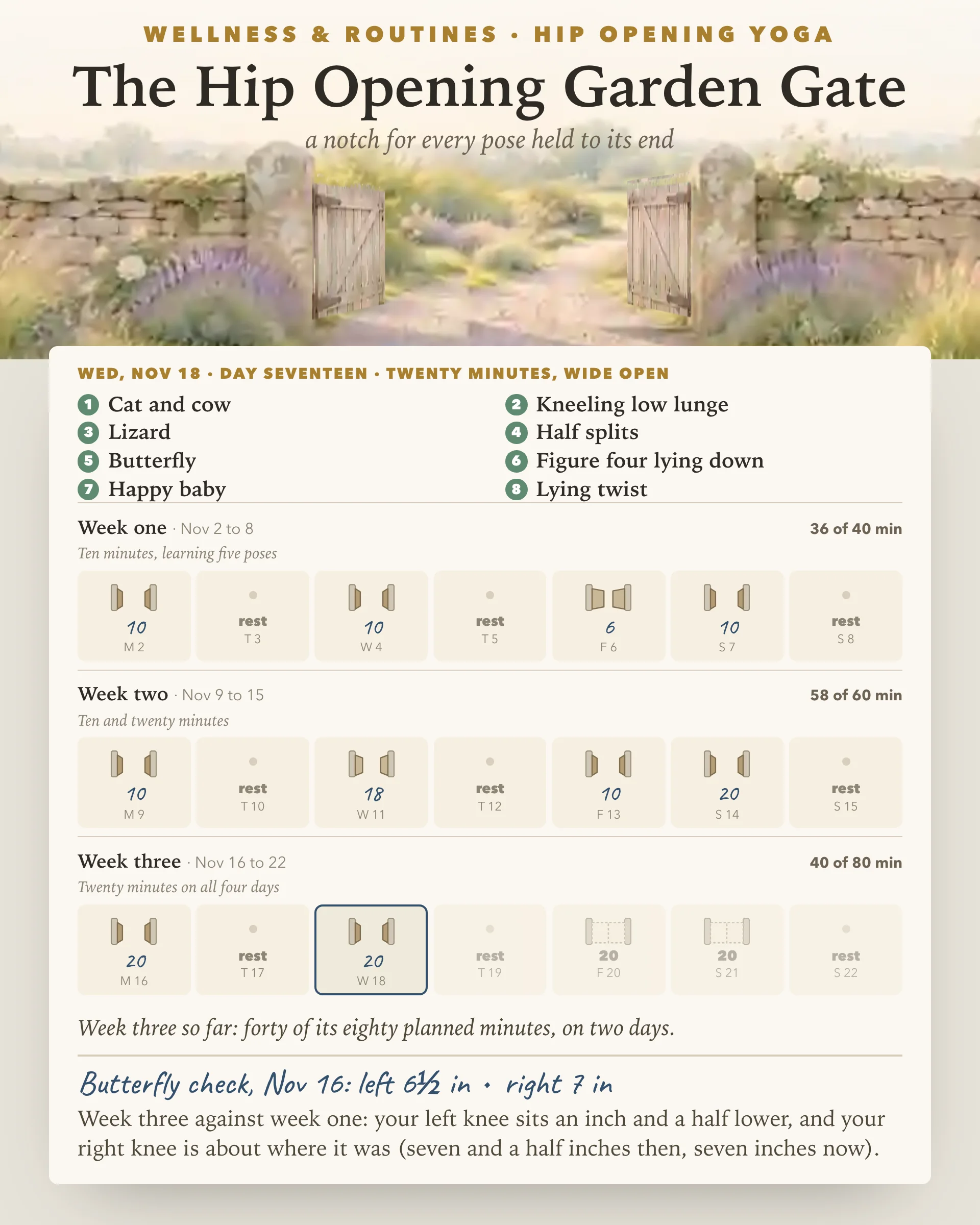
Hip opening yoga is less mysterious than its name. It is a group of poses that take the hip where an ordinary day rarely does: the front of the hip lengthening behind you, the thighs turning out and apart, the outer hip stretching across. After long hours in a chair or a car, these are the directions that tend to go quiet. This page builds a short session from twelve of them, runs it on a timer, and shows what you actually held as a garden gate swinging open.
Each pose has two ways to do it, with a chair, a block, a strap or a blanket, and a plain line on where the stretch should land. If you feel it in a joint instead of the muscle, change the setup or come out.
Choose ten, twenty or thirty minutes: five, eight or ten poses, each with an equal share of the time. Poses done on each side split their share, right side first, and the timer tells you when to switch. The page runs your choices in one order, standing first and lying last, so you get down to the floor once.
Unlatch the gate and follow along. The painted gate eases open while you hold a pose and keeps a notch only when that pose runs its whole time. Come out early and its notch stays shut, and the skipped seconds are never added back. End a session early and only its whole minutes count. The clock follows real time, even on a phone that dims mid-pose.
The plan runs four weeks, four days a week: ten-minute sessions in week one, a mix of ten and twenty in week two, twenty on all four days in week three, and two thirty-minute sessions in week four.
Once a week, before a session, sit with the soles of your feet together and measure how far each knee rests from the floor, set up the same way every time. The page reads each knee only against your own first check, never against an average and never one knee against the other.
Physical therapists at Creighton University tested a similar measurement taken lying down, one leg at a time, in nineteen healthy adults. It held up when one person repeated it, but a change had to reach about 3.7 centimeters, close to an inch and a half, before it stood clear of measuring error, and comparing left with right was far less reliable. So the page calls a change only from an inch and a half.
Hip range responds to regular stretching over weeks, not days. A review by sports scientists at the University of Palermo pooled twenty-three studies of long-term stretching: range of motion improved with every kind, steady holds most of all. Time per week mattered more than the length of any one session, and more days a week went with bigger gains. The authors suggested five days a week, so this plan's four sit a little under that.
A rehabilitation team at the University of Virginia ran an eight-week gentle yoga program for twenty-three healthy adults aged 62 to 83, nineteen of whom finished. Their hip extension while walking and their stride length both increased, but with no comparison group the study cannot separate the yoga from anything else that changed. A meta-analysis by exercise researchers at the University of Edinburgh gathered twenty-two randomized trials of yoga in older adults and found better lower body flexibility than in people who did nothing new, with a smaller edge over other exercise.
None of this research tested this page, and none of it shows that the hips store emotions or that hip openers release old trauma.
Talk to a doctor or physical therapist first if you have had a fall, dizzy spells, a heart or blood pressure condition, a recent injury, or pain in your hips, knees or back. After a hip replacement, ask your surgeon before any deep hip bend or any pose that crosses one leg over the other; the page marks those poses so you can show the list. Pad your knees, keep the stretch to a mild pull, and come out of anything sharp, tingling or numb.
The Hip Flexor Clothesline works only the front of the hip. The Hip Compass moves the joint in every direction rather than holding stretches. The Yin Yoga Water Clock asks for much longer, quieter holds on the floor. This page sits between them: a mix of hip openers you choose, each held a minute or a few, on both sides.
It is a set of yoga poses that move the hip joint in the directions a chair-bound day rarely asks for: the front of the hip lengthening in a lunge, the thighs turning out in butterfly and frog, and the outer hip stretching in figure four and pigeon. Held slowly, with props where you need them, they ask for patience rather than strength.
There is no single best one, because tight hips can be tight in different directions. A low lunge reaches the front of the hip, butterfly and frog the inner thighs, and figure four and half pigeon the outer hip and buttock. A balanced session takes a few from each group, which is why this page offers twelve and lets you choose.
Think in weeks, not days. Reviews of stretching studies find that range of motion grows with regular practice over several weeks, and that the total time spent stretching each week matters more than any one long session. Four short sessions a week, kept up for a month, is a fair test.
Ask your surgeon before you try it. Many of these poses bend the hip deeply or cross one leg over the other, which are the movements most often limited after the operation. The page marks those poses so you can show the list at your next appointment.
It is a popular saying, but no study has shown that hip stretches release stored emotions or old trauma. If a long hold stirs something up, it is fine to notice it and ease out, and this page makes no promise either way.
By the team behind Fabulous, the science-based self-care app used by over 30 million people.


