
The Overwhelm Recovery ProtocolWellness & Routines · ~5 min
About this template · Updated November 2026
Most hip dips exercises you will find promise to fill the dips in. This page doesn't. Hip dips are mostly bone, and no workout changes the shape of bone. What you can change is how strong and steady the muscles at the side of your hips are, and that is what these six weeks are for.
A hip dip is the inward curve on the side of your body between two bony points: the top rim of the pelvis you can feel at your waist, and the knob at the outer top of your thigh bone. Three things set how deep that curve looks.
The first is bone. Pelvises differ in width and shape, and so does the angle where the neck of the thigh bone meets its shaft. A survey of more than eight thousand thigh bones from a hundred human groups, led by an anthropologist at the Australian National University, found that angle varies widely between people and does not change across adult life. It measured bones, not living hips, so it cannot tell you how anyone's outline looks; it does show that the frame under the curve is set long before you pick up a loop band.
The second is fat. Many women store more fat around the hips and thighs than men do, a pattern that a review led by endocrinology researchers at Boston University traces to sex hormones, development and the fat cells themselves, and which is linked with lower heart and metabolic risk than fat carried around the middle.
The third is muscle. The gluteus medius and the smaller gluteus minimus run from the outer face of the pelvis down to that knob on the thigh bone. They are the muscles that keep your pelvis level each time you stand on one leg, as you do with every step.
Exercise cannot reshape your pelvis or move the top of your thigh bone. It also cannot burn fat from one chosen spot. In a small study, eleven young adults trained one leg with about a thousand light leg presses a session, three times a week for twelve weeks; they lost some fat overall, mostly from the arms and trunk, and showed no measurable change in the leg that did the work.
Strength is different. The side hip muscles get stronger when you load them steadily and add a little at a time, and they are the ones holding you level on one leg. That is the whole promise here. The page does not measure your hips, show you a before and after, or tell you how anything will look.
All eight press or lift a leg out to the side, or hold the pelvis level while the other leg moves. Researchers at the University of North Carolina recorded muscle activity in 21 healthy, active adults during twelve common exercises and found that the side-lying leg lift worked the gluteus medius hardest of the group. That shows which moves reach the muscle in one session, not how much strength anyone gains over weeks, so take it as a reason to include the move, not a ranking to obey.
Every session runs in the same order: four floor moves (glute bridge, clamshell, side-lying leg lift, fire hydrant), then four at the counter or a chair (standing leg lift, side steps, side lunge, curtsy step back). One set of each, three days a week.
Each move has three levels, an optional loop band, and two kinds of support when standing. Tap start and the page paces each rep in real seconds, one side and then the other; stop partway and only whole reps go in, marked stopped early. A forty-second rest between moves keeps true time even if your phone locks.
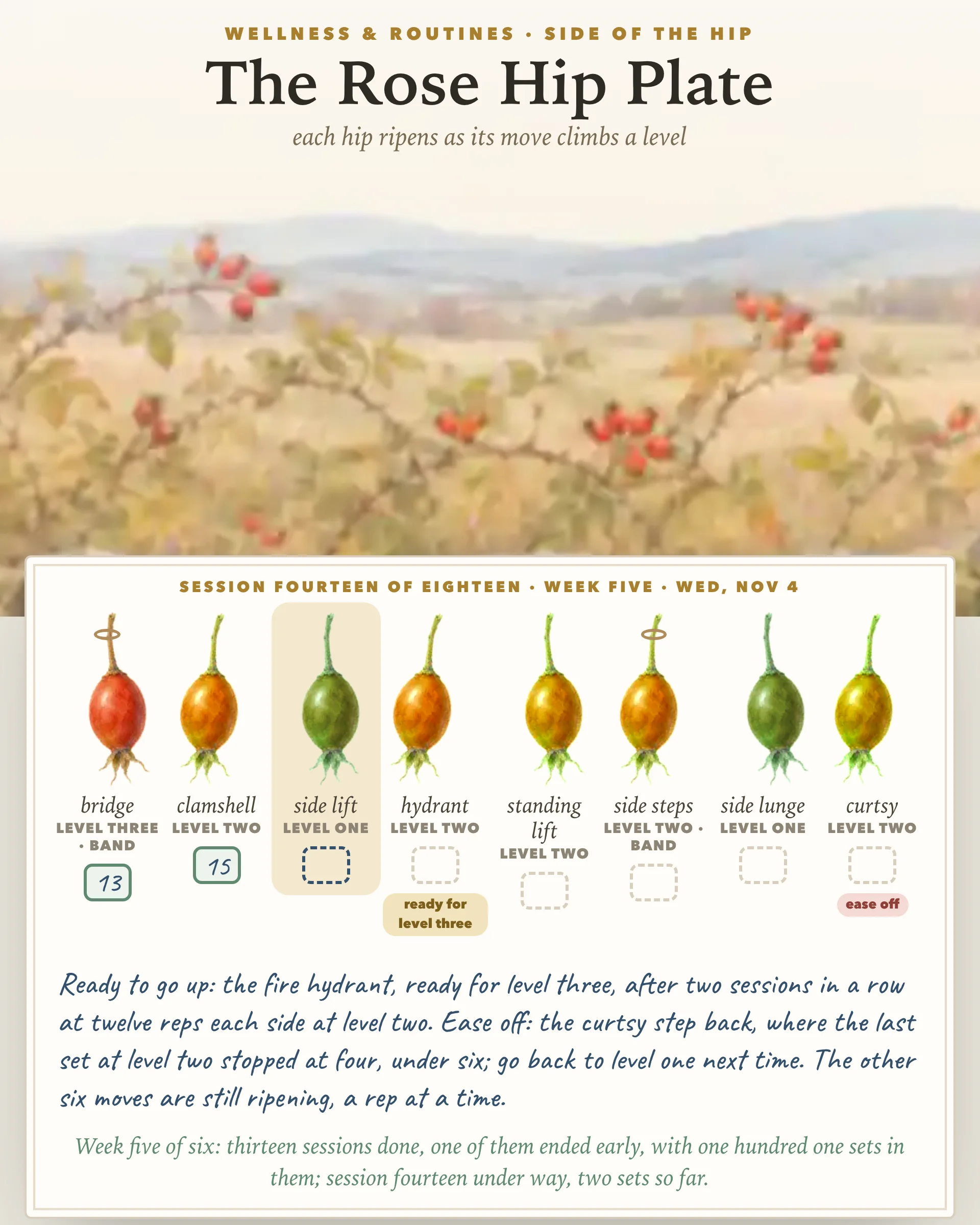
Each move is a painted rose hip on the plate, green at level one, gold at level two, red at level three, a shade deeper as your reps climb. A move reads ready to go up only after its two latest sessions, in order, each had a whole set at the top of its range at the same level and band. A set under the range says ease off instead. Fruit ripens on its own schedule, and so does strength.
The Balloon Glute Workout trains the big muscles you rise and climb with, through squats and step-ups. The Tuning Fork Inner Thigh Workout works the opposite side of the leg, the muscles that draw it in. The Ten-Cup Band Board is a whole-leg session built around the band. This plate stays on one job: the outside of the hip.
Check with a doctor or physical therapist first if you are pregnant or had a baby recently, have a hip or knee replacement or recent surgery, have had a fall or dizzy spells, live with a heart or blood pressure condition, or have hip, knee or back pain that lingers. A warm, tired feeling at the side of the hip is the muscle working; sharp or pinching pain in the joint means stop that move for the day. Keep the counter or a sturdy chair within reach when standing.
No. Hip dips come mostly from the shape of your pelvis and the angle at the top of your thigh bone, and adult bone does not reshape with exercise. Training the muscles at the side of your hips makes them stronger and steadier, which is worth doing for its own sake.
They are the inward curve between the top of the pelvis and the outer top of the thigh bone. How deep it looks depends on the width and shape of your pelvis, the length and angle of the neck of the thigh bone, and where your body tends to store fat. It is ordinary anatomy, not a sign of weakness or low fitness.
Moves that lift or press the leg out to the side: side-lying leg lifts, clamshells, fire hydrants, standing leg lifts and side steps against a loop band. In a lab study that measured muscle activity, the side-lying leg lift worked the gluteus medius hardest of the twelve exercises tested.
Three days a week with a rest day between is plenty for these muscles. A session here is one set of each of the eight moves, about fifteen minutes at first and closer to twenty as the reps climb.
It helps for the side steps and the glute bridge, and it is how the other moves get harder once level three feels easy. A light loop band is enough to start, and every move can be learned without one.
By the team behind Fabulous, the science-based self-care app used by over 30 million people.


