
The Overwhelm Recovery ProtocolWellness & Routines · ~5 min
About this template · Updated November 2026
Pain on the outside of the hip follows you up the stairs, out of the car and into bed when you roll onto that side. If you have been told it is hip bursitis, you have probably also been told to exercise, and then handed a sheet of stick figures. This page turns that sheet into a timed routine with a feeder that fills as you go. It supports the plan from your doctor or physical therapist and never replaces it. Where their advice differs from anything here, theirs wins.
The bursa is a small, fluid-filled cushion over the bony point on the side of your hip. For years, pain there was blamed on that cushion being inflamed. Imaging tells a different story. When radiologists reviewed ultrasound scans of 877 people with outer hip pain, only about one in five had bursitis at all, while about half showed changes in the gluteal tendons that attach at that same bony point. A clinical review now describes gluteal tendinopathy as the main local source of this pain, most common in women after menopause, and notes that high-quality studies are still scarce. You will see it called greater trochanteric pain syndrome, gluteal tendinopathy or hip bursitis. The name matters less than what it suggests: muscles and tendons that respond to steady, well-judged loading.
The clearest evidence comes from a trial of 204 people with long-lasting outer hip pain, published in the BMJ in 2018. One group had fourteen sessions with a physical therapist over eight weeks, combining advice about daily habits with gradually harder hip exercises; one group had a steroid injection; one waited. At eight weeks, 51 of 66 people in the exercise group reported feeling better, compared with 38 of 65 after the injection and 20 of 68 who waited. At a year, the exercise group still did better than the injection group on overall improvement, though their pain scores had drawn level.
That is encouraging, with limits worth naming. The trial tested a supervised program, not a page on your phone, and not these eight moves in this order. A group average also says nothing certain about your own hip, which may have another cause altogether. Use this routine to do the home part well, and keep the person who examined you in the loop.
You start on your back: knees pressing gently out against a belt, slow bridges, and a knee drawn toward the same shoulder. Then you roll onto your more comfortable side, sore hip on top, for clamshells and small leg lifts. You finish at the kitchen counter with hip extensions, side steps and a stretch for the front of the thigh.
Notice what is missing. Many handouts still include the IT band stretch or a stretch that pulls one knee across your body. The researchers behind that trial left those out on purpose, explaining in their protocol that stretches holding the hip across the midline press the sore tendons hard against the bone. The same reasoning is why so many clinicians suggest not crossing your legs, not standing with your weight slumped into one hip, and keeping a pillow between your knees when you lie on your side.
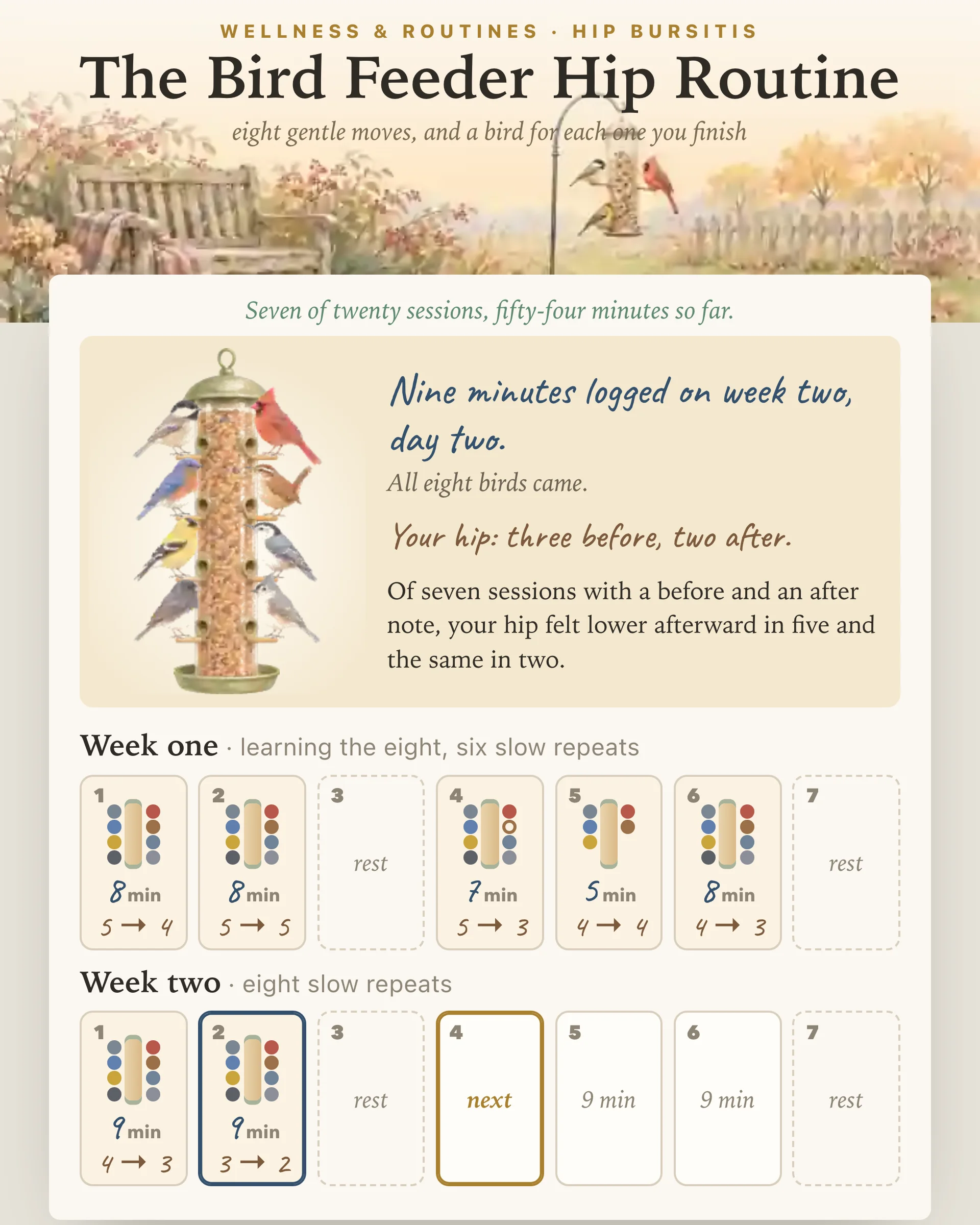
Before you start, tap a number from zero to ten for how your hip feels. Press the button and a real-time clock calls each move, counting repeats and holds, and keeps true time even while your phone is locked. Finish a move and its bird lands on the feeder: a chickadee for the knee presses, a cardinal for the bridges, a wren for the clamshells. Any move that hurts gets skipped with one tap, and its bird simply stays away that day. End early and only the whole minutes you moved are kept.
Afterward, tap how your hip feels now. Over four weeks the bird count shows each session as a small feeder with your before and after numbers beneath it, set only against your own earlier notes. If pain rises after a session, lingers, or wakes you at night, the page says one thing: stop and check in with your doctor or physical therapist.
Talk to your doctor or physical therapist first if you have had a fall, dizzy spells, a hip or knee replacement, a heart or blood pressure condition, or pain that is new or getting worse. Stop any move that hurts, and keep a hand on the counter for everything you do standing. Skip the routine and get medical care the same day if your hip turns hot, red or swollen, you run a fever, pain arrives suddenly and severely, your leg goes numb or tingly, or the pain began after a fall.
If you are building a fuller picture for an appointment, a Pain Journal captures when your hip hurts and after what, and The Doctor Visit Card helps you arrive with your questions written down. Once your hip has settled and your physical therapist agrees, The Hip Lanterns offers a broader strength routine with three levels for each move.
Most physical therapists start with gentle work for the muscles on the outside of the hip: pressing the knees out against a belt, bridges, clamshells, small side-lying leg lifts, and standing moves at a counter such as hip extension and side steps. A 2018 trial in the BMJ built its program around that kind of slow hip strengthening, made gradually harder over eight weeks and paired with advice on daily habits.
Researchers who study the condition advise against stretches that pull the knee across the body, such as the classic IT band stretch and crossed-leg piriformis stretches, because they press the sore tendons against the bone. Crossing your legs and lying on the painful side do the same. Skip anything that brings on sharp pain, and ask your physical therapist before adding a move.
Often not. One large ultrasound study of people with outer hip pain found an inflamed bursa in only about one in five, while about half had changes in the gluteal tendons. That is why many clinicians now call it greater trochanteric pain syndrome or gluteal tendinopathy, and why exercise for it focuses on those tendons and muscles.
It varies a great deal, and outer hip pain often lasts for months. In one trial of about two hundred people, roughly three in four in the education and exercise group said they were better after eight weeks, though not everyone was. Nobody can promise a timeline for your own hip, so set expectations with your doctor or physical therapist.
No. This routine supports the plan from your doctor or physical therapist and never replaces it, and their advice wins wherever the two differ. Get medical care the same day if your hip is hot, red or swollen, you have a fever, the pain came on suddenly and severely, your leg goes numb, or the pain began after a fall.
By the team behind Fabulous, the science-based self-care app used by over 30 million people.


