
The Overwhelm Recovery ProtocolWellness & Routines · ~5 min
About this template · Updated November 2026
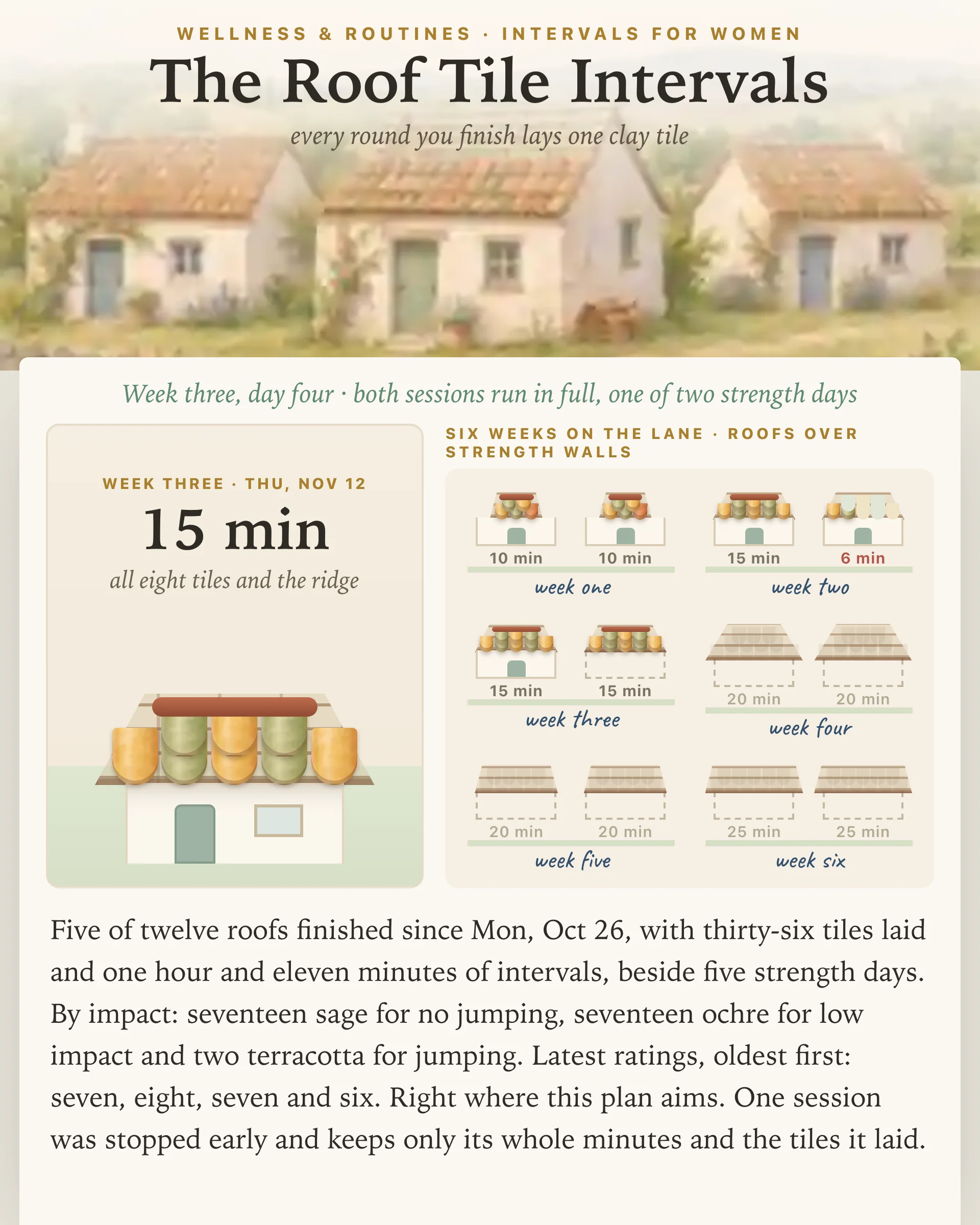
A HIIT workout for women can be ten minutes on your living room floor, with no jumping if you prefer. Interval training is short spells of hard work with easy rest between, repeated a set number of times. This page builds the session from twelve moves at three impact levels, times it in real time, and lays a clay tile on a small roof for every round you finish. Six weeks of two sessions a week sit beside two strength days, for women of any age.
A warm-up of three to five minutes opens each session and a cool-down of at least two closes it. Between them come rounds of twenty to forty-five seconds of work and twenty to forty-five of rest. Choose ten to twenty-five minutes and the page fits as many whole rounds as the time allows, handing the rest to the cool-down, so the parts always add up. Week one: a three-minute warm-up, five rounds of twenty seconds on and forty off, and a two-minute cool-down.
No jumping keeps both feet down: chair squats, fast punches, wood chops, counter push-ups. Low impact keeps one foot down: a high-knee march, step jacks, skater steps, step-back lunges. Jumping leaves the floor: jumping jacks, squat jumps, skater hops, running in place. Pick up to six and the rounds take turns through them.
Every jump has a twin with a foot down. Turn on the pelvic floor switch and each jump becomes its twin, because landing presses down on the muscles under your bladder. A 2018 review of 22 studies covering 7,507 women aged 12 to 69 found leaking across seventeen sports, from about 6 percent in low-impact activity to 80 percent in trampolining, with high-impact sports near twice the rate of medium-impact ones. Those studies counted leaking rather than testing a cause, and could not weigh menopause or hormone use. If you notice leaking, or a heavy, dragging feeling low in your pelvis, keep the switch on and see a doctor or a pelvic floor physical therapist. It is common and treatable.
Work at six or seven of ten in weeks one and two, short phrases only, then at seven or eight, a few words and a breath. Each rest should bring whole sentences back. In a 2015 study, sixteen active volunteers ran thirty minutes at a pace set only by how easily they could speak. All sixteen held the pace where talking stayed comfortable, thirteen the pace where speech first got hard, and only two the pace where talking was no longer comfortable, which is why the work spells here stay short. That study used steady runs, not intervals.
After each session you rate the work. One nine or ten suggests easing off; a nudge to push harder waits for two whole sessions in a row rated five or under.
A tile goes down only when a round's work and its rest have both run, and a session run to its end gets its ridge. Stop early and you keep the whole minutes and the tiles laid, nothing rounded up. A locked phone keeps your place, a pause never counts, and "I feel unwell, stop" ends the session in one tap. Each week is a pair of cottages on a lane: a roof for each session and a wall for each strength day you mark.
In a 2024 trial, 42 inactive young women did body-weight circuit intervals, cycling intervals or no training, the first two three times a week for eight weeks. The body-weight group gained upper and lower body strength and balance; the cycling group gained leg strength. A second 2024 trial gave 40 women aged 18 to 25 with overweight or obesity eight weeks of coached fifty-minute sessions, three a week. One group spent thirty-five minutes on intervals; the other swapped fifteen of those minutes for machine weights. Peak oxygen uptake rose in both and more in the group that lifted, and only that group gained muscle. Hence the strength days beside each roof.
Both were short, coached trials in young women; neither tested sessions alone at home, the pelvic floor, or women in midlife and later.
Talk to your doctor first if you have a heart condition, high blood pressure or diabetes, have had a heart attack, a stent or heart surgery, or are pregnant or had a baby in the past year. With osteoporosis, ask before any jumping. Check with a doctor or physical therapist after a fall, dizzy spells or a joint replacement, or with pain that keeps coming back. Stop at once for chest pain or pressure, faintness, a racing or skipping heartbeat, or breathlessness that the rest does not settle.
The Firefly Intervals is built for women past fifty: one way of moving per session, paired work and rest rhythms, and fireflies that glow round by round. This page is for any age, mixes moves from three impact levels in one session, sets work and rest apart, and stands strength days as walls under each roof. The Beginner HIIT Pinwheels is a five-move circuit for a first try, and The HIIT Timer is a bare clock for rounds you already know.
A short one you can repeat twice a week: a few minutes of easy marching, then rounds of twenty to forty-five seconds of brisk work such as squats to a chair, a high-knee march or step jacks, each followed by an easy walk in place, and a slow finish. Ten minutes is enough to start, building to twenty-five over six weeks.
Yes. Chair squats, fast punches, a high-knee march and step jacks can push your breathing up to the short-phrase level with a foot always on the floor. Jumping is one option among three, and the first one to drop if you leak, feel heaviness low in your pelvis or have sore knees.
Two interval sessions a week is a sound place to begin, with a strength day after each and easy days between. In one trial of young women, swapping part of each interval session for weight training raised fitness more than intervals alone, which is why this plan keeps both.
Around six or seven out of ten for the first two weeks, where you can manage short phrases but not full sentences, then seven or eight. Nine or ten is more than this plan asks. Each rest should bring you back to speaking in whole sentences before the next round begins.
Anyone with a heart condition, high blood pressure or diabetes, anyone who has had a heart attack, a stent or heart surgery, and anyone pregnant or within a year of giving birth. With osteoporosis, ask before jumping. Stop at once for chest pain, faintness or breathlessness that rest does not ease.
By the team behind Fabulous, the science-based self-care app used by over 30 million people.


