
Leaves on a StreamEmotional Fitness · ~3 min
About this template · Updated September 2026
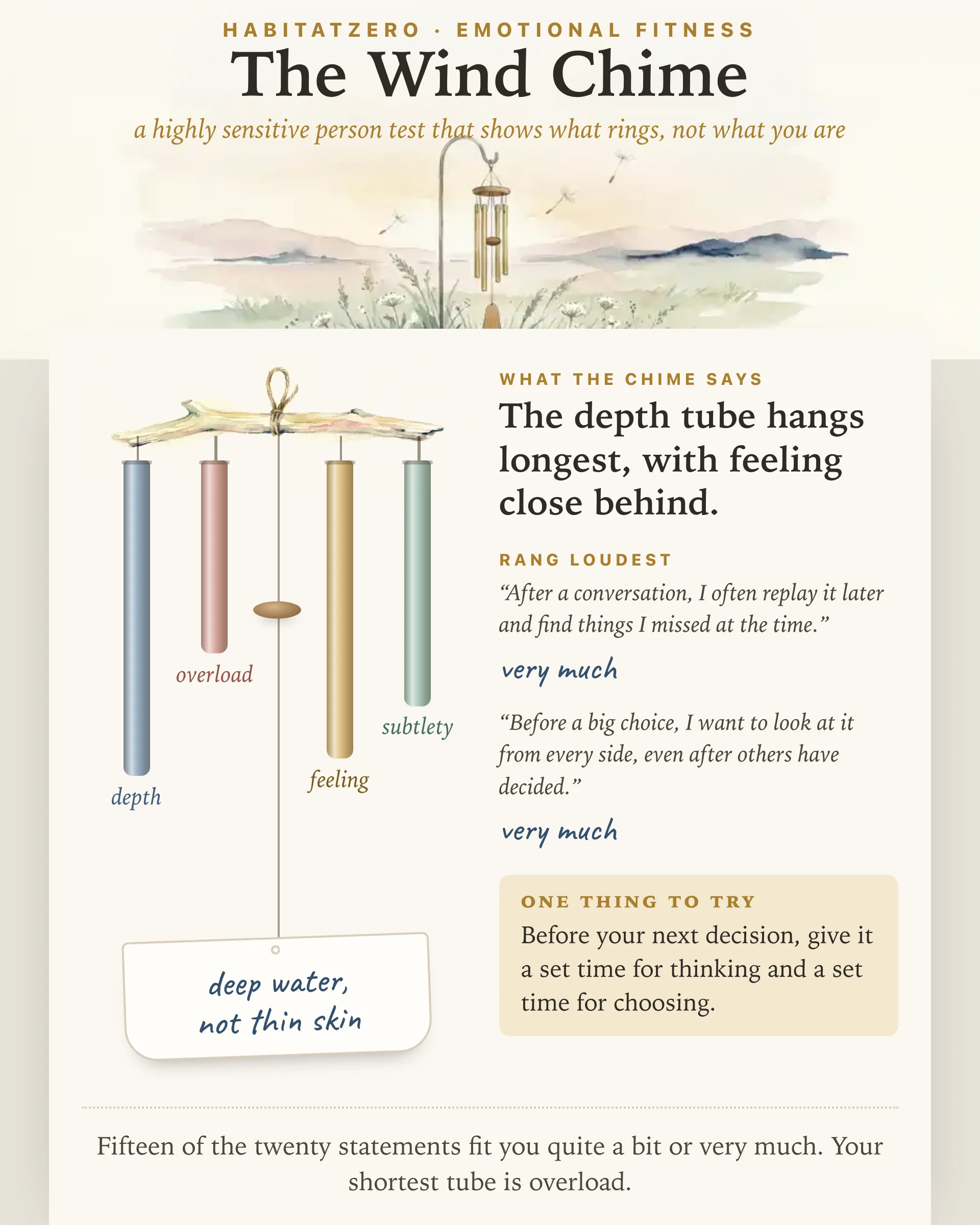
The highly sensitive person is Elaine Aron's idea. The psychologist began studying the trait in 1991 and, with fellow psychologist Arthur Aron, gave it a research name: sensory processing sensitivity. Her own site, The Highly Sensitive Person, holds her self-test, her books and plain summaries of the research. This wind chime was made separately. Neither Aron is connected to it or has endorsed it, and its twenty statements were written for this page rather than drawn from the HSP Scale or any other published questionnaire.
Aron sums the trait up in four letters, DOES: depth of processing, overstimulation, emotional reactivity and empathy, and sensing the subtle. The chime gives each strand its own tube, named in everyday words: depth, overload, feeling and subtlety.
A wind chime is a fair picture of all four at once. It answers a breeze most people never feel. It clangs when the wind gets up. Its note hangs in the air after the air goes still. And it rings along with whatever moves around it. None of that is a flaw; it is what a chime is for, and also why one left out in a storm gets loud.
You answer twenty statements, five for each tube, taking turns so no strand arrives in one block. They are small, everyday scenes: a crowded store on a Saturday, a sharp comment that stings for days, a hum from the fridge that nobody else seems to hear. For each one, tap how much it sounds like you: not really, a little, quite a bit or very much.
Not really leaves the tube where it hangs. Each step up lengthens it, so a strand you answer very much five times hangs at full length. The card tells you which tube each statement strikes, and the tube swings when it grows, unless your device asks for less motion.
When the twentieth answer lands, the reading appears. It names your longest tube, and a second one when it is close behind. It quotes the statements that rang loudest, counts how many of the twenty fit you quite a bit or very much, and points out a tube that hangs clearly shorter than the rest. Tap any tube to see its five statements and change an answer; the chime and the reading move with you. The sail at the bottom takes one short line in your own words, something you want to remember about the way you take the world in.
The Arons' first paper on the trait, published in 1997, ran seven studies with different samples and measures. It found a core sensitivity that overlapped with social introversion and with emotionality without being the same as either. That paper also introduced the 27-item Highly Sensitive Person Scale, the questionnaire behind the group study described next.
Later work suggests sensitivity is a spread, not a switch. In a study of 906 adults who completed the HSP Scale, researchers found three groups rather than two: about 31 percent high in sensitivity, 40 percent in the middle and 29 percent low, all sitting along one continuous trait. Aron's site makes a related point about labels: sensitivity is not introversion, and by her estimate about 30 percent of highly sensitive people are extroverts.
A 2019 critical review by Greven and colleagues, with Aron among the authors, describes the trait as common and heritable. Highly sensitive people seem to suffer more in harsh surroundings and to gain more from supportive ones. The same review is frank about the gaps: the field still needs more reliable and objective ways to measure the trait, and a clearer way to tell it apart from related ones.
That is the honest frame for this page. The chime is not a validated measure. Its statements were written here and have not been tested against the HSP Scale, and it has no cutoff that sorts you into a group. The tube lengths describe how you answered on one day. Sensitivity is not a disorder, and nothing here diagnoses anything. If noise, crowds or other people's moods wear you down most days, a doctor or therapist can help you work out what is going on, since overload can have more than one source.
Take it on an ordinary day, answering for how you usually are rather than how this week went. It works best as a starting point for a conversation, with yourself or with someone close. A long overload tube is a good reason to plan quiet into a crowded week. A long feeling tube can explain why a friend's bad day follows you home. A long depth tube may be why quick decisions feel so uncomfortable.
If you have ever wondered whether you are sensitive or simply introverted, the Introvert Extrovert Quiz looks at the other half of that question. The Social Battery helps you plan recovery around a busy stretch, and the Window of Tolerance is the place to go when overload tips over into overwhelm.
Come back to the chime when an answer stops sounding like you. The tubes will move, and the reading will follow.
Someone high in sensory processing sensitivity, the temperament trait psychologists Elaine and Arthur Aron described in 1997. People high in it tend to take in more detail and turn it over longer, which brings a rich read on the world and a quicker slide into overload when too much is going on. Aron puts it at 20 to 30 percent of people.
Aron sums them up as DOES: depth of processing, overstimulation, emotional reactivity and empathy, and sensing the subtle. This chime gives each one a tube, called depth, overload, feeling and subtlety, so you can see which strands your answers lean on and which stay quiet.
No. Researchers treat it as an ordinary personality trait with upsides and costs, not a diagnosis, and this test does not diagnose anything. If sound, crowds or other people's moods leave you struggling most days, a doctor or therapist can help you look at what else might be adding to the load.
No. Aron's own self-test lives on her site, hsperson.com, and her research scale is published in the scientific literature. This wind chime is an independent tool with no connection to Elaine or Arthur Aron. Its twenty statements were written for this page, and it has not been validated against her scale.
What you see here is a sample chime someone already hung. To answer the twenty statements yourself, change any answer later and keep your line on the sail, open the chime in HabitatZero, where it costs nothing.
By the team behind Fabulous, the science-based self-care app used by over 30 million people.


