
The Overwhelm Recovery ProtocolWellness & Routines · ~5 min
About this template · Updated November 2026
Hatha yoga is not a brand or a method someone owns. It is the old name for the physical side of yoga, the postures, breath work and rest that Sanskrit manuals set down between roughly the eleventh and fifteenth centuries. An Oxford Sanskrit scholar's 2011 essay on the word itself notes that haṭhayoga literally means the yoga of force, and that the popular reading of ha and ṭha as sun and moon is a later, esoteric gloss. Nearly every physical yoga class today descends from that family, which is why a class called hatha usually just means a slow, general one: poses held for several breaths, time to breathe, and a long rest at the end.
This page gives you that class at home, with a plan for six weeks.
A class moves from stillness to effort and back, always in five parts:
At thirty minutes that comes to three minutes of breathing, five of warm-up, twelve standing, six on the floor and four of rest. Choose twenty or forty-five and every part shrinks or grows with it.
Pick the length, then tap the standing and floor poses you want. Each part holds a set number, so the minutes always add up. Every pose has its full way and a supported version: a chair for the warm-up, the warriors and triangle, a wall for mountain, tree and cobra, a block or a chair on the floor. Choose the support ahead of time or switch to it mid-pose.
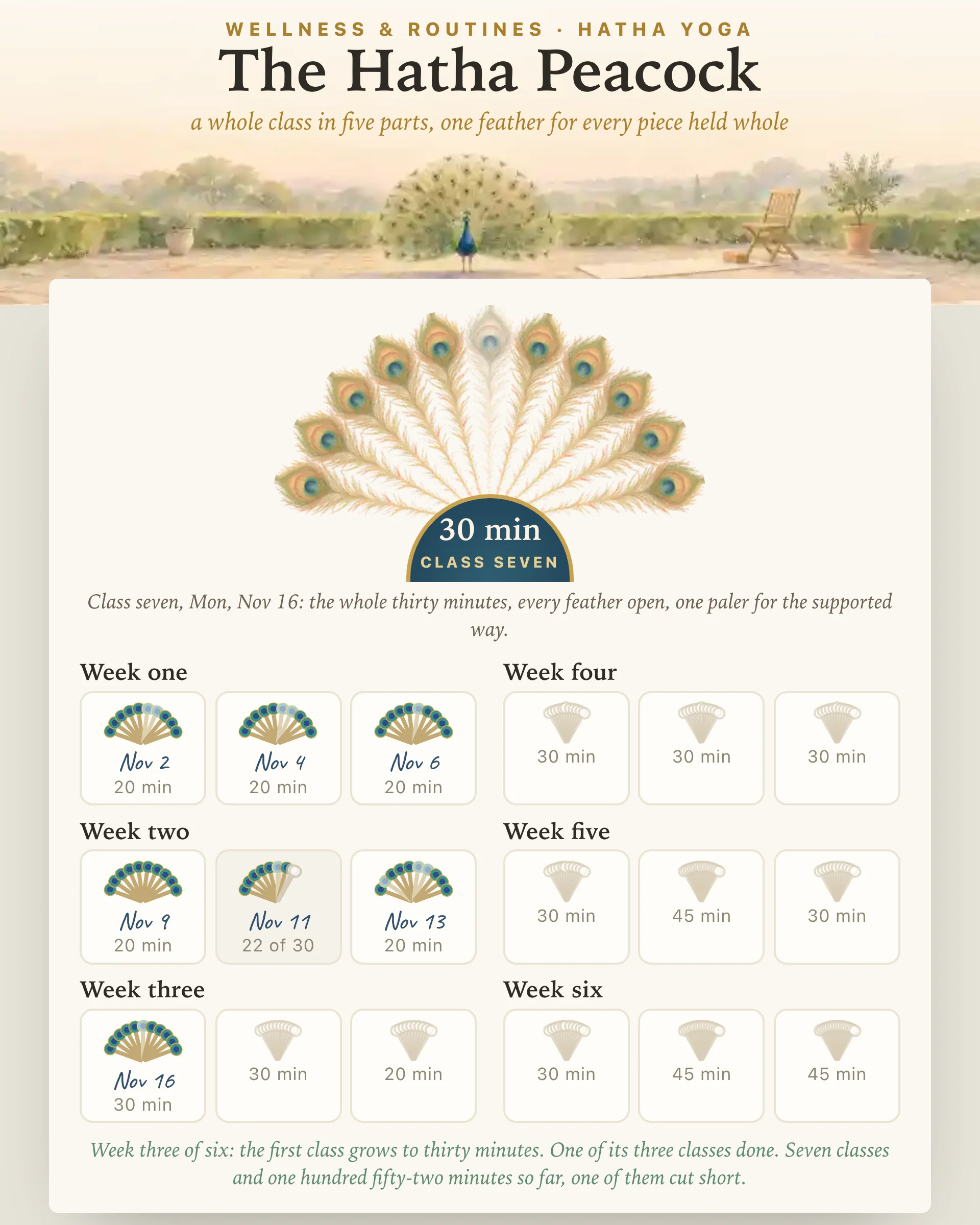
The player keeps real time, so a phone that locks mid-pose loses nothing, and two-sided poses tell you when to change sides. The peacock's tail holds one feather for every piece of the class. A feather swings open as its piece runs and takes its full color only if the piece runs its whole time; with the support it opens paler. A skipped piece stays gray, and skipped time never counts. Stop early and you keep the whole minutes you did.
A harder way, such as tree with the foot on the inner thigh, appears only after the two most recent classes that included that pose ran whole with it held in its full way. A pose held with the chair, wall or block never counts toward stepping up, and a class you stopped or skipped through breaks the run.
The plan starts with three twenty-minute classes and grows a little each week until week six holds a thirty and two forty-five-minute classes. Each finished class lands as a small fan in its week. If a long class does not fit a day, pick a shorter one; it still counts.
Hatha is the style most often named in yoga trials. A German research group's 2016 review of 306 randomized yoga trials found it in thirty-six, and found that trials of one style reached positive conclusions no more often than trials of another, so the authors suggest choosing by preference and availability. The review compared conclusions, not the size of any benefit, so it cannot tell you yoga treats any particular problem.
For midlife and older adults, two studies are worth knowing. In a University of Illinois trial, 118 adults with an average age of sixty-two took hour-long hatha classes three times a week for eight weeks and did better on memory and task-switching tests than a group doing stretching and strengthening. The differences were modest, the trial was short, and the tests were done in a lab. A University of Edinburgh review of twenty-two trials in adults averaging sixty or older found that yoga improved balance, lower body flexibility and leg strength compared with doing nothing new, and beat walking or other exercise on leg strength, flexibility and low mood, with no clear edge on the other measures.
None of this research is about detoxing or moving energy, and no pose here claims either. The evidence supports a plainer claim: regular, gentle practice can help you stay steady, stronger in the legs and a little more flexible.
Check with a doctor or physical therapist first if you have had a fall, dizzy spells, a joint replacement or recent surgery, or if you have a heart or blood pressure condition, glaucoma, osteoporosis or pain that does not settle. With osteoporosis, ask about the forward folds and the twist. Keep the chair or wall close for every standing pose, and ease out of anything that hurts.
If you are brand new, The Yoga Mannequin teaches two poses a week on a wooden figure. The Sun Salutation Water Wheel drills one flowing sequence in rounds, and The Pop-Up Book of Standing Poses goes deep on standing work. This page is the whole class in one piece: arrive, warm up, stand, come down to the floor, and rest.
Hatha is the old Sanskrit name for the physical side of yoga: postures, breath work and rest, written down in manuals from roughly the eleventh to the fifteenth century. Most yoga taught today grew out of it, so a class labeled hatha usually means a slow, general class rather than one particular method.
It suits beginners because the pace is unhurried and each pose is held for several breaths rather than flowed through. Start with twenty minutes, lean on the chair, wall or block whenever you want, and let the classes lengthen over a few weeks.
This class draws on sixteen. Standing: mountain, a half sun salutation, chair pose, warrior one, warrior two, triangle and tree. On hands and knees: cat and cow. On the floor: cobra, a seated forward fold, bound angle, bridge, knees to chest, a lying twist and legs up the wall. Last comes the final rest.
Studio classes often run an hour or longer, yet the same shape fits into much less time. Here a class takes twenty, thirty or forty-five minutes and always keeps five parts: seated breathing, a warm-up flow, standing poses, seated and lying poses, then rest.
Hatha is the family, not one branch of it. Brisk flowing classes and slow, prop-heavy ones both descend from it. A class billed simply as hatha tends to hold each pose for a while and leave room for breathing and a long rest at the end.
By the team behind Fabulous, the science-based self-care app used by over 30 million people.


