
The Overwhelm Recovery ProtocolWellness & Routines · ~5 min
About this template · Updated November 2026
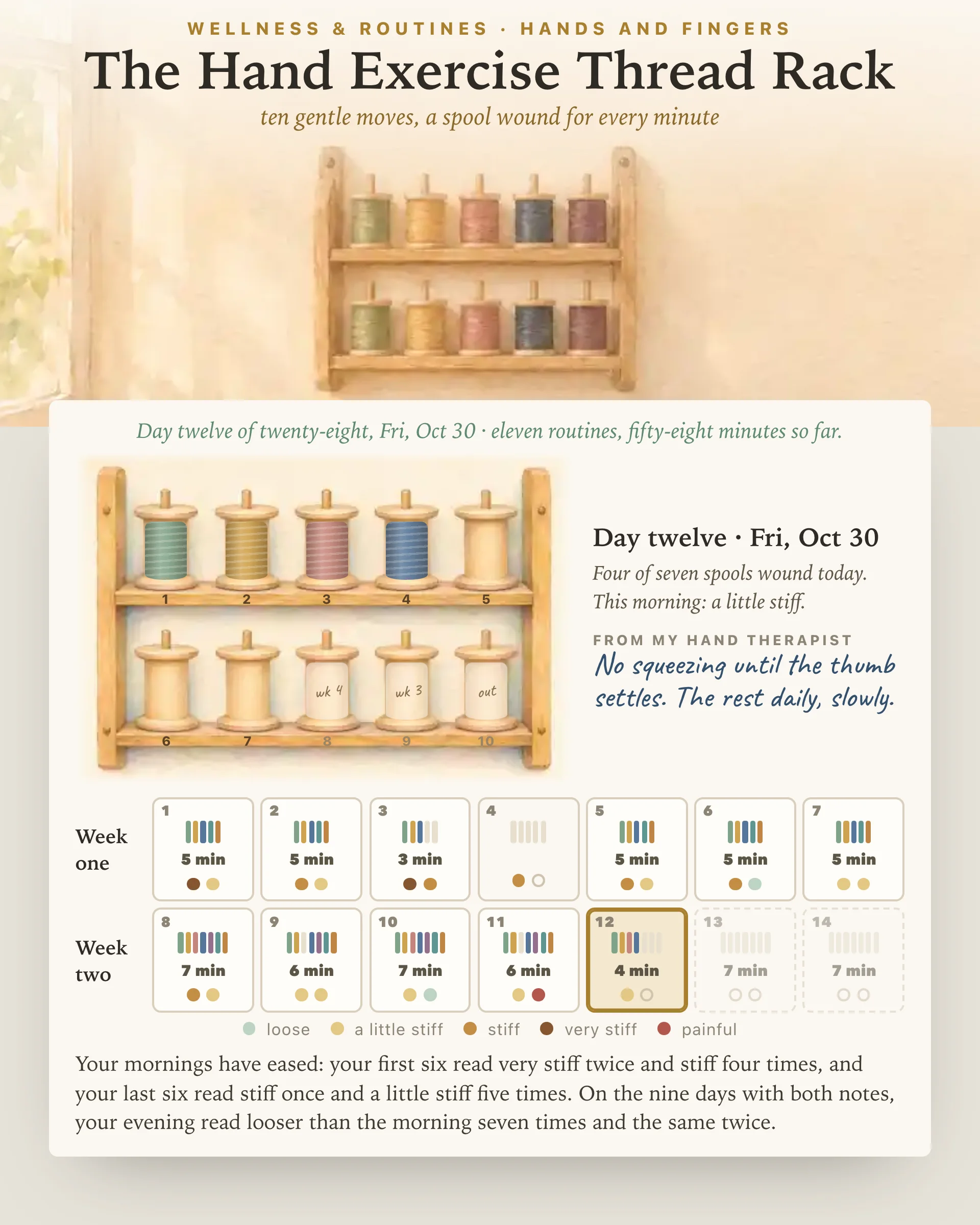
Stiff hands show up in small ways: a jar lid that will not turn in the morning, buttons that take an extra minute, fingers that feel thick until the coffee is made. These hand exercises are gentle range-of-motion moves for a kitchen table, and this page turns ten of them into one short daily routine. A timer paces every minute, and a painted thread rack winds a spool for each minute you finish.
If you live with arthritis, are healing from a hand or wrist injury, or have had surgery or a joint replacement, the plan from your doctor, physical therapist or hand therapist comes first, and this page only helps you keep up with it. The move list has a line for the gist of what they told you, and any move they ruled out leaves the routine with one tap. Check with them before you start if your hands hurt now, and stop any move that hurts while you do it.
Each move gets one minute, counted out by a cue on screen.
Each move has an easier version, such as a loose half fist or smaller circles, and most work both hands at once.
The rack holds ten bare wooden spools, one per move. Press the button and the first minute begins: the cue says what to do right now, such as "open into a fan, four of ten", while the spool winds with colored thread. When the minute runs out, the spool is full and the next move begins.
Only what you finish counts. A move you skip keeps its spool bare, and if you end early, the log keeps whole minutes, so stopping before the first full minute logs nothing at all. The clock keeps real time, even on a phone that locks partway through. Stop after three moves and you can wind the rest later in the day.
Two short notes complete each day: how your hands feel when you wake and again in the evening, from loose to very stiff, with a separate choice for pain. The four-week grid shows each day as a strip of wound threads and two small knots for the notes, and the reading compares your recent mornings with your earliest ones, measuring you against nobody but yourself.
Week one starts with five moves, five minutes a day. Tendon glides and thumb stretches join in week two, wrist bends in week three, and finger walks and the soft squeeze in week four, for ten minutes a day. Many people find the moves easier after a warm shower or with their hands warmed in a bowl of water first.
For hand osteoarthritis, a Cochrane review of seven trials found that exercise brought small improvements in hand pain, function and finger joint stiffness right after the programs ended. The authors rated that evidence low in quality, the gains had faded at later follow-ups, and the few side effects reported were more finger joint inflammation and hand pain.
For rheumatoid arthritis, the SARAH trial randomly assigned 490 adults to usual care or usual care plus a hand program of stretching and strengthening tailored by a therapist. After a year, hand function had improved more in the exercise group, while pain was about the same in both. Note the word tailored: a therapist chose and adjusted the moves for each person.
European rheumatology experts also include exercise among the non-drug options in their recommendations for managing hand osteoarthritis, next to education, assistive devices and splints.
None of this means hand exercises cure arthritis or undo joint damage. What they can do is keep your hands moving through their range.
See a doctor promptly for sudden swelling in a hand or finger, numbness or tingling that does not go away, a hand or joint that turns hot or red, a finger that suddenly will not bend or straighten, or pain after a fall or injury. Raise pain that keeps getting worse, or stiffness that grows week after week, with your doctor or hand therapist too.
For hand strength built with things from around the house, try The Grip Tray. To measure your grip across the months, use The Grip Dial, and for the rest of the body, The Stiffness Map has gentle stretches.
Start with gentle range-of-motion moves: wrist circles, curling a soft fist and opening it into a wide fan, tendon glides through five finger shapes, touching the thumb to each fingertip, and finger lifts and spreads with your palms flat on a table. Move slowly, and only as far as feels comfortable.
They may help a little. A Cochrane review of hand osteoarthritis found small gains in pain, function and finger stiffness from low-quality evidence, and a large trial in rheumatoid arthritis found a therapist-tailored program improved hand function over a year. They are not a cure. With arthritis, an injury or surgery, follow the plan from your doctor or hand therapist first and use this page to keep up with it, never in place of it.
They are done sitting down, without weights, and each move has an easier version. Ask your doctor first if a hand or wrist has been injured, operated on or replaced, or if it already hurts, and stop any move that causes pain.
This plan asks for five minutes a day in week one, building to ten by week four. Studies have used anything from a few sessions a week to several a day, so if a therapist gave you a schedule, keep to theirs.
Get checked promptly for sudden swelling, numbness or tingling that does not go away, a hand or joint that turns hot or red, a finger that suddenly will not bend or straighten, or pain after a fall or injury. Stiffness that keeps growing over weeks is worth a visit too.
By the team behind Fabulous, the science-based self-care app used by over 30 million people.


