
The Overwhelm Recovery ProtocolWellness & Routines · ~5 min
About this template · Updated November 2026
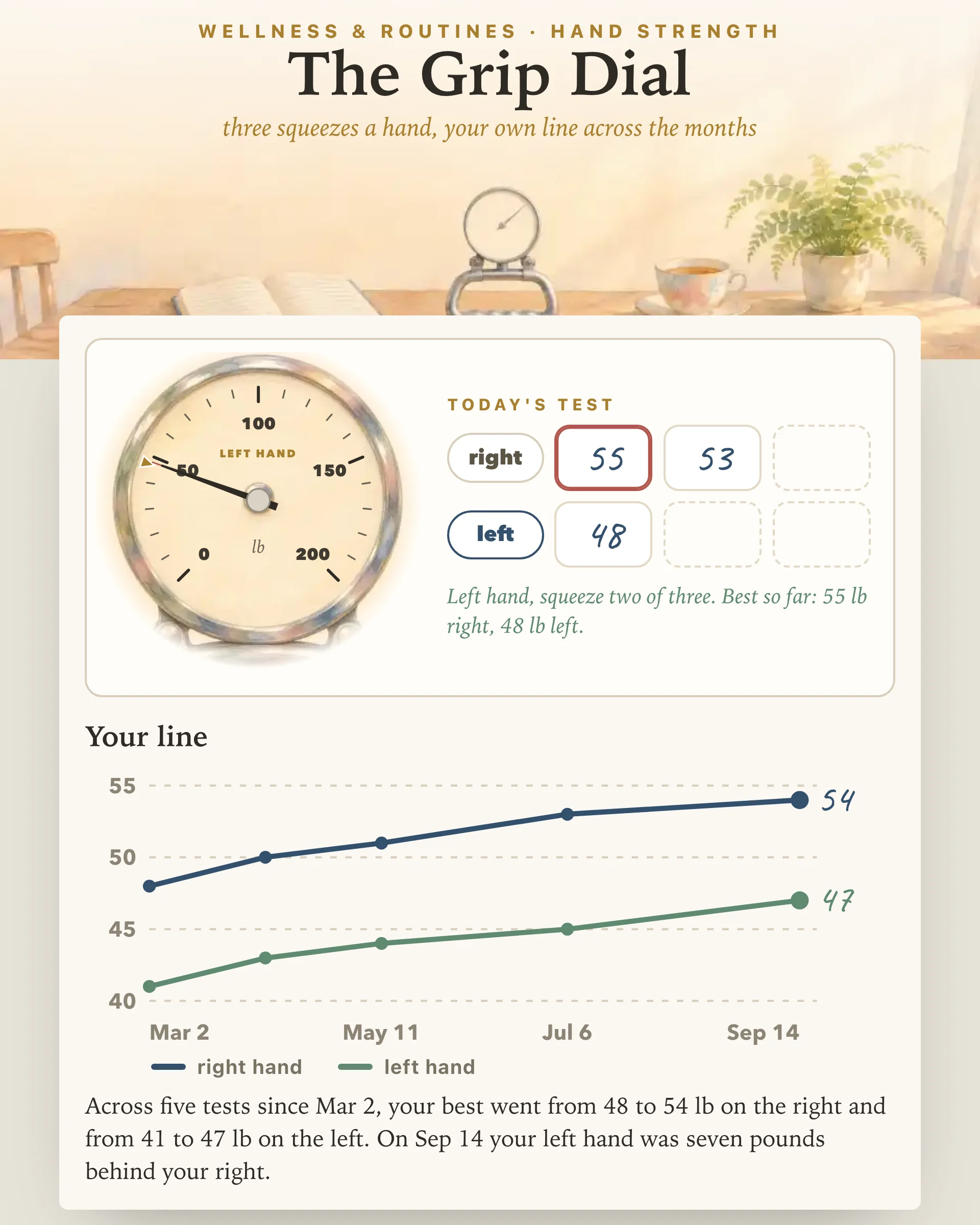
A grip strength test asks one thing of you: squeeze a hand dynamometer as hard as you can. The needle stops at a number, one of the plainest strength measures clinics and researchers use. Taken at home every four weeks, the same way each time, it becomes a record of your own hands, and this page keeps that record without ranking you against anyone else.
How you sit and hold the dial changes the number. A systematic review of grip protocols found that most studies described their method only in part, and set the two most detailed versions side by side, from the American Society of Hand Therapists and from Southampton. This page follows what they share.
Use the same chair and about the same time of day for every test, so the readings compare fairly.
The dial follows the hand that is up next. Type a reading and the black needle swings to it; log it and the sheet writes it into that hand's row and moves you to the other hand. A thin red needle marks today's best, and a small gold triangle marks that hand's best from your last test. Pounds or kilograms, every number switches together.
Save the test and it joins your line, one point per hand, spaced by date, with a reading of how each hand has moved since your first test. Squeezes logged on an earlier day stay that day's test until you save or clear them.
Dodds and colleagues pooled twelve British studies and nearly 50,000 people and found that grip climbs to a peak in early adult life, holds through midlife and declines after that, with the median highest around 51 kilograms for men and 31 for women. Below is the middle half of people at each age in their data, the 25th to the 75th percentile, in kilograms. Multiply by 2.2 for pounds.
Read these bands loosely. By design, a quarter of people at every age sit below each band and a quarter above it. In most of the pooled studies a person's result was their single best squeeze from either hand, so compare your stronger hand's best, not an average. Devices and positions varied, and a home gauge may not read exactly like a clinic's. A number outside a band is not a diagnosis, which is why the worksheet compares you only with your own earlier readings.
In half a million UK adults aged 40 to 69, followed for about seven years, every five kilograms of weaker grip went with a higher risk of death from any cause, and from heart disease, lung disease and several cancers. That describes large groups. It does not show that raising your own number changes your risk, and grip may partly stand in for what travels with it, such as activity, illness and age. The authors called for more work before grip is used to screen people for risk.
So let the line do what it does well: show the direction of your own hands over months, allowing a few pounds of wobble from sleep, a cold room or a different chair.
The four weeks between tests use four moves at the table, three days a week: crumpling newspaper one-handed, pinching a clothespin with each fingertip, working a hand through dry rice, and slow hammer turns. Each week adds a round or a little more effort, and day twenty-eight is your next test. For a fuller routine with household things and a timed carry, The Grip Tray covers the training side, and The Whole-House Strength Routine works the rest of you.
Check with a doctor or physical therapist before your first test if you have had a hand, wrist or elbow injury or surgery, a joint replacement, a recent fall or dizziness, arthritis that flares, pain in your hands or arms, or a heart or blood pressure condition. Stay seated, breathe out instead of holding your breath, and stop if anything hurts. Raise a sudden drop in your readings, or new weakness, numbness or tingling in a hand, with your doctor now rather than at the next test.
Sit in a firm chair with both feet on the floor, your upper arm by your side and your elbow bent to a right angle, thumb on top of the dynamometer. Squeeze as hard as you can for about three seconds, rest, and switch hands until each hand has had three tries. The best squeeze on each side is your result.
In twelve British studies pooled together, the middle half of 65-year-old women squeezed about 21 to 29 kilograms and the middle half of men that age about 37 to 48, with lower ranges at older ages. The article on this page lists the bands from age 40 to 85. Treat them as a rough guide, since the device, the chair and the method all shift the number.
Not in a way you can compare with published ranges. A bathroom scale or a spring gripper measures something different, so its numbers will not line up with any chart. Without a dynamometer, use the practice weeks here and ask for a reading at a checkup or a physical therapy visit.
Both are in use. The hand therapists' protocol averages three tries, while the Southampton protocol, common in studies of older adults, takes the single highest of six squeezes across both hands. This page keeps each hand's best, which is how most published age ranges were built.
Not by itself. Grip shifts with hand size, sleep, pain and the device, and one reading is a snapshot. Research ties weaker grip to poorer health across large groups, but only a clinician who knows you can say what your own number means. Mention a sudden drop, or new weakness, numbness or tingling, to your doctor.
By the team behind Fabulous, the science-based self-care app used by over 30 million people.


