
The Overwhelm Recovery ProtocolWellness & Routines · ~5 min
About this template · Updated September 2026
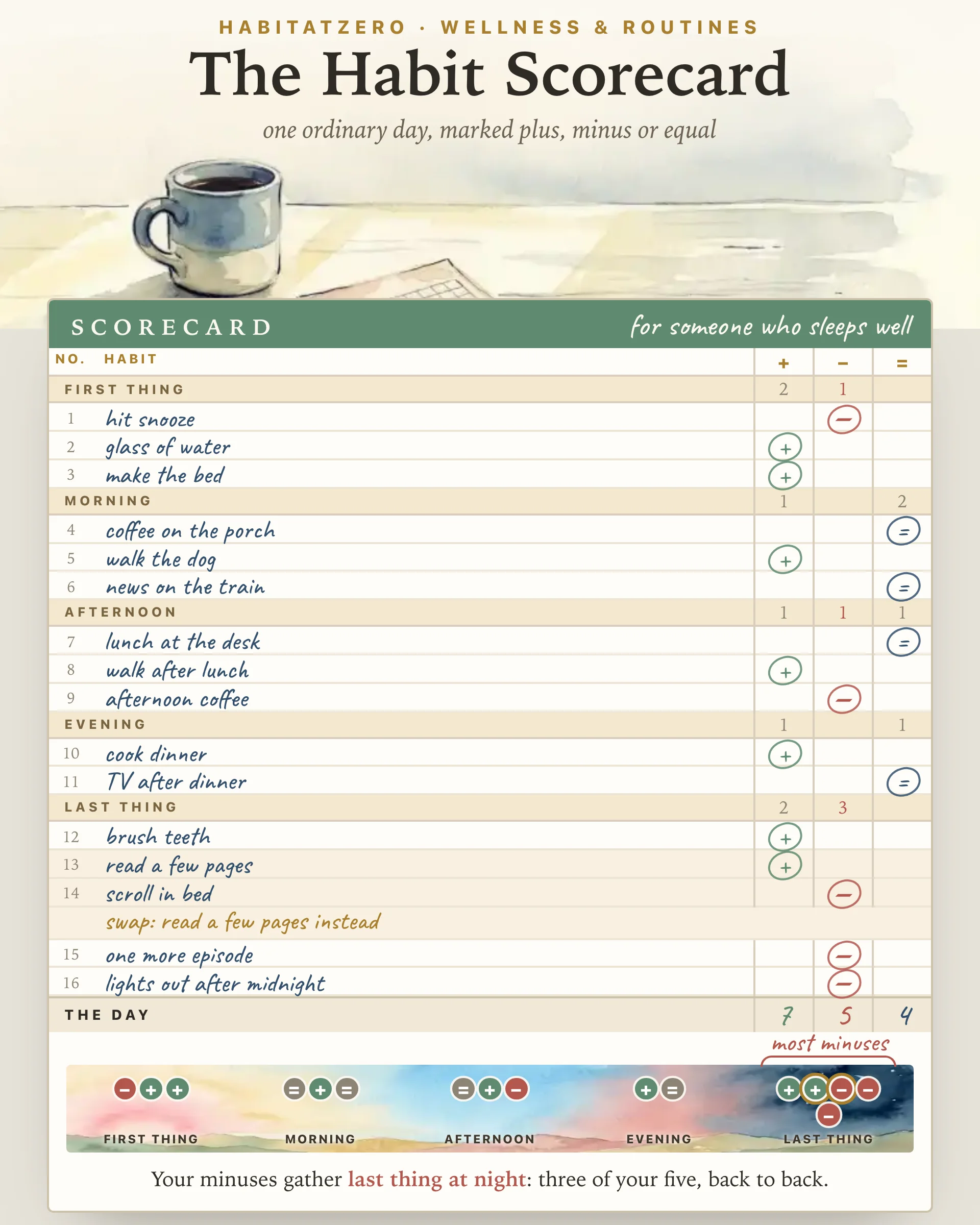
The Habits Scorecard is James Clear's exercise. He sets it out in chapter four of his 2018 book Atomic Habits, and an excerpt on his site walks through the scorecard as he teaches it. This page is an independent, interactive take on his exercise: Clear and his publisher had no hand in building it and have not endorsed it, and the book remains the place to read the method in full.
The exercise is almost too plain to take seriously. You list what you do on an ordinary day, from waking to lights out, and mark every habit: a plus if it is good for you, a minus if it works against you, an equals if it does neither. When a mark is hard to call, Clear suggests asking whether the habit moves you toward the kind of person you want to be. He is also explicit that nothing needs to change yet. The first job is only to notice.
Clear introduces the scorecard beside the Japanese railway practice of pointing and calling, where operators point at each signal and say its state aloud so nothing slides past on autopilot. Your day needs the same treatment, because habits are the part of it that runs without you. In two diary studies that asked people every hour what they were doing and what they were thinking, habitual actions tended to come with thoughts about something else entirely, while less familiar actions kept people's minds on the task (Wood, Quinn and Kashy, 2002). A scorecard makes you look straight at the actions your attention usually skips.
The card is laid out the way you would keep one in pencil, split into five parts of the day: first thing, morning, afternoon, evening and last thing. Each part opens with suggestions you can tap, or you can write your own in a few words. Go in the order the day actually runs, and use the earlier and later buttons when something lands in the wrong spot. Each part holds eight habits, room enough for everything that truly repeats.
Then mark each line in one of three columns. Subtotals fill in beside each part of the day, and the bottom row keeps the count for the whole day.
Once four habits carry a mark, the card starts to read the day. It names the part of the day holding the most minuses, notices when several run back to back, and draws the whole day as beads on a painted strip from dawn to night, so a cluster shows as a clump of red.
The read also looks for a minus that sits right beside a plus, and the order is the point. Habit researchers describe how a response gets tied to the context it keeps occurring in, including the action that comes just before it in a routine, until that context sets it off with no goal needed (Wood and Neal, 2007). The habits on either side of a minus are part of its machinery. When one of them is already a plus, you have a foothold.
You can pair the two, so the good habit carries that moment, or swap the minus out for something that fits the same slot. Pick one and the card pencils it beside the line. If you later move or re-mark either habit so the pair no longer sits side by side as a minus and a plus, the note comes off and the card says why.
The scorecard is a teaching exercise, and a search of the research databases turns up no study of it by name. What evidence exists concerns its ingredients, and the strongest is self-monitoring: a meta-analysis of 138 experiments found that helping people monitor their progress made them more likely to reach their goals, and the effect was larger when the record was physically written down (Harkin and colleagues, 2016). A scorecard is a close cousin of that kind of record, but it is a snapshot of one day rather than ongoing tracking, and every mark is your judgment, not a measurement. Treat the read as a prompt for attention, not a verdict on your character.
Fill it in on a plain weekday rather than a vacation or a day that went sideways, since the point is the day you repeat. It earns its keep when a change you keep promising yourself never finds a place to start, when a new routine collapses at the same hour every time, or after a move, a new job or a new baby has rearranged your days. Score one day, choose one neighbor, and leave the rest alone for now.
If the plus you plan to lean on is new and still wobbly, the Habit Loop Worksheet takes a single habit apart, cue by cue. If your pair turns out to be a treat and a chore, The Temptation Lockers is built for exactly that bargain. And to see whether a swap survives the next few weeks, give it a row on the Daily Habit Tracker.
It is an awareness exercise from James Clear's book Atomic Habits. You write down the habits of an ordinary day in the order they happen, then mark each one plus, minus or equal. Nothing has to change yet, because the aim is to see the day as it actually runs.
Ask whether the habit helps the person you want to become. A glass of water first thing may earn a plus from someone chasing steady energy, while a late coffee earns a minus from someone trying to sleep better. The same habit can score differently for two people, and equal is for the ones that do neither.
Look for the stretch of the day where your minuses bunch together, since one change there tends to reach furthest. A minus that sits right next to a plus is the easiest place to begin: pair the two, or swap the minus for something that serves you better in that slot.
No. The exercise is James Clear's, set out in chapter four of Atomic Habits, and this interactive card was built independently with credit to him. Neither Clear nor his publisher reviewed or endorsed it, so for the scorecard in his own words, go to the book or his website.
The card on this page is a sample day, already marked, that you can look over. Scoring your own day, and coming back to its reading after a week of changes, happens in HabitatZero, where the scorecard is free.
By the team behind Fabulous, the science-based self-care app used by over 30 million people.


