
Leaves on a StreamEmotional Fitness · ~3 min
About this template · Updated September 2026
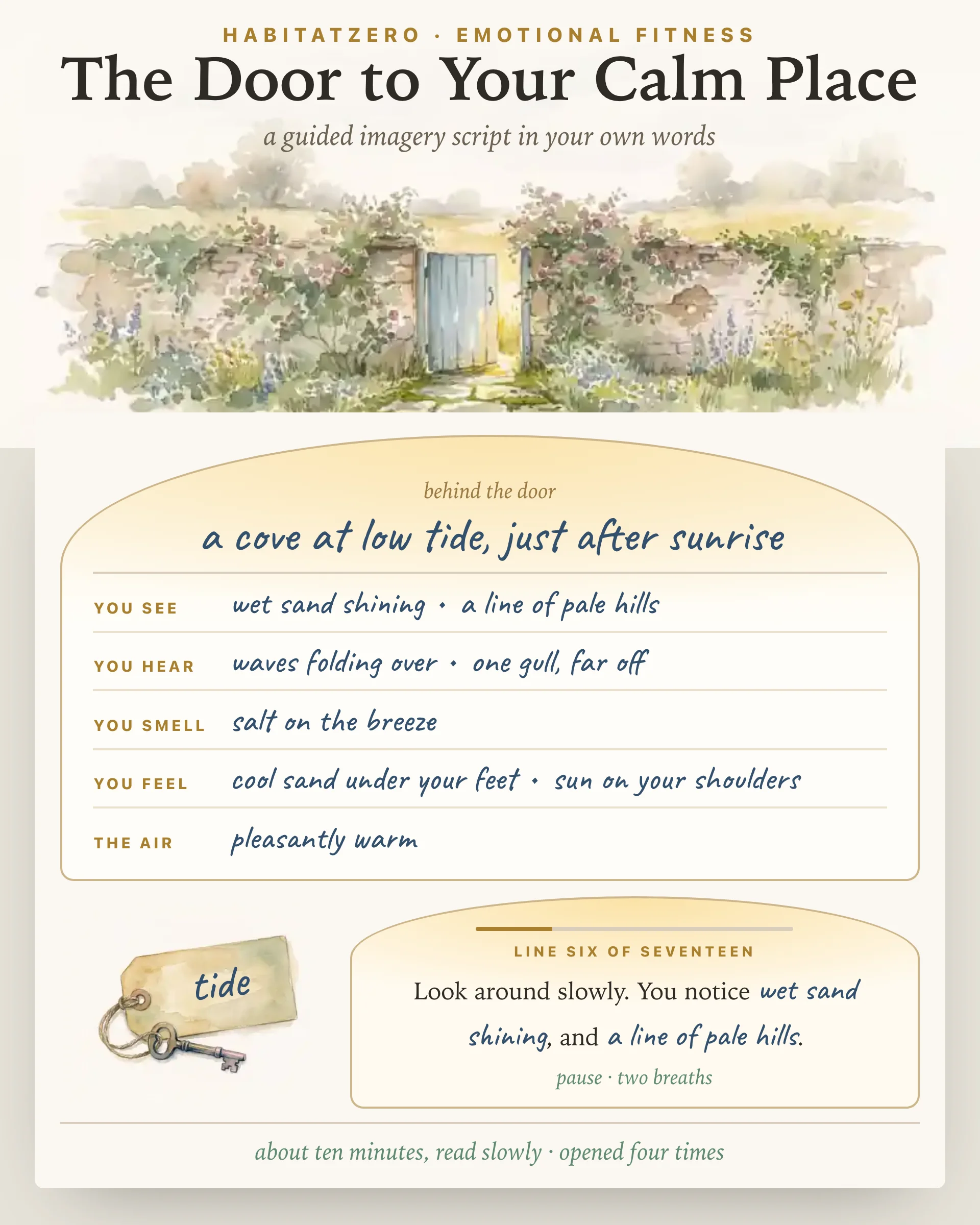
Guided imagery is a relaxation practice with a simple core: you picture a place where you feel at ease, fill it with detail through every sense, and rest there while your breathing slows. A guided imagery script is the set of words that walks you in and back out again. Most scripts hand you somebody else's beach. This page asks you to build your own place first, then writes the script around your words.
A stock script works when its picture happens to suit you, and slides right past you when it doesn't. Research on mental imagery gives a reason to take the building seriously: picturing something tends to stir more feeling than describing the same thing in words, partly because images reach into memories of real moments. A place assembled from details you chose, the sound you like and the smell that settles you, has a better chance of feeling like somewhere rather than a paragraph.
Sight is only one channel, so the page also asks what you hear, smell and feel on your skin, plus how warm the air is. Two details per sense is plenty. Past that, the lines turn into lists, and lists are the opposite of slow.
The painted door at the top is the way in. Under it, an arched doorway holds the place itself:
As you fill things in, the script below writes itself. Your details appear in your own handwriting inside the page's sentences, and anything still missing shows as a gap. Pauses are marked after their lines, mostly in breaths, and the page adds up reading time, pauses and the stay you picked, so you know whether you are setting aside eight minutes or twelve.
Press open the door and the script runs one line at a time. Read it aloud or silently; the page waits through each pause and moves on by itself. You can hold, go back a line or skip ahead, and stepping out early costs nothing. To record it, start a voice recorder on your phone, open the door and read each line as it appears, so the silences land in the recording too.
In one randomized study, sixty college students were split between twenty minutes of recorded progressive muscle relaxation, deep breathing or guided imagery and a control condition. All three techniques left their groups more relaxed than the control group, and the imagery group's heart rate and skin readings drifted steadily toward calm.
The clinical picture is more modest. A 2020 meta-analysis of guided imagery before surgery pooled eight trials. In adults it found lower anxiety and slightly less pain after the operation; the biggest effects were in children, and several results were small or not statistically clear. A review of guided imagery for muscle and joint pain called the evidence encouraging but inconclusive: eight of its nine trials favored imagery, yet few of them were rigorous.
So treat this as a relaxation practice that can take the edge off a tense hour. It is not a treatment for an anxiety disorder, for trauma or for chronic pain, and it belongs alongside other care rather than in place of it.
The same pull that makes imagery calming means it can also call up memories you did not invite. If anything in your place stirs something painful, open your eyes. You can pick another place at any time, and a made-up place is every bit as welcome here as a remembered one. The script says this near the start and leaves the door open behind you at the end, so nothing gets shut in. If hard memories keep surfacing whenever you close your eyes, try it with your gaze resting on one spot instead, or work through it with a therapist first.
Build the place on an ordinary afternoon, not in the middle of a bad one. Then read it through a few times while life is calm, so the place and your word are familiar before you need them. After that it suits the ten minutes before sleep, the wait before an appointment you are dreading, or a break when your thoughts will not settle.
If your body is too wound up to picture anything, loosen it first with Progressive Muscle Relaxation or a few rounds of Box Breathing. If closing your eyes feels wrong today, 5-4-3-2-1 Grounding uses the same senses on the room you are actually in.
Settle into a comfortable position and slow your breathing. Picture a way in, then build one calm place through your senses: what you see first, then sounds, smells and what touches your skin. Rest there for a few minutes, give the place a word, and come back by noticing the room around you before you open your eyes.
It is an imagined spot, remembered or invented, that you fill with sensory detail until it feels restful, so you can return to it when you need to settle. This page calls it a calm place, because calm is an easier promise to keep than safe, and the place only has to feel calm to you.
Short studies suggest it can help people relax, and a pooled analysis of trials run before surgery found modest drops in anxiety and later pain, though not every result was statistically clear. Think of it as a relaxation practice that can take the edge off a tense hour, not as a treatment for an anxiety disorder.
Go carefully if turning inward tends to bring back painful memories, flashbacks or a sense of unreality. You can keep your eyes open, keep the script short, or learn it with a therapist first, and you can stop whenever a picture turns hard.
The public page shows the door with a sample place and its script already filled in. Your own place, your word on the key and the timed read-through live in HabitatZero, which keeps them for you at no cost.
By the team behind Fabulous, the science-based self-care app used by over 30 million people.


