
Leaves on a StreamEmotional Fitness · ~3 min
About this template · Updated September 2026
Credit first. The growth mindset comes from the research of Carol Dweck, a psychologist at Stanford (her faculty profile), who studied how people's beliefs about whether their abilities can change shape what they do after a failure. Her book Mindset: The New Psychology of Success carried the idea into classrooms and offices. Test Flights is a Fabulous worksheet built on that published idea. Dr. Dweck did not write, review or endorse it, and it has no tie to her, her publishers or any program sold in her name.
Setbacks rarely arrive alone. The quiz comes back with a red number, and a second later a sentence shows up to explain it: I'm just not a math person. That sentence is the fixed mindset at work. It takes one result and turns it into a verdict about a trait you supposedly cannot change, which quietly tells you to stop trying.
A growth sentence keeps the facts and drops the verdict. I haven't learned this kind of problem yet admits the quiz went badly; it just refuses to call the matter settled. Dweck has written that we are all a mixture of fixed and growth mindsets and probably always will be, and that the useful move is to watch for your own fixed-mindset triggers rather than pretend you have none (Dweck, 2015).
When a paper plane nosedives, throwing it harder only sends it into the grass faster. What fixes it is a change to the fold: a bent wing tip, a heavier nose, a different design. In the same essay, Dweck called equating the growth mindset with effort perhaps its most common misconception. Effort matters, she wrote, but stuck students also need new strategies and input from others, and praising effort that produces no learning only makes someone feel good for a moment. She also described what a colleague named a false growth mindset: claiming the idea while your words and actions say otherwise. Her suggested line for a stuck student is the loop this page is built on: talk about what you've tried, and what you can try next.
So every rewrite here needs a new fold: one specific strategy you will actually try. A plan that only asks for more of the same, like try harder or never give up, gets turned back as a harder throw.
Start with the crash. Tap the part of life where the setback happened, from school and work to people or money and home, and write the sentence you told yourself, word for word. Add the setback in a few words so you remember where it came from.
Then fold. Say the sentence again as a growth sentence and change one thing: redo the missed problems with someone who can explain them, cut the presentation to three points, run-walk instead of forcing a full run. One setback can leave several sentences; catch them all, and each waits in the flight log until you fold it.
After trying it, log the flight: flew, wobbled or nosedived, plus a line about what happened. A nosedive tells you about the fold, not about you, so the card offers a fresh fold, up to three per plane.
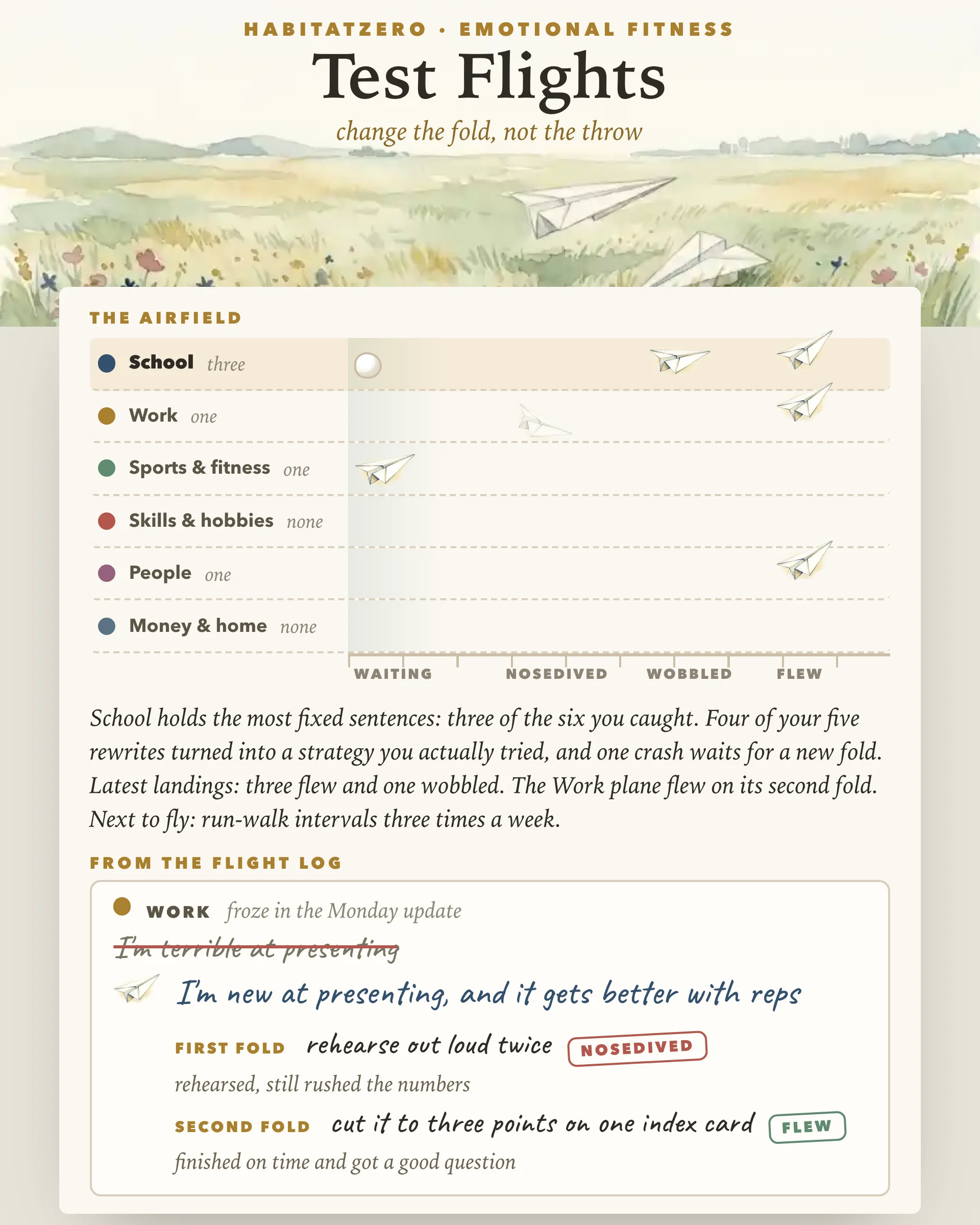
On the airfield, each plane sits in the lane for its part of life, at the spot where its latest flight landed, so two answers show at a glance: which area holds the most fixed sentences, and how many rewrites became strategies you actually flew. The first tells you where your triggers live. The second keeps the rewriting honest, since a lovely sentence that never leaves the table has changed nothing yet.
In two 2018 meta-analyses, Sisk and colleagues found weak overall links between students' mindsets and their academic achievement, and weak average effects of mindset interventions, with some sign of benefit for students from low-income families or at academic risk (Sisk et al., 2018). The National Study of Learning Mindsets then tested two online sessions of about twenty-five minutes each with a nationally representative sample of US ninth graders. Lower-achieving students' core-course grades rose by about a tenth of a grade point, higher achievers saw no change, and the effect held mainly in schools whose peer culture supported taking on challenges (Yeager et al., 2019).
Small, real and dependent on context is a fair summary. A belief on its own does little; what this sheet asks for is behavior, trying a specific new approach and checking whether it helped, which sits closer to deliberate practice than to positive thinking.
Fill in the crash within a day of the setback, while you can still hear the exact words, and come back to log the flight once you have tried the strategy. Read the airfield now and then: a lane that keeps filling up calls for a teacher, coach or friend who can show you a better fold, not more willpower.
If the sentence you catch is less about ability and more about your worth, the Inner Critic Translator is the better first stop. For school crashes, The Study Techniques Cabinet holds specific methods worth folding into a strategy, and teachers who want feedback that names a next step can pair this sheet with Glow and Grow.
A guided page for turning the sentence a setback leaves behind into one with room to improve. This one works like a paper plane test: you catch the fixed sentence, refold it as a growth sentence with one specific strategy, then log whether trying it helped.
Fixed mindset examples sound like verdicts on a permanent trait: I'm just not a math person, I'm a bad test taker, I'm not a runner. Going from fixed to growth mindset means keeping the facts and adding the learning, as in I haven't learned this kind of problem yet, then naming a next step such as redoing the missed problems with a tutor.
Less dramatically than classroom posters suggest. A pair of 2018 meta-analyses found weak average effects of mindset programs on academic achievement, and in a national US study of ninth graders, two short online sessions lifted lower achievers' grades by about a tenth of a grade point. Treat this sheet as practice in trying new strategies, not as a promise.
No. Test Flights is an independent worksheet made by Fabulous. It draws on Carol Dweck's published research, but she did not create, review or endorse it, and it has no connection to her, her publishers or any program sold in her name.
Not to look around: the page shows a sample airfield with six planes and where each one landed. To catch your own crashes, fold strategies and keep the flight log from one setback to the next, personalize it in HabitatZero, which is free.
By the team behind Fabulous, the science-based self-care app used by over 30 million people.


