Reading JournalStudy & Learning · ~4 min
About this template · Updated September 2026
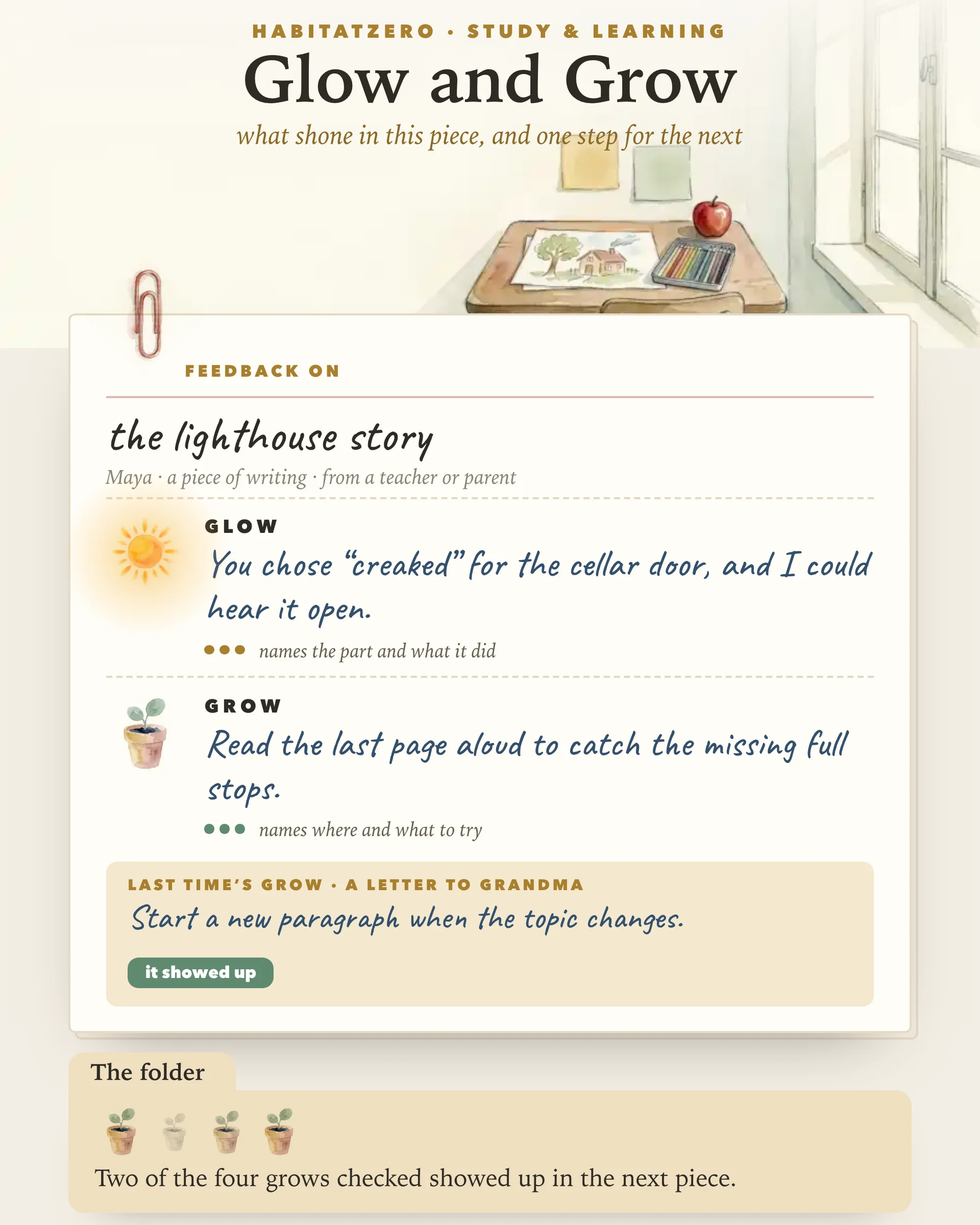
Glow and grow is two comments on one piece of work. The glow names something that went well, specifically enough that the child could put a finger on it. The grow names one next step, small enough to try on the very next piece. Teachers write them on stories, math pages and posters; parents use them over homework; students trade them on drafts, their own included. We could not trace the phrase to a single author, so this page credits nobody and is simply a worksheet for the habit.
In their review The Power of Feedback, John Hattie and Helen Timperley argue that useful feedback answers three questions: where am I going, how am I going, and where to next. A glow answers the second with evidence from the work itself. A grow answers the third. They also make an uncomfortable observation about classrooms: students often learn that the answer to "where to next?" is simply more, meaning more tasks and more expectations. One named step is the opposite of more.
The same review is blunt about praise aimed at the person. Comments like "good girl" or "great effort" usually carry little information about the task, and they too often pull attention away from it. That is why this page treats "good job" as a place to start rather than a finished glow.
Feedback is not automatically good for learning. When Avraham Kluger and Angelo DeNisi pooled more than six hundred comparisons in a meta-analysis of feedback interventions, feedback raised performance on average, yet over a third of the interventions made performance worse. Their explanation was about attention: the further feedback drifted from the task toward the self, the weaker it became. A glow that quotes the exact line keeps a child's attention on the page. A glow announcing that the child is clever sends it somewhere less useful.
Tap what is being handed in: writing, math, a drawing, a project, reading aloud or a performance. Add a first name if you keep slips for more than one child, and say who is giving the feedback: a teacher or parent, a classmate, or the author. The starters change to match. A story offers "Your opening line works because…", a math page offers "You checked…", and a self-check turns every you into I.
Finish a starter with what you actually saw. The painted sun beside the glow brightens in three steps: general, names the part, names the part and what it did. Type "good job" and move on, and a nudge asks which part you mean. The seedling beside the grow perks up the same way, and a grow that reads like two steps gets flagged, because a single step is easier to try and easier to check next time.
When the same child brings back the same kind of work, the slip shows last time's grow and asks whether it showed up: yes, partly or not yet. File the slip and it lands in a folder that holds sixty, newest first. Underneath, it counts how many grows showed up in the following piece, how many glows name the exact part, and which grow you have written twice without a yes. A step that keeps returning is often asking to be shown once, side by side, rather than written a third time.
In Ruth Butler's classroom experiment with fifth and sixth graders, pupils who got individual comments showed the most interest and the best performance afterward. Pupils who got grades, or grades with comments attached, did not get that lift. If a mark has to go home, keep it separate from the slip.
Classmates can hold the pen too. A meta-analysis of peer assessment covering fifty-four controlled studies found it improved academic performance compared with no assessment and with teacher assessment, and it did not differ clearly from self-assessment. The starters give a young reviewer words that stay kind and stay on the work.
We found no trial of glow and grow under that name. The studies above concern feedback in general, and none of them tested a painted sun. The sun's three steps come from a simple reading of your words, so treat them as a nudge, not a verdict. And no slip replaces teaching: if a grow asks for a skill the child has never been shown, show it first and write the grow after.
Fill a slip while the work is still in front of you, so the glow can quote it. If a book report is on its way, The Book Report gives the reader a jacket to fill and gives you something concrete to glow about. For a routine about how the day went, rather than feedback on one piece of work, Rose, Bud, Thorn fits better. And when an older student's grow keeps coming back, turning it into a term goal on the Semester Goal Worksheet can give it the weeks it needs.
It is a two-part comment on one piece of work. The glow names something that went well, clearly enough that the child could point to it on the page, and the grow names one step to try on the next piece. Teachers use it on stories, math pages, art and presentations, and parents use it on homework at the kitchen table.
A useful glow points at the work itself: you chose creaked for the cellar door, and I could hear it open. A useful grow is one step the child can see and try: start a new paragraph when the topic changes. Good job and try harder tell a child how you feel, but neither one says where to look or what to do next.
Glow starters work best when they aim at a part of the work, such as your opening line works because, or the colors you chose for. Grow starters work best when they open with an action, such as add one sentence that shows, or check your answer by. On this page the starters change with the kind of work, and they switch to I and my for a self-check.
Yes. Choose a classmate or self-check as the source and the starters change voice to fit. A meta-analysis of fifty-four controlled studies found that peer assessment raised academic performance compared with no assessment, and that it worked about as well as self-assessment.
They are close cousins. Two stars and a wish offers two strengths and one hope for next time, while glow and grow keeps to one of each, which makes the single next step easier to remember and to check on the following piece.
By the team behind Fabulous, the science-based self-care app used by over 30 million people.