
Leaves on a StreamEmotional Fitness · ~3 min
About this template · Updated September 2026
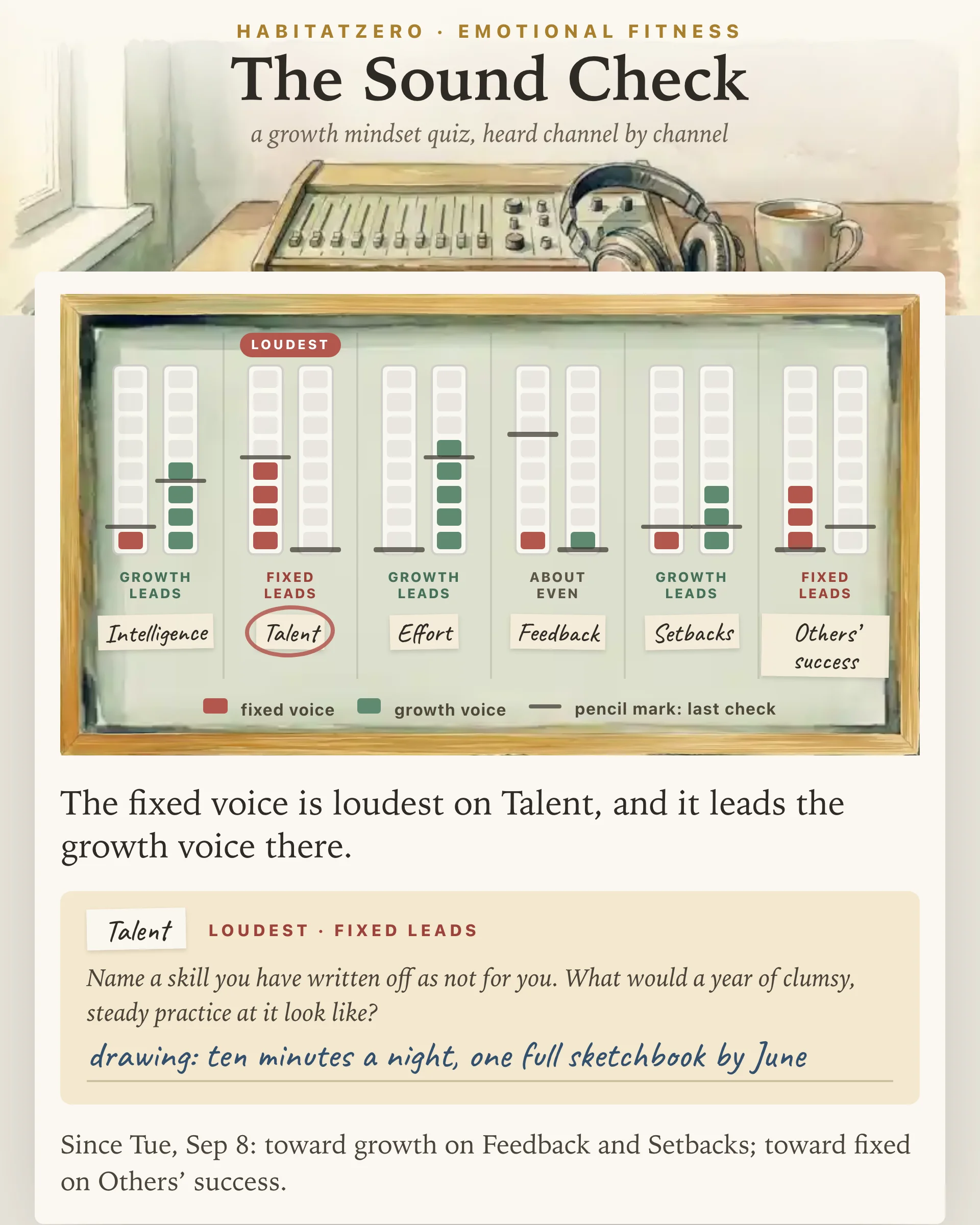
This quiz rests on the work of Carol Dweck, a psychologist at Stanford University (her faculty profile), whose research on fixed and growth mindsets asks a plain question: do you believe your abilities are mostly set, or that they can be built? The Sound Check is Fabulous's own take on that question. Its twenty lines were written for this page rather than borrowed from any of her research scales, and neither Dr. Dweck nor her collaborators made, reviewed or endorsed it.
Dweck has written that nobody holds a pure growth mindset. Each of us carries a mix of both, the mix keeps shifting with experience, and certain moments tend to tip it: taking on a challenge, hearing criticism, or coming off worse than someone else (Dweck, 2016). That is why this quiz never hands you one number. You can be certain that practice pays off in the pool and just as certain that you were never a math person.
So the page listens on six channels: intelligence, talent, effort, feedback, setbacks and other people's success. Each channel carries two voices. The fixed voice says the matter is settled, that you either have it or you don't. The growth voice says the matter is still open and depends on what you try next. Every line you answer turns one of them up, or neither when you pick not sure.
Each line is a short, everyday statement. Some are worded the way the fixed voice talks and some the way the growth voice talks, so agreeing with everything does not push you toward either side. Tap how much you agree, from strongly disagree to strongly agree, and the meters on that line's channel climb as you go. Answer for how you usually think, not how you wish you thought.
When all twenty are in, a tag marks the channel where the fixed voice is loudest, and the rest fall into three groups: leaning fixed, about even and leaning growth. A channel only leans one way when one voice sits at least two steps above the other. Plenty of channels land about even, which is ordinary. Tap solo on any channel to see the lines behind its meters, and change an answer right there if you misread one; the meters, the tag and the questions all follow.
Each channel that leans fixed gets one reflection question. On the talent channel, for instance, it asks you to name a skill you have written off and picture a year of clumsy, steady practice at it. There is one line for your answer. Make it specific, because details are what the fixed voice cannot wave away.
A few months later, start a new sound check. Your last check stays on every meter as a pencil mark, and the reading tells you which channels moved toward growth or toward fixed, which single line changed the most, and what you wrote last time.
Mindset lessons have been rolled out in schools around the world, and the research behind them is more modest than their reputation. In 2018, Sisk, Burgoyne and colleagues published two meta-analyses, one on how closely mindset tracks academic achievement, drawing on more than 365,000 students, and one on whether mindset interventions raise it. Both overall effects were weak, with some sign that students from low-income families or at academic risk might benefit (Sisk et al., 2018).
A national experiment followed a year later, reported in Nature. The National Study of Learning Mindsets gave a nationally representative sample of more than twelve thousand US ninth graders two short online sessions, under an hour in total. Lower-achieving students ended the year with core-course grades about a tenth of a grade point higher than similar students in the control group, higher achievers showed no real change, and the gains held best in schools where classmates' norms backed the message (Yeager et al., 2019).
Put together, beliefs about ability matter a little, for some people, in some settings. This quiz helps you notice your own beliefs. It does not measure how able you are, and it cannot predict your grades.
Take it at a starting line, such as a new school year, a new job or the first week of January, and again a few months in. A check taken the day after a setback is worth having too, since that is when the fixed voice tends to be at its loudest.
Read the loudest channel as a place to experiment, not a flaw to fix. In the same essay, Dweck called it a misconception that a growth mindset is only about effort, and pointed to trying new strategies and seeking help from others. So if effort is your loudest channel, change the method before you add hours, and The Study Techniques Cabinet has specific ones to try. If the fixed voice sounds less like a claim about ability and more like a harsh critic, Inner Critic Translator is the better next page.
Teachers can run it with a class if each student keeps their desk private: the six channels make a good discussion, and comparing students' results does not. Pair it with Glow and Grow, so the feedback students hear afterward points to a next step rather than a verdict.
It measures how far you believe abilities such as intelligence and talent can grow through practice, better strategies and help from others, which is a growth mindset, or that they are largely set, which is a fixed mindset. This one keeps six areas apart instead of adding everything into one score, since most people lean growth in some places and fixed in others.
Yes. The lines describe moments a high school student and an adult both know, like a subject that will not click or a friend who wins something you wanted. A teacher can have each student take it privately, talk through the six channels as a class without comparing anyone's results, and run it again at the end of the semester.
Only a little, on the best evidence so far. In 2018, two meta-analyses by Sisk, Burgoyne and colleagues found weak overall links between mindset and achievement and weak overall effects from mindset programs. A 2019 national experiment with US ninth graders then found that lower-achieving students gained about a tenth of a grade point, while higher achievers saw no real change. Use this quiz to notice your beliefs, not to raise a grade.
No. The Sound Check is an independent quiz from Fabulous, and its twenty lines were written for this page rather than taken from any scale in her studies. It builds on her published research, but Dr. Dweck and her colleagues had no hand in making it and have not endorsed it.
Not to see how it works: the filled-in example on this page lays a January check over a September one. To answer the twenty lines yourself, keep the pencil marks and set a retake beside them months later, personalize it in HabitatZero, which costs nothing.
By the team behind Fabulous, the science-based self-care app used by over 30 million people.


