Leaves on a StreamEmotional Fitness · ~3 min
About this template · Updated September 2026
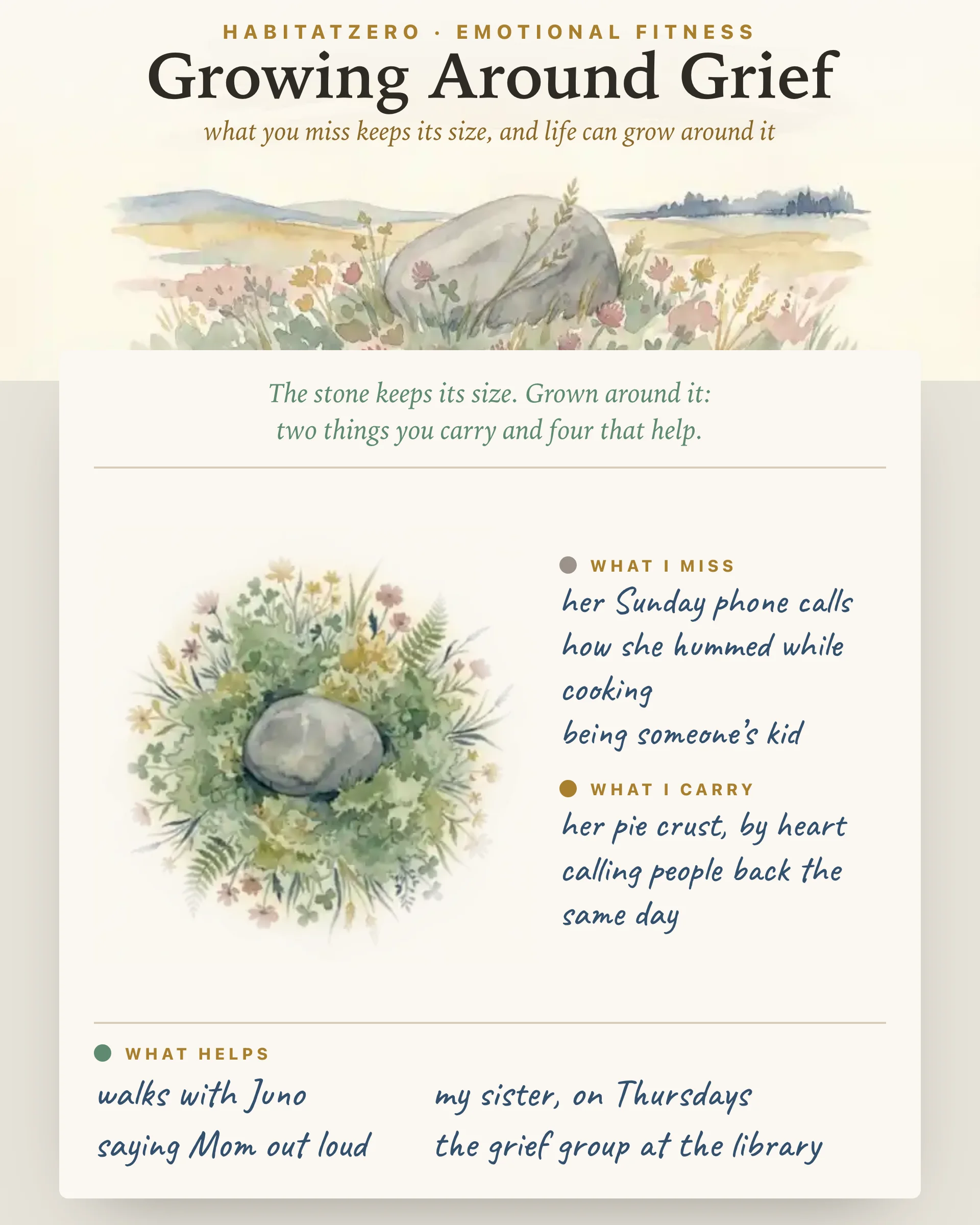
The picture this worksheet is built on comes from Lois Tonkin, a grief counselor in New Zealand, who set it out in a one-page 1996 article called Growing around grief. This page is an independent worksheet built on her picture; it has no affiliation with Tonkin, and she has not reviewed or endorsed it.
Most of us carry an unspoken expectation that grief should shrink, that time will wear it down until it is small enough to set aside. Tonkin's picture works differently. In it, the grief does not get smaller. What changes is the life around it, which slowly grows new ground: people, routines, meaning, and the parts of the person you keep. The loss takes up less of the whole while staying its own size.
The worksheet asks three things, and you can answer them in any order.
What I miss. The obvious losses and the ones nobody else would think to ask about: their voice on the phone, being known that well, someone to tell the small news to. However many lines you write here, the stone in the middle of the page stays exactly the size it is, because missing someone is not something this page measures.
What I carry. What you keep of them: a saying, a recipe you know by heart, the way they made room for strangers at the table. Keeping something of theirs is not a refusal to accept the loss. A 2022 Lancet commission on death and dying describes this as a continuing bond, where the aim is a lasting connection rather than detaching from the person who died.
What helps. Anything that makes a hard hour easier, however small: a walk, a friend who says their name without flinching, a support group, a counselor, an afternoon of rest you do not have to earn.
Tap one of the three doors to open its list. Each list offers suggestions you can tap, plus a short line for your own words, and everything you add appears in handwriting. A list holds six lines at most, so the picture stays easy to read, and removing a line takes two taps, so nothing vanishes by accident.
The part a paper worksheet cannot do is the drawing. The stone at the center stays the same size no matter how much you write about what you miss. Each line you add to what you carry or what helps uncovers a little more of the meadow painted around it, and a sentence under the title describes, in plain words, what has grown so far. It is a picture, not a score. There is no finished meadow to reach and no date for reaching it.
You may have heard that grief comes in five stages. A 2017 review by Margaret Stroebe, Henk Schut and Kathrin Boerner found no sound empirical evidence that grief follows a set sequence of stages, and warned that expecting one can hurt people whose grief looks different. That is why this page has no stages and asks for no dates. It never asks how long ago the loss happened or suggests where you ought to be by now.
Tonkin's picture deserves the same honesty. It is a way of describing grief that came out of counseling rather than a result from a controlled trial. Use it if it matches what you notice in yourself, and set it aside if it does not.
Most people find that the symptoms of grief ease with time, the American Psychiatric Association notes, but for a smaller group grief stays intense and keeps getting in the way of daily life. The association calls that pattern prolonged grief disorder, and there are evidence-based treatments for it. This page cannot tell you whether that fits your situation, and it does not try: it scores nothing and gives no verdict. If grief has kept your work, sleep, meals or people on hold for a long time, talk with a grief counselor or your doctor, and bring your three lists if they help you begin. This worksheet is a place to reflect; it is not therapy and not a substitute for care.
If you are in crisis or thinking about hurting yourself, call or text 988 (US) right now, or reach your local emergency number.
Open it on a quiet evening, in the days before a hard anniversary, or after a day when the absence felt louder than usual. One line in one list is plenty for a sitting. If you would rather speak to them than about them, the Grief Journal is built for unsent letters. If your list of what helps feels thin, the Coping Skills Toolbox has more to try. And when the hard season is not about a death at all, the Emotional Healing Journal may suit you better.
It is a short set of prompts that helps you put a loss into words, so the feelings have somewhere to go besides the middle of the night. This one asks three things, what you miss, what you carry of the person and what helps, and draws your answers as a stone with a meadow growing around it.
Whatever is true, in a few words. Under what you miss, a voice, a routine, the feeling of being known. Under what you carry, a recipe, a saying, a habit of theirs that is now yours. Under what helps, a person, a place or a small ritual that eases a hard hour. When words will not come, tap one of the suggestions instead.
Yes. The prompts and suggestions are written for adults grieving a parent, partner, sibling, child or close friend, and they assume a grown-up life of phone calls, recipes and support groups. Younger children usually do better with a trusted adult beside them and simpler, picture-based activities.
No. Researchers who reviewed the stage idea found no solid evidence that grief moves through a fixed order, and they warned that expecting stages can make people feel they are grieving wrong. This worksheet has no stages and no deadline, so you can start with any list and come back whenever you want.
Any time you want company in it, and especially if grief has kept your sleep, work, meals or relationships on hold for a long time. A grief counselor or your doctor can help you sort out what you are carrying, and there are treatments for grief that stays intense. This page is a reflection tool and cannot tell you whether that applies to you.
By the team behind Fabulous, the science-based self-care app used by over 30 million people.