
The Overwhelm Recovery ProtocolWellness & Routines · ~5 min
About this template · Updated September 2026
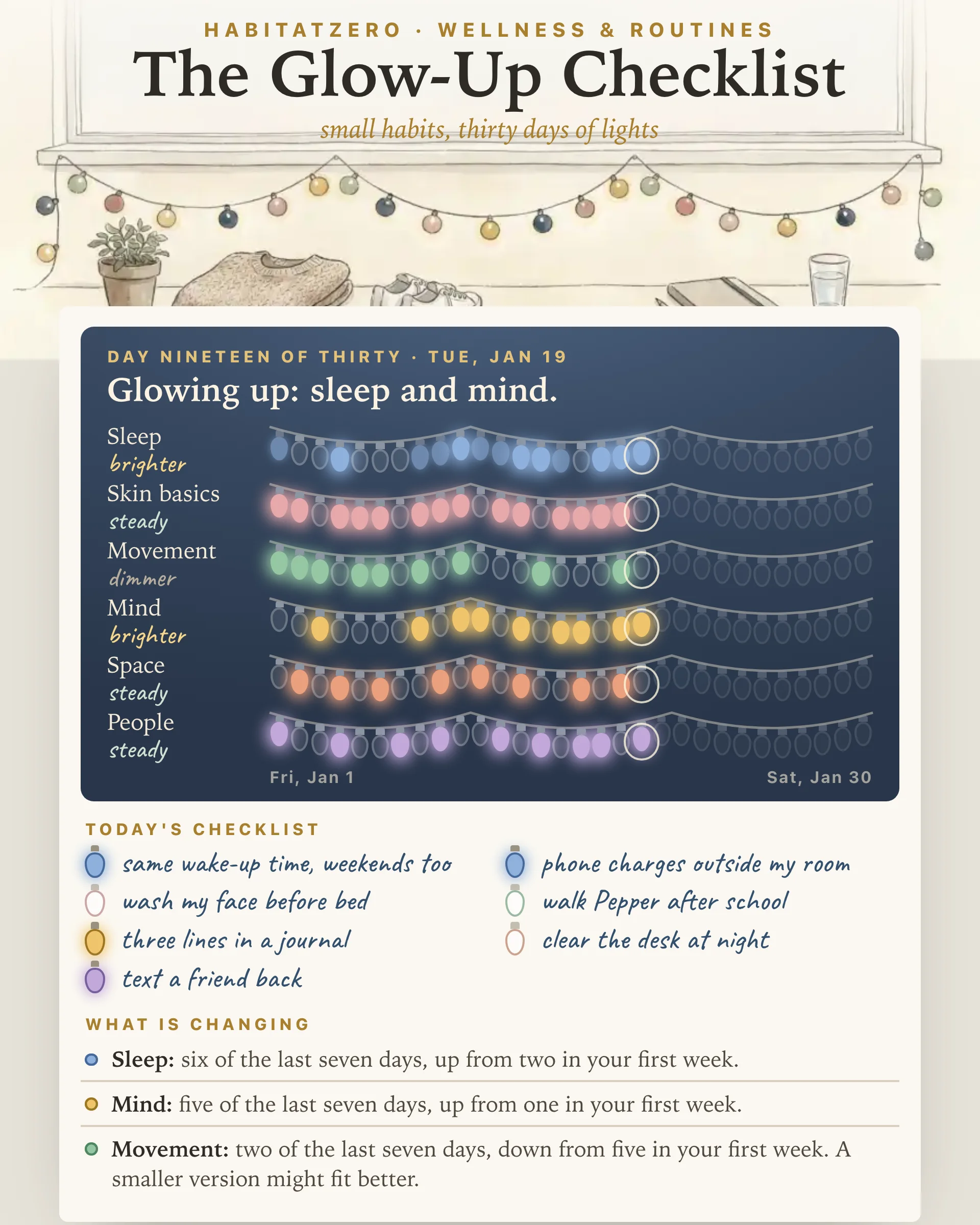
Most glow-up content sells a new face in thirty days: a skincare haul, a punishing workout split, a gallon of water, no sugar, and a before-and-after photo. This page makes a quieter offer. You choose a few small habits in the parts of life that shape how you feel, check them off at night, and after a week or two you can see which parts are genuinely changing. Nothing here scores your looks, your weight or your body. The only glow it counts comes from the lights on the page.
A forty-item glow-up list tends to fail the same way. It is thrilling on the first of the month and exhausting by the fifth, because every unchecked line starts to read like a small verdict on you. This checklist sorts habits into six areas instead: sleep, skin basics, movement, mind, space and people. Each area holds two habits at most, and the whole list holds eight. The cap is deliberate. Eight small things fit into a school night with homework and practice, and spreading them across areas stops one loud goal from crowding out everything else.
Small really does mean small. "Wash my face before bed" will outlast "a full skincare routine," and "a twenty-minute walk" will outlast "work out every day."
Tap a suggestion under any area or write your own, and each habit gets its own bulb. When you check a habit, its bulb glows, and so does that area's bulb for the day on a strand below. Each strand is thirty bulbs long, one for every day of your glow-up challenge, hung in three swags of ten. A bulb glows softly when you kept some of an area's habits that day and fully when you kept all of them.
Your first check starts day one. Forgot a night? Step back with the arrows and fill it in honestly. If a habit is not working, remove it. The days it already lit stay lit on its strand, so trading it for something smaller never wipes out what you did.
Once a week has passed, the page starts reading the strands. It sets your first seven days beside your most recent seven, area by area, and tells you which areas are brighter, which are steady and which are dimmer. A gap of two lit days or more counts as a change, and anything less reads as steady. You may have planned your glow-up around movement and discover that sleep is the area actually moving.
Sleep has the strongest case on the list. The American Academy of Sleep Medicine's consensus statement advises that teenagers aged 13 to 18 sleep eight to ten hours out of every 24 on a regular basis, and it links getting that much with better attention, learning, memory and emotional regulation. If you only light one strand this month, light that one.
Movement comes next. The World Health Organization's 2020 guidelines suggest that teens average sixty minutes a day of moderate to vigorous activity across the week, and they repeat a message worth keeping close: some activity is better than none. A walk with the dog counts.
As for how long a glow-up takes, real habits run longer than a month. In a study that followed people building one new daily behavior, the time until it felt automatic ranged from 18 to 254 days, and missing a single day did not materially change the outcome. So a 30 day glow up challenge is a good start rather than a finish line, and a dark bulb is just a dark bulb.
Kindness toward yourself turns out to be practical too. Across four experiments, people who met a failure or a weakness with self-compassion were more motivated to improve than people given a self-esteem boost, and in one experiment they studied longer after failing a hard test. That is why this page calls a slipping area "dimmer" and suggests going smaller, never harder.
The limits are worth stating. Nobody has tested glow-up checklists as such, and no study shows that a month of habits changes your appearance. The reading here is a count of your own checks, not a measure of your health.
New Year's is the classic moment: set up your glow-up plan in the quiet week before January 1, and let day one be whichever day you first check something. It works just as well at the start of a semester, after a hard breakup, or any time you want a fresh start that has nothing to do with your reflection. After setup it asks for about a minute a night.
For a weekly look at how cared for you feel overall, pair it with the Self-Care Wheel. If sleep keeps losing to homework, shifts and practice, The Week That Fits shows where your hours actually go. And if you would rather be handed a different small task each day, try The 30-Day Challenge.
One last thing. If glow-up talk has turned into disliking how you look, or food, weight or exercise has started to feel out of control, tell a doctor, a school counselor or another adult you trust. That deserves real support, which no checklist can give.
A handful of small habits spread across the parts of life that shape how you feel: sleep, skin basics, movement, mind, your space and the people around you. Two per area and eight in all is plenty for one month.
Longer than a month, and that is fine. In one study of new daily habits, the time until a habit felt automatic ranged from 18 to 254 days. Treat a 30 day glow up challenge as a beginning, and let a missed night be just one night.
Start with sleep and movement, where the evidence is strongest: teens are advised to sleep eight to ten hours a night and to average an hour of activity a day. Then add one small habit each for skin basics, your mind, your space and your people.
Yes, and this one does. It never scores your face, body or weight. You choose habits by how they make you feel, and the page reads your progress only from the days you actually kept, one area at a time.
Not to look around, since the page shows a filled example with its strands already glowing. To keep your own checklist and light it night after night, personalize it in HabitatZero, which costs nothing.
By the team behind Fabulous, the science-based self-care app used by over 30 million people.


