The Overwhelm Recovery ProtocolWellness & Routines · ~5 min
About this template · Updated September 2026
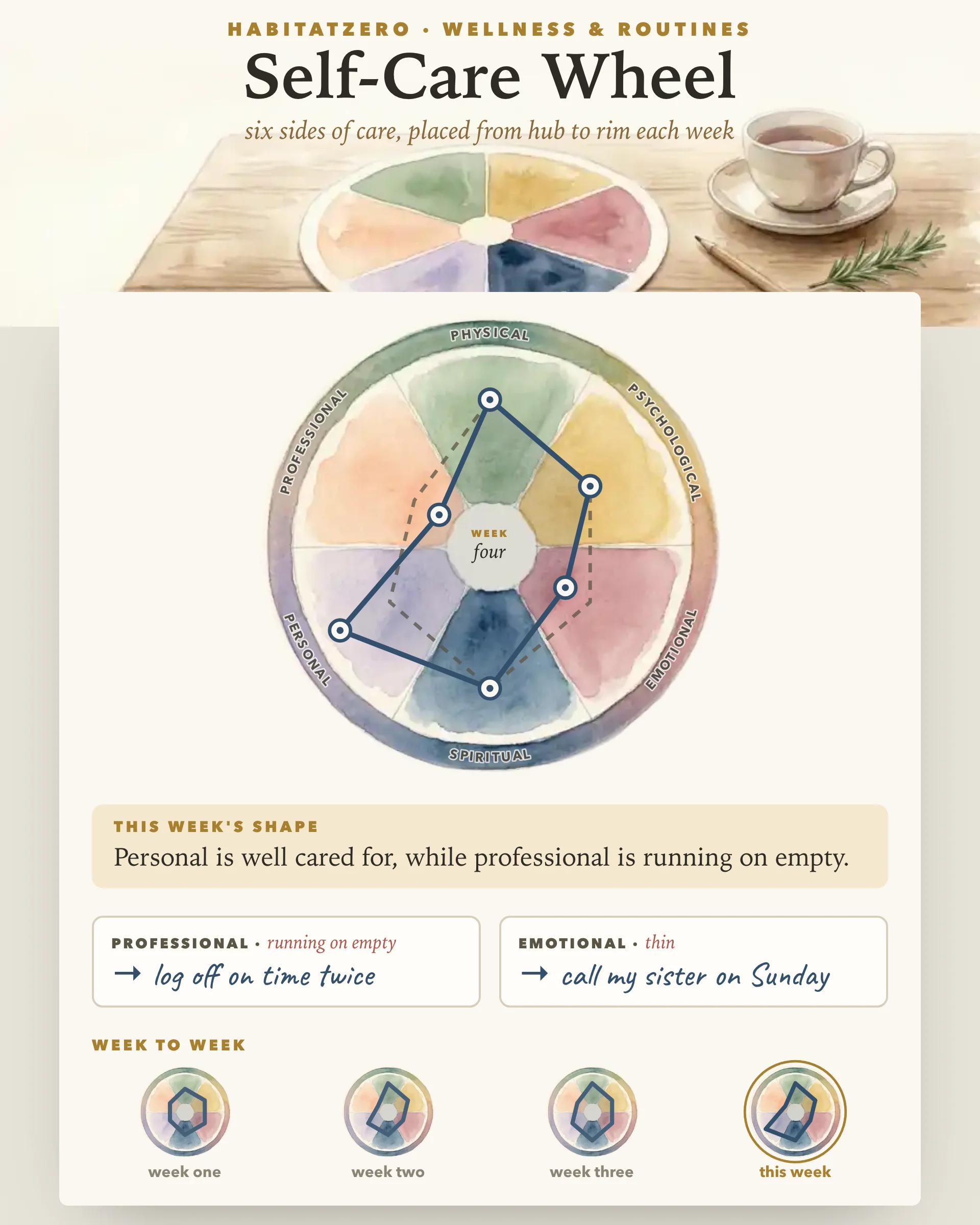
The self-care wheel is Olga Phoenix's idea. She created the Self-Care Wheel in 2013, while immersed in trauma-related work, as a map of six areas of care: physical, psychological, emotional, spiritual, personal and professional. The wheel's printed credit line says she adapted it from a self-care assessment worksheet in Transforming the Pain, a 1996 workbook on vicarious traumatization by Karen Saakvitne, Laurie Pearlman and their colleagues, and her site lists therapists, advocates and agencies among the people who use it today. This page borrows only her six area names. The wording, the painting and the weekly mechanics are HabitatZero's own, and she has not reviewed, approved or partnered on any of it.
Most self-care advice arrives as a list, and a list quietly suggests that more is better. A wheel asks a different question: which part of you got left out? You can sleep well, walk every day and still go a month without one honest conversation about how you feel. As a list, that month looks healthy. On a wheel, one side has caved in.
The six areas are broad on purpose. Physical covers sleep, food, movement and the appointments you keep postponing. Psychological is about having room in your head: quiet, curiosity, time away from screens. Emotional means your feelings get noticed and someone hears about them. Spiritual is whatever steadies you and feels larger than the week, religious or not. Personal is time that belongs to you rather than to a role. Professional is work with edges, meaning breaks, limits and help when the pile grows.
Each wedge has five stops running from the hub to the rim. Tap the one that matches the week you actually had: near the hub if that side ran on empty, out at the rim if it was well cared for. As you tap, the stops join into a single inked outline, and that outline is the whole point. You are not grading yourself. You are looking at a shape.
Once all six are placed, the page reads the shape back to you in a sentence and brings the two thinnest sides forward. Each one arrives with a handful of small ideas, such as an early night on purpose or lunch away from the desk, plus a line for your own words. One act per side is the limit, because two small acts that happen beat six that stay on paper. If nothing sits lower than cared for, the page says so and asks for nothing.
Keep the week and its outline moves onto a strip that holds eight weeks. The next time you open the wheel, last week's shape waits underneath as a dashed line, and the read tells you which sides filled out and which pulled in. When the same side stays thin, the act you chose for it last time comes back as a suggestion, so you can try it again or pick something else.
The wheel is a reflection tool rather than a clinical questionnaire, and this page treats it that way: nothing here is a score or a verdict about you.
The habits around it have better support. A literature review on self-care among mental health practitioners gathered research on several domains of practice, including physical health, social support and spirituality, and stressed the value of a proactive approach, with self-care planned in rather than left until strain forces it. That review is about helping professionals, the same group the original wheel was drawn for, so read it as encouraging rather than conclusive for everyone else.
The weekly rhythm leans on goal research. A meta-analysis of 138 experiments found that prompting people to monitor their progress helped them reach their goals, and that the effect grew when the progress was physically recorded. A strip of kept outlines is exactly that kind of record.
One honest limit belongs to the professional wedge. The World Health Organization describes burn-out as an occupational phenomenon, the result of chronic workplace stress that has not been successfully managed. If that side stays thin for weeks, the real fix may be a conversation about workload rather than one more act of self-care. And if any side sits near the hub week after week, or a low stretch starts getting in the way of ordinary life, talk to a doctor or a counselor.
Choose one evening a week and keep to it. Sunday suits many people, since the two acts then have a whole week in front of them. Four minutes is plenty. A wheel with two sides tended is doing its job, and nobody's stays perfectly round for long.
The wheel works well alongside the rest of the self-care set. If the thinnest side needs more than one small act, the Self-Care Checklist is a longer menu to choose from, and the Self-Care Planner gives each act a day of its own. When the question is bigger than care, such as career, money or love, The Wheel of Life takes the same circular look at your life as a whole.
A circle divided into areas of self-care, used to see at a glance which parts of your life are being looked after and which are being skipped. The best-known version, created by Olga Phoenix, names six areas: physical, psychological, emotional, spiritual, personal and professional. This page turns those six areas into a weekly check-in you fill in by tapping.
Olga Phoenix created the Self-Care Wheel in 2013 through the Olga Phoenix Project. Its printed credit line says it was adapted from a self-care assessment worksheet in Transforming the Pain, a 1996 workbook on vicarious traumatization by Karen Saakvitne, Laurie Pearlman and their colleagues. HabitatZero made this interactive version on its own, without any tie to her or her project.
Olga Phoenix offers her original wheel as a free download for personal reflection on her website. This page is a different kind of tool: a wheel you fill in that remembers your weeks. It is laid out to print, so the controls drop away and your inked shape, the written read and your two small acts stay on the page.
Rate each area honestly for the week you just had, notice where the shape caves in, and choose one or two small acts for the thinnest areas instead of overhauling everything at once. Repeating the check every week matters more than any single wheel, since the change between two shapes shows whether the acts are helping.
You can study a filled example right here, with week four inked over the dashed outline of week three. Tapping in your own sides, choosing your acts and building a strip of kept weeks begins when you personalize the wheel in HabitatZero, at no cost.
By the team behind Fabulous, the science-based self-care app used by over 30 million people.