The Overwhelm Recovery ProtocolWellness & Routines · ~5 min
About this template · Updated September 2026
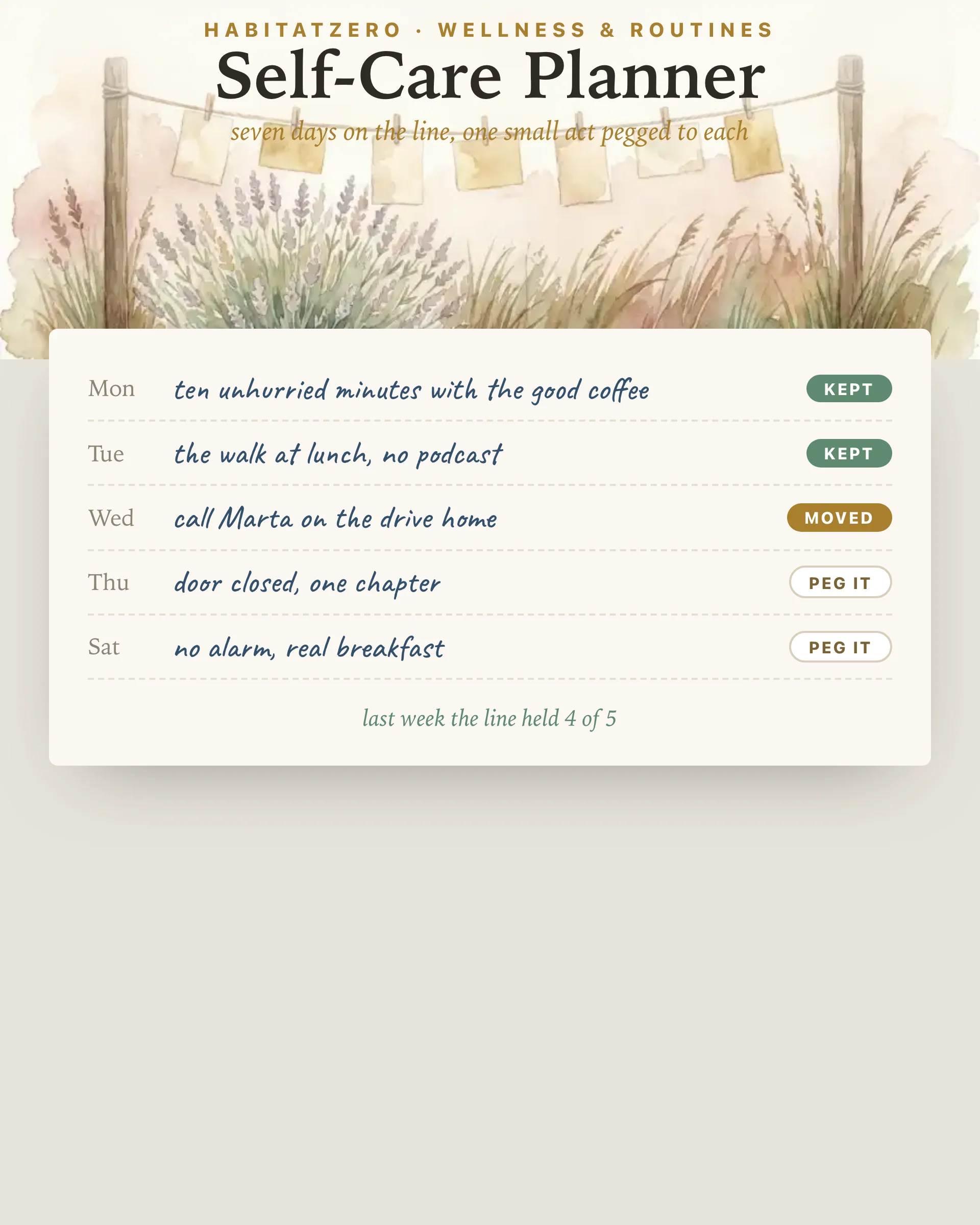
There's a particular kind of week where you did everything except anything for yourself — and if you check the calendar, the reason is right there: everything else had a time slot, and the care had a vibe. A self-care planner fixes exactly that. Seven days on the line, one small act pegged to each, decided before the week gets a chance to negotiate.
The planner's structure is a clothesline: Monday through Sunday, one act apiece. Not a regimen — an appointment. Ten unhurried minutes with the good coffee. The lunch walk, no podcast. A door closed and one chapter. The early night that pays for Monday. The sizing rule is printed on the sheet: small enough to keep on a bad day. Ten minutes counts; so does a closed door.
The insistence on assigning days isn't fussiness. Health-behavior research draws a sharp line between intending something and action planning it — specifying when and where it will happen — and Sniehotta and colleagues' work on planning found the planned version substantially likelier to survive contact with real weeks. A day of the week is the smallest useful address, and one act per day keeps the whole plan recitable from memory.
What the pegs hold matters too. Research on recovery from work — Sonnentag and Fritz's recovery-experience studies — links experiences like psychological detachment and genuine relaxation during off-hours to better wellbeing and restored energy. The clothesline is, functionally, a recovery schedule: it books the detachment before the week books everything else.
When the seven days have run, each peg gets one tap: kept (with a satisfied strike-through) or moved — carried forward to next week, dignity intact. The two-option reconciliation is deliberate. Missed self-care usually converts directly into self-criticism, which is a spectacularly counterproductive fate for an act of care; moved converts it into a reschedule instead. Sweep the line, and the planner remembers one sentence about the week that ended: last week the line held 4 of 5.
This planner is the middle of a trio, and the three deliberately don't overlap. The Self-Care Checklist is the menu — what actually restores you, worth rereading when the pegs feel stale. This planner is the booking — the menu items given days. And the Self-Care Journal is the receipt — the nightly record of how the tank actually ran. Menu, booking, receipt: most people are missing exactly one of the three tenses, and it's usually this one.
Seven pegs. Two honest outcomes. The care, on the calendar before the calendar fills.
A weekly page where acts of care get assigned to specific days before the week starts - one per day, Monday to Sunday - and get reconciled afterward as kept or moved. It is scheduling applied to the part of life that usually goes unscheduled.
Acts sized for your worst day, not your best: ten slow minutes with coffee, a lunch walk without a podcast, a door closed with a chapter, an early night before the hard morning. Grand plans photograph well and get skipped; small pegs hold.
Because unscheduled intentions lose every negotiation with a busy week. Health-behavior research distinguishes intending from planning the when and where - action planning - and finds the planned version far likelier to happen. A day is the smallest useful address.
Tap it moved and it travels to next week with its dignity intact. The reconciliation exists so that missed care becomes rescheduled care rather than evidence in the case against yourself.
Occupational-health research on recovery suggests yes: experiences like psychological detachment and relaxation during off-hours track with better wellbeing and next-day energy. The planner's job is making sure those experiences get calendar space instead of leftovers.
Three tools, three tenses. The checklist is the menu of what restores you; this planner books the week ahead; the nightly journal records how it actually went. Menu, booking, receipt - use whichever tense your week is missing.
Yes - a plan template with the calendar already inside it. Instead of a blank grid asking you to design a system, the week is laid out and each day takes one bad-day-sized act with a time attached. Fill it Sunday and the plan part is done; the rest of the week is just keeping pegs.
By the team behind Fabulous, the science-based self-care app used by over 30 million people.