Leaves on a StreamEmotional Fitness · ~3 min
About this template · Updated September 2026
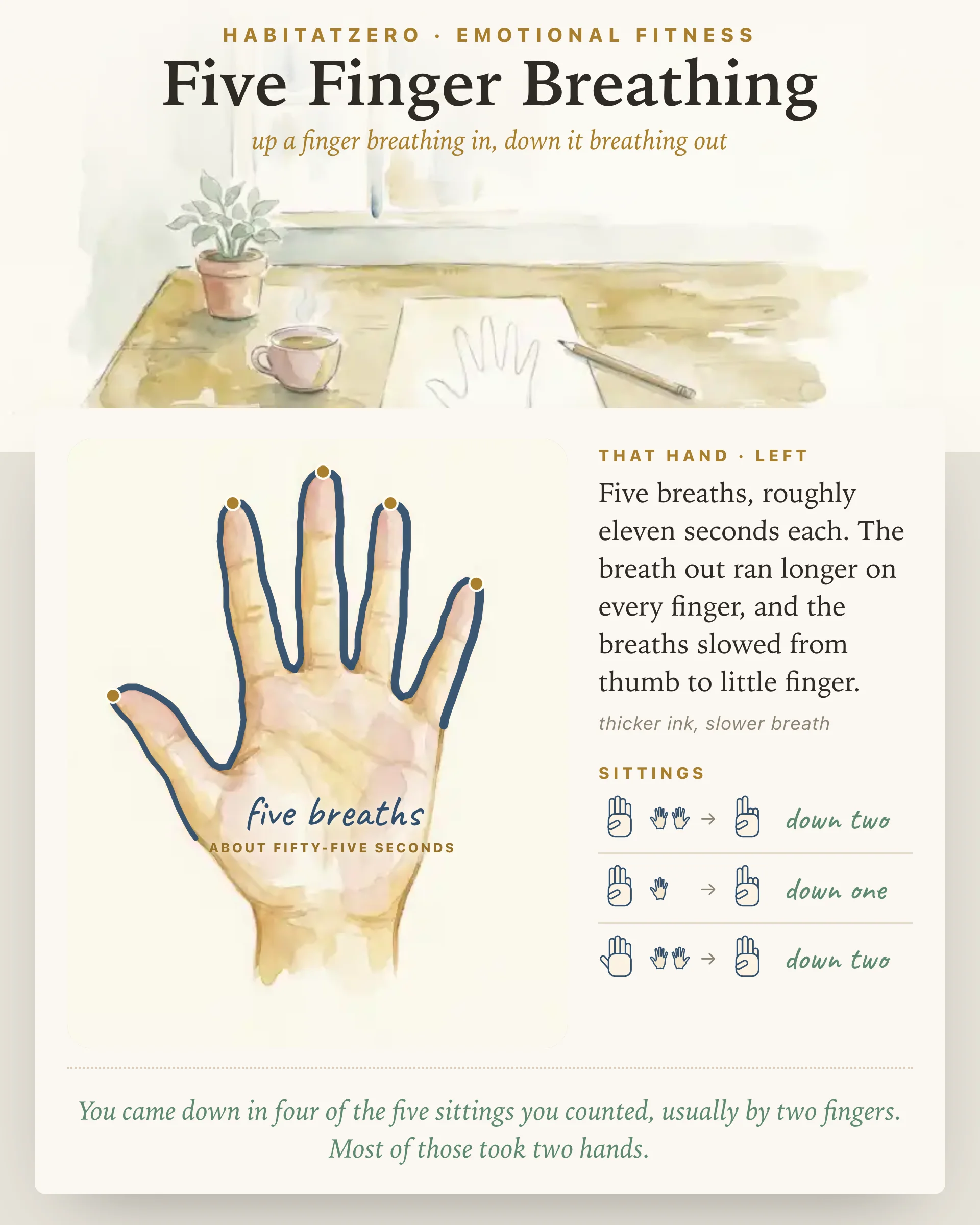
Five finger breathing turns your own hand into a guide for slow breathing. Spread the fingers of one hand, and with the pointer finger of the other, trace up the outside of the thumb while you breathe in, then down into the gap while you breathe out. Carry on over each finger in turn. Five fingers give you five slow breaths and a clear place to stop, and the only equipment is a hand you always have with you. You may also hear it called hand breathing, finger breathing or, in classrooms, starfish breathing.
Cleveland Clinic's walkthrough, from pain psychologist Judith Scheman, uses your non-dominant hand as the base and takes that second route, back from the little finger. Either way, one rule matters more than the rest: let the finger wait for the breath. When a finger races ahead, the breathing tends to hurry after it.
The painted hand is the one you trace. Put a finger on the green dot and follow the dotted line, or, if dragging is awkward, tap the dot each time your breath turns and the ink moves on for you. There is no timer and no sound. The page never sets the pace; it only keeps a record of yours.
That record lives in the ink. Every stretch you took slowly comes out thicker, every rushed one thin and pale, so a finished hand is a small drawing of how you breathed. Underneath, a short reading puts it into words: how long the five breaths took, whether your breath out was the longer half on each finger, and whether you slowed down as you went. Switch hands and the painting flips, and each finished hand drops a small stamp into the tray for this sitting.
The before-and-after check uses your fingers too. Before you start, tap how wound up you feel, one finger for a little and five for a lot. Count again when you finish, and the sitting lands in a log that keeps the last twelve. Once a few are there, the page tells you how often the count came down, by how many fingers, and how many hands that usually took.
We found no trial that tested five finger breathing on its own. What has been studied is slow, deliberate breathing in general. A 2023 meta-analysis of twelve randomized trials with nearly eight hundred adults linked breathwork to lower self-reported stress than control conditions, a small-to-medium effect, with similar results for anxiety and depressive symptoms. The same authors rated most of those studies at moderate risk of bias and cautioned against letting enthusiasm outrun the evidence.
The breath out seems to matter most. In a remote randomized study, five minutes a day of breathing that stretches the exhale lifted mood and lowered breathing rate more than the same five minutes of mindfulness meditation over a month. That is why the reading on this page notices whether your breath out ran longer than your breath in.
Tracing gives your attention something to feel and follow, which many people find easier to hold onto than a silent count. That is a good reason to try it, not a proven mechanism. Five finger breathing is a way to practice settling, and it does not replace care when anxiety keeps getting in the way of your days.
Teachers and school counselors reach for this exercise often, because a hand is concrete and five breaths end quickly. Trace your own hand beside your child's and go at their speed. Small children breathe faster at rest than adults do, so a slow breath for a five-year-old is shorter than a slow breath for you, and one hand is plenty. If your child would rather follow a shape, Star Breathing uses the same climb-and-slide rhythm around a painted star.
It fits anywhere your hands can rest: a waiting room, a meeting that has gone tense, the minute before a hard call, a night when sleep keeps its distance. Practice on a calm day first so the rhythm is familiar when you need it. If you would rather have the pace counted for you, Box Breathing holds each side of a square for four counts, and when there is no time for a whole hand, The Physiological Sigh is one double breath in and a long sigh out. Skip the exercise while driving. And if you feel light-headed at any point, let each breath get smaller and smoother, and go back to ordinary breathing for a minute.
It is a calming exercise that uses one hand as a map for the breath. A finger from the other hand climbs each finger while you breathe in and slides down the far side while you breathe out, so a single hand gives you five slow breaths and a clear place to stop.
Yes. Hand breathing, finger breathing, finger tracing breathing and, in many classrooms, starfish breathing all name the same move. Some versions trace back toward the thumb for a second round of five, while others simply switch to the other hand.
Both. Teachers and counselors like it for young children because it is concrete and ends after five breaths, and adults like it because it can be done under a desk without anyone noticing. With a small child, trace your own hand next to theirs and let them set the speed, since young children breathe faster at rest.
Nobody seems to have tested the hand-tracing version on its own. Pooled trials of deliberate breathing show modest drops in self-reported stress and anxiety, and practices that stretch the out-breath look especially good for mood. Treat it as a short daily practice, and see a professional if anxiety keeps getting in the way of your life.
Reading this page and exploring the filled-in example need nothing at all. To trace the hand yourself and keep a log of your sittings, personalize it in HabitatZero, which costs nothing.
By the team behind Fabulous, the science-based self-care app used by over 30 million people.