
The Overwhelm Recovery ProtocolWellness & Routines · ~5 min
About this template · Updated November 2026
Credit first. The equations behind this page were published by Bjarne Martens Nes, Ulrik Wisløff and their colleagues, who put thousands of healthy adults from the HUNT Study in central Norway through treadmill tests. Their 2011 paper on estimating peak oxygen uptake without exercise testing supplies the estimate, and their 2014 follow-up on long-term outcomes supplies the age reference that turns it into a fitness age. This worksheet is our own independent build from those printed numbers. The researchers did not make it, check it or endorse it.
A fitness age is a translation of one measurement. The measurement is peak oxygen uptake: the most oxygen your body can take in and use when you are working as hard as you can, counted in milliliters per kilogram of body weight per minute. Measuring it properly takes a treadmill run in a mask until you cannot go on, which almost nobody does.
So the Norwegian team asked whether answers you can give at home could stand in for the lab. Among the healthy adults aged 20 to 90 they tested, four things carried most of the signal: age, waist size, resting heart rate, and how much hard exercise people said they did. They fitted one equation for women and one for men from exactly those four. Later they published the average peak oxygen uptake at each age. Your fitness age is simply the age at which that average equals your own estimate.
You give five answers. Pick the women's or the men's equation, type your age, measure your waist in inches or centimeters, and enter a resting pulse. If you do not know your pulse, sit quietly for five minutes and let the page run thirty seconds while you count beats at your wrist or neck; it doubles the count. Then say how often you exercise, how hard, and for how long in a usual week.
Those three exercise answers multiply into one activity score, as the study scored them. Sessions taken easy, without heavy breathing or sweat, counted as no activity at all, however often or long they were. When an answer stops counting, the page dims it and says why.
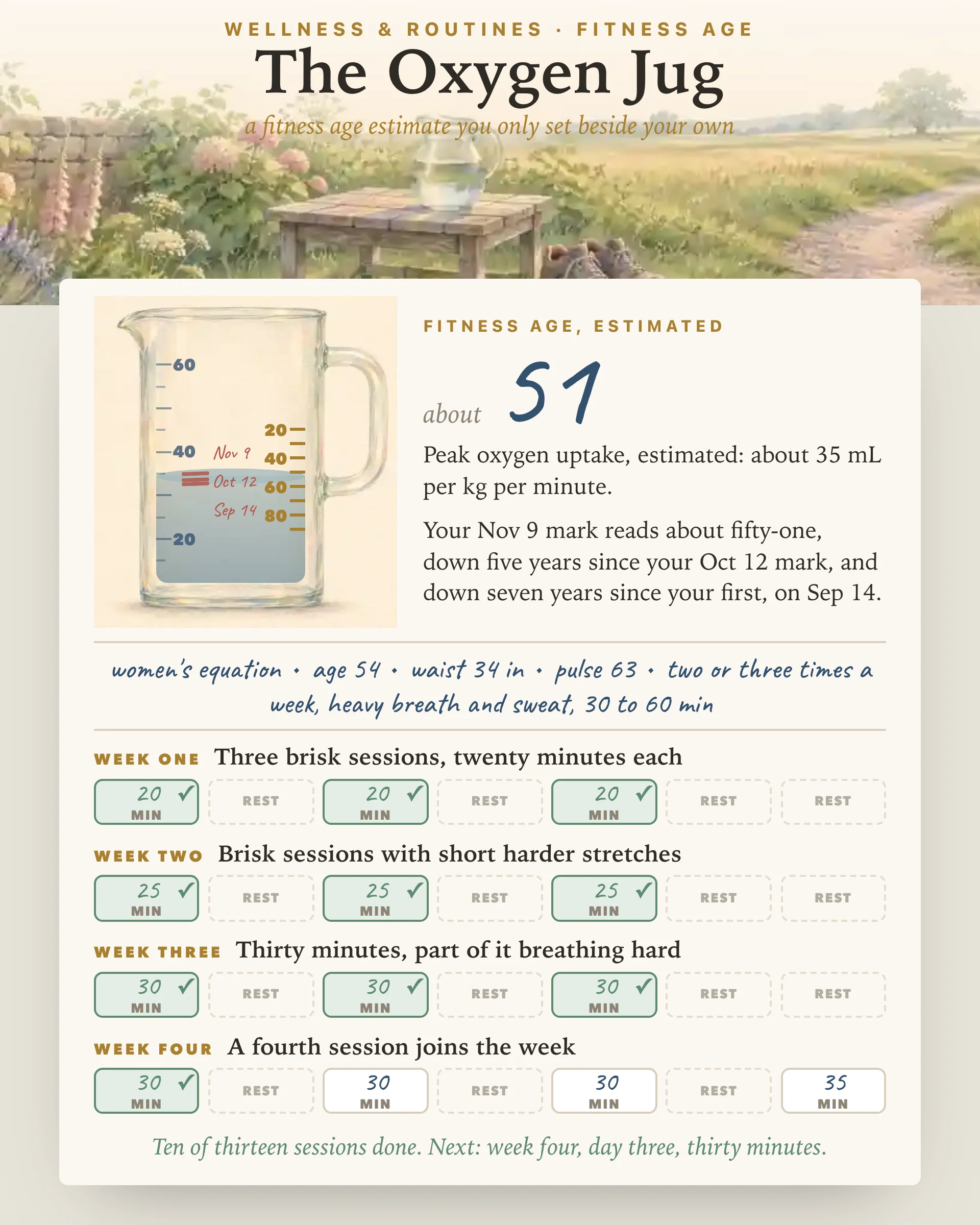
With every answer in, the jug fills. The scale on the left of the glass is the estimate in milliliters; the gold scale on the right is the study's average for each age, drawn for the equation you picked. Where the water meets the gold scale is your fitness age. Mark the level and it stays on the glass with its date. Each new mark is set only beside your own earlier ones, and the page names which answers moved it: your exercise, your pulse, your waist or another birthday.
Under the jug sits a four-week plan, from three brisk twenty-minute sessions up to four of half an hour or more, with short stretches that leave you breathing hard. It works on the one input that changes quickly. For timed fast and easy stretches, the Japanese Interval Walking Timer pairs well with weeks two to four.
The estimate is rough. Against a measured treadmill result, the typical miss was 5.7 points for men and 5.1 for women. On the age scale that is roughly fifteen years either way. The equations also ran high for the least fit people and low for the fittest.
Who was studied matters too. Everyone tested was an apparently healthy adult from one Norwegian county, a population the 2014 paper describes as almost all white. People with heart or lung disease, or taking blood pressure medicine, were left out. If a medicine slows your pulse, expect the estimate to read fitter than you are.
The 2014 paper followed about 37,000 adults for around 24 years and found that a higher estimate went with fewer deaths from heart and blood vessel disease, most clearly in people under 60. That is a pattern across a population, not a forecast for you, and the authors noted their method had never been tested for tracking change in one person. The label itself deserves care as well: in a 2021 experiment with young adults, seeing risk as a fitness age prompted weaker intentions to change habits than seeing it as a percentage or a heart age.
So use the number as a private yardstick. Answer the exercise questions for the habit you really keep, not the plan you began this week, because those answers move the estimate far faster than your heart and lungs change.
Take your first estimate on a calm morning, after five quiet minutes in a chair. Mark it, work through the four weeks, then come back every month or two. If you like repeatable checks, the thirty-second chair stand and the grip dial track leg and hand strength in the same you-against-you way.
Before you begin the plan, talk with a doctor or physical therapist if you have had a fall, dizziness or fainting, a joint replacement, a heart or blood pressure condition, chest pain when you exert yourself, or pain that has not settled. Stop and rest if anything hurts or your breathing feels wrong rather than simply hard.
It turns a few everyday answers into an estimate of your peak oxygen uptake, the most oxygen your body can use at full effort, and then states it as an age: the age at which an average healthy adult of your sex would have that same value. This one uses equations from researchers who measured thousands of adults in the HUNT Study in Norway.
An equation published by Bjarne Nes, Ulrik Wisløff and colleagues in 2011 estimates peak oxygen uptake from age, waist, resting heart rate and an activity score that multiplies how often, how hard and how long you exercise. Their 2014 paper gives the average value for each age, and the age where that average matches your estimate is your fitness age.
Treat it as a rough guide. In the original study the typical miss against a treadmill test was about five to six points of oxygen uptake, close to fifteen years on the age scale, and it ran high for the least fit people and low for the fittest. It was built on healthy Norwegian adults and was never checked for tracking one person over time.
The number moves when its inputs move. Exercise that leaves you breathing hard, two or three times a week for half an hour or more, changes the activity answers, and over months your resting pulse or waist may shift as well. Answer for the habit you actually keep, and read a change of a few years as noise.
No. It is an independent worksheet that applies the equations the researchers published in a peer-reviewed journal, and they did not build, review or endorse it.
By the team behind Fabulous, the science-based self-care app used by over 30 million people.


