Leaves on a StreamEmotional Fitness · ~3 min
About this template · Updated September 2026
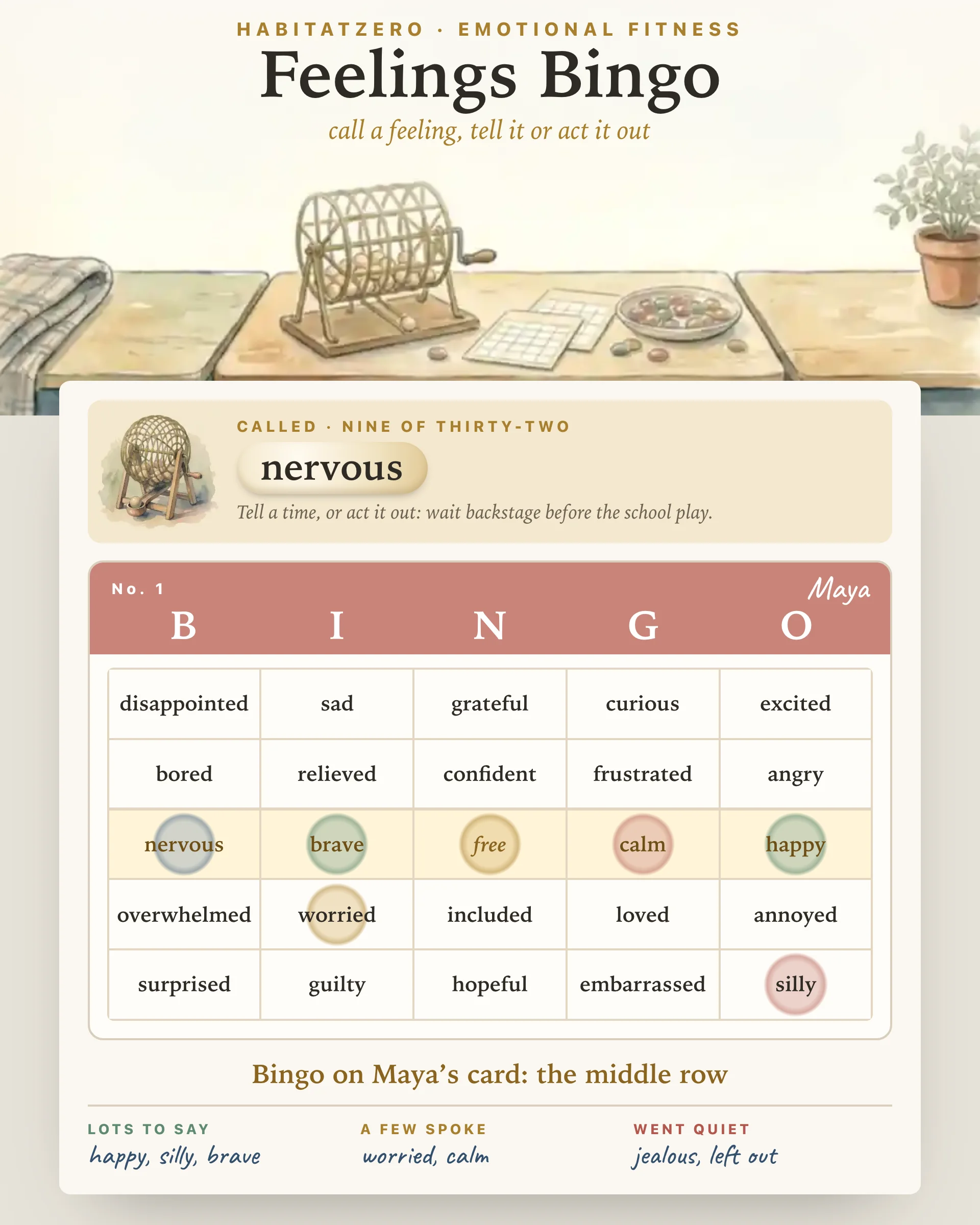
Bingo already does most of what a feelings lesson needs. Everyone listens for the next call, and the waiting is half the fun. Feelings bingo swaps the numbers for words like proud, nervous and left out, and adds one rule: a square gets marked only after the player tells about a time they felt it, or acts it out. One game becomes dozens of small, low-stakes turns at putting the right word to what is going on inside.
Every player gets a card of their own shuffle, so nobody gains anything by copying a neighbor. You call a feeling. Anyone holding it earns the mark by telling a real moment, such as the morning of a recital, or by showing the feeling with face and body. Passing is always allowed. The first player to complete a line, or the whole card if you choose, calls bingo.
The telling is the point. A child who says proud out loud with a story attached is rehearsing emotional vocabulary, and a child acting out frustrated at a stuck jar lid is rehearsing how that feeling looks. The listeners practice too: hearing that a classmate felt left out at recess is where a lot of empathy starts.
Younger players, roughly four to seven, get three-by-three cards drawn from twelve everyday feelings: happy, sad, mad, scared, excited, calm, silly, proud, surprised, worried, frustrated and shy. Lines fill quickly, so several games fit into one sitting.
Older players, roughly eight to twelve, get five-by-five cards with a free center, drawn from thirty-two feelings. Fourteen are comfortable ones like grateful, relieved and included; eighteen are harder, from jealous and embarrassed to guilty and overwhelmed. A line takes longer to finish, so the harder feelings usually come up before anyone wins.
Pick the players, slide to the number of cards, from two up to thirty, and deal. Each deal comes from one saved shuffle, so the cards you print are exactly the cards on the screen, and next week's game can reuse the same set. The print has two cards to a page, with calling slips at the back if you would rather pull feelings from a hat.
Each call turns out a feeling nobody has heard yet, with a short scene for anyone who would rather act than tell. Called feelings stay lit on the board, so the list is never in dispute. On screen, tap a square to lay a chip on it; an uncalled square stays open, and lifting a chip takes two taps. When a player calls bingo, open their card by number and the page tells you whether every square in their line has really been called.
The part a printed sheet cannot do comes after each call. Tap how the feeling landed: lots to say, a few spoke, or went quiet. Once three feelings have a read, the page sorts them into what came easily and what did not, and it keeps that record across games. Over a few weeks you might notice that jealous has gone quiet three games running while silly always draws a crowd.
Knowing your own feelings is a named building block of social and emotional learning. CASEL's framework lists identifying one's emotions under self-awareness, and showing concern for the feelings of others under social awareness. School programs that teach these skills have a solid record: a meta-analysis of 213 of them, covering more than 270,000 students from kindergarten through high school, found better social and emotional skills, behavior and academic performance than in comparison groups. Naming feelings early also seems to matter. In a small study of 72 children from low-income families, the ability to recognize and label emotion expressions at age five predicted social behavior and academic competence at age nine, even after accounting for verbal ability and temperament.
None of that research tested bingo. A game is one friendly way to give children frequent practice with feeling words; it is not a curriculum, an assessment or a screening tool. The easy-or-quiet record describes one group on one day, shaped by who was tired, who was new and who was sitting next to whom. Treat it as a hint about which words need more airtime, never as a judgment about any child.
Say before the first call that passing is fine and acting counts as much as telling. Keep stories short, and move on warmly if one turns heavy; if a child shares something that worries you, follow up privately after the game. For a feeling that keeps going quiet, try it outside the game on a calm day, with a picture book, a puppet or a story from your own week.
Once children can name a feeling, the next question is how big it is, and the Feelings Thermometer is built for exactly that. Older players who are ready for finer shades of meaning can explore the Feelings Wheel. And if your group liked a game with a purpose, the Gratitude Scavenger Hunt turns a walk or a classroom into a search for small good things.
It is bingo with feeling words in the squares instead of numbers. When a feeling is called, a player who has it marks the square only after telling about a time they felt that way or showing it with face and body, so every mark doubles as a small turn at naming an emotion.
Yes. Emotions bingo, emotion bingo and feelings bingo are three names for one classroom game. Some printable versions use drawn faces and others use words. This one uses words, printed larger on the younger cards, and every call arrives with a small scene a child can act out.
Deal up to thirty cards, print them two to a page, and hand one to each student. Call feelings from the screen and invite a story or an acted-out version from anyone holding that square. When someone calls bingo, open their card number to confirm that every square in the line has been called.
The younger cards are three by three, drawn from twelve everyday feelings such as happy, mad, shy and proud, which suits roughly ages four to seven. The older cards are five by five with a free center and thirty-two feelings, including jealous, left out and overwhelmed, for roughly ages eight to twelve.
You can look through a sample game on this page without an account. Personalizing it in HabitatZero, which costs nothing, saves your deal so printed cards keep matching the screen, and keeps the record of which feelings went quiet from one game to the next.
By the team behind Fabulous, the science-based self-care app used by over 30 million people.