The Overwhelm Recovery ProtocolWellness & Routines · ~5 min
About this template · Updated September 2026
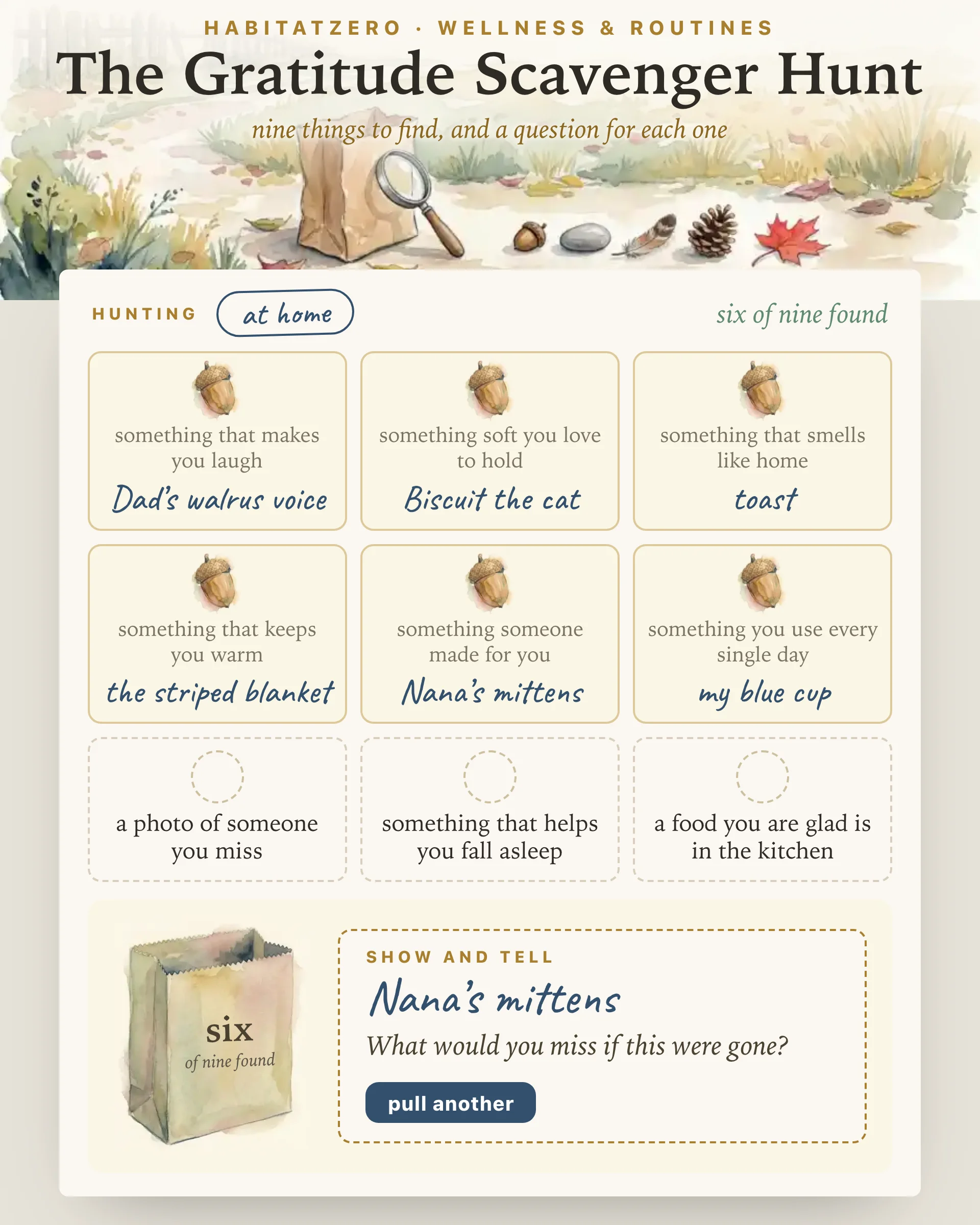
Ask a seven-year-old what they are thankful for and you will hear "my family" and "food", in the voice of someone reading out a bus timetable. The question is too big, and it lands while they are sitting still. A gratitude scavenger hunt shrinks the question and gets them on their feet. You hand over a card of small, findable things (something that smells like home, something someone made for you, a sound worth stopping for) and send them off to look. They come back with a blanket, a drawing, the dog on a lead. Then you talk about what they brought.
The game turns up in kitchens and classrooms every November, in the weeks before Thanksgiving, and it works just as well on an ordinary walk in March. This page is the card, the stamp and the collecting bag for it, written for you, the adult running things. The hunting belongs to the children.
Good clues are concrete. They point at the senses, at people, and at objects so familiar that nobody looks at them any more. "Something you are grateful for" is a poor clue, because it is the big question again in smaller print. "Something that keeps you warm" is a good one, because a child can walk over to it and pick it up.
The sheet carries four sets of fifteen clues: at home, outdoors, in the classroom, and around a holiday table. The table set is mostly about people, such as someone who cooked today, which suits the half hour before a big meal.
Choose where you are hunting and nine clues are dealt onto the card. Deal six for small children, or twelve when you have a whole afternoon. Take off anything that does not fit your house, pull a spare from the pile, or write a clue of your own; most families have a "something Grandpa built". The card stops at twelve clues and will not drop below three.
When a hunter comes back with a find, tap its clue. A painted acorn lands on the tile, and you can jot a word or two for what turned up. Each find lines up beside the paper bag, whose label keeps count.
The piece a printed list cannot manage comes last. Under the bag sits show and tell. Pull a find and the sheet hands back one thing from the bag together with one question to ask about it: what made you choose this one, who helped it be part of your life, what would you miss if it were gone. Every find gets a turn before any comes round twice, and each finished card adds to a running count of full bags.
Nobody has run a trial of scavenger hunts; the research is on the ingredients.
Andrea Hussong and her colleagues describe children's gratitude in four parts: becoming aware of what you have received, thinking about why it came to you, feeling glad about it, and doing something to show it. In a week-long diary study of roughly a hundred parents with children aged six to nine, parents reported more gratitude from their children on days when they themselves had done more than usual to draw it out: showing thanks in front of them, talking over what the child had been given, picking activities with gratitude in mind. Those reports came from the parents and the design cannot prove cause, yet it points at the talking as the useful part. That is why the questions under the bag exist: finding the blanket covers the noticing, and the conversation afterwards covers the other three.
With older children the picture is mixed. In an experiment across eleven classes of early adolescents, the classes assigned to count their blessings reported more optimism and life satisfaction than the comparison classes. But when a later review pooled twenty studies of young people, it judged gratitude programs, taken as a whole, to be generally ineffective and asked for better trials.
One hunt will not install a character trait. It buys twenty pleasant minutes of practice at noticing, and an opening for a conversation that is hard to start cold.
Resist grading the finds. A child who brings the TV remote for "something you use every single day" has answered correctly. Answer a question yourself now and then, too: showing thanks where the children could see it was one of the behaviors that diary study counted.
If a find deserves keeping past the day, write it on a slip for The Gratitude Jar. Older children who have outgrown carrying a bag often do better drawing from the Gratitude Prompts Deck. And if the outdoor set sends you all into the leaves, The Fall Bucket List holds the rest of the season's plans.
It is a finding game in which every clue points at something worth appreciating, such as a thing that keeps you warm or a person who helped you this week. Children search for a match to each clue, then tell the group why they picked it.
Clues a child can physically walk to tend to land best: something soft you love to hold, a sound worth stopping for, something a relative made for you, a classmate who made you smile. This card draws from fifteen clues apiece for home, outdoors, the classroom and a holiday table.
Yes, with less running about. Pick the table clues, which are mostly about the people in the room, let everyone name their finds from their chairs, and spend the time on the show and tell questions.
At Thanksgiving, start it while the cooking finishes and hold show and tell once everyone sits down. With a class, put a single card on the board, send pupils off in pairs, then close the lesson by pulling a handful of finds for the whole room to hear.
Anyone can look over the sample hunt on this page to see the acorns, the bag and the questions in action. Dealing a card of your own and holding on to the finds is done in HabitatZero, and that costs nothing.
By the team behind Fabulous, the science-based self-care app used by over 30 million people.