
Leaves on a StreamEmotional Fitness · ~3 min
About this template · Updated September 2026
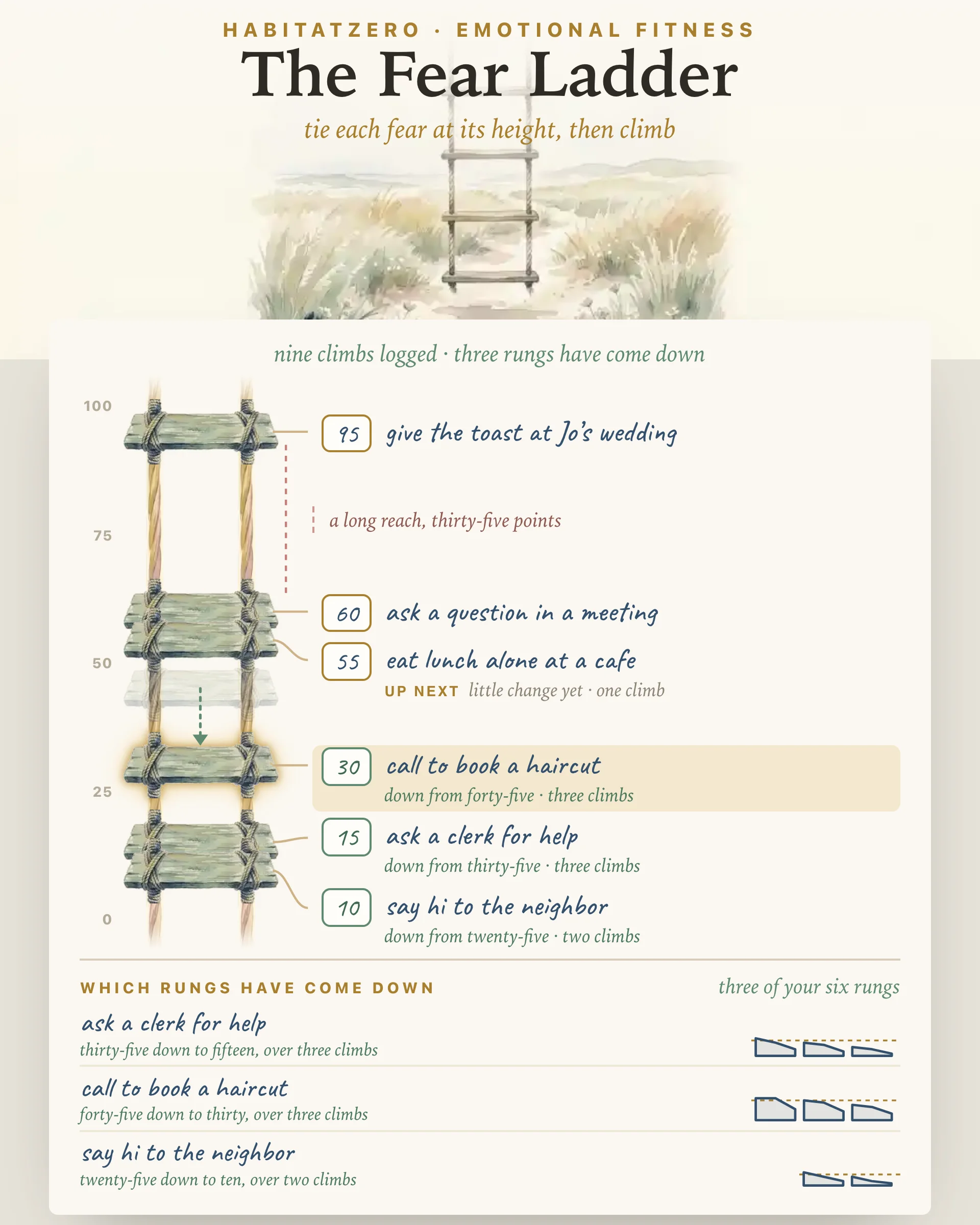
A fear ladder is a plan for facing something you have been avoiding, one small step at a time. Therapists also call it an exposure hierarchy or a fear hierarchy: a short list of situations tied to one fear, ranked from the one that barely makes you flinch to the one you cannot picture doing yet. You start on the bottom rung, climb it until it shrinks, and only then reach for the next.
Avoidance feels like relief, and that is the trap. Every time you cross the street to miss a dog or let a call go to voicemail, the fear gets a little more convincing, because you never find out what would have happened. Exposure turns that around: you go toward the thing on purpose, in doses you can manage, and see for yourself.
A meta-analysis of thirty-three randomized studies on specific phobias found that exposure-based treatment beat no treatment by a wide margin and also outperformed placebo and other kinds of therapy, with more sessions linked to better results. A review of cognitive-behavioral therapy for anxiety disorders names exposure as one of the two methods therapists use most and concludes that the approach helps with conditions ranging from social anxiety to panic disorder, OCD and PTSD.
Begin with what you want to be able to do. That is your top rung: give the toast, drive the highway to see your mom, let a friend's dog rest its head on your knee. Then shrink it. Change one thing at a time, such as how close you get, how long you stay, whether someone comes along, or how busy the place is. Eight to ten rungs is plenty.
Rate each rung from zero to a hundred for how much fear it would stir, on the same ruler as The SUDS Scale, where zero is complete calm and a hundred is the worst you can imagine. The numbers do not need to be precise. What matters is the order and the spacing. If you are not sure which situations belong on the ladder at all, The Road From a Trigger can help you trace what sets the fear off first.
Pick the lowest rung that still asks something of you and do it for real. Stay long enough to notice what actually happens instead of leaving the moment the fear spikes. Then climb that same rung again, a few times a week if you can. Expect several climbs before it feels smaller.
A 2014 paper on getting more out of exposure therapy suggests testing the specific outcome you dread, varying the practice and the places you do it, and dropping safety signals, the things that make a situation feel safer, such as a water bottle in hand or one eye on the exit.
Never force a rung that is too high. If a step leaves you flooded, go back down a rung or split it into two smaller ones. That is the method doing its job. A step that throws you far outside The Window of Tolerance is too big for today, and the ladder will still be there tomorrow.
Unlike a printed fear ladder worksheet, this one hangs from rope, and each rung is tied at the height of its rating, so the gaps show at a glance. When two neighboring rungs sit thirty points or more apart, the page marks a long reach and offers to set a new rung halfway, because big jumps are where climbs tend to stall.
After each climb, you set three numbers: where the fear stood just before you began, how high it peaked, and where it was at the end. The rung then moves to the height of its latest peak, with a faint mark where it started. Below the ladder, a short reading names the rungs that have come down since you first rated them and counts the climbs that peaked under your rating. The ladder holds ten rungs, and each keeps its last eight climbs.
A drop inside a single climb is not the goal. A review of exposure research found that neither how far fear falls during a session nor how low it ends predicts how well people do afterward. That is why this page moves a rung by its peak across climbs instead of grading the end of any one attempt. A rung that comes down over a week or two of practice is an encouraging sign, not proof, and a stubborn rung does not mean you are doing it wrong.
A fear ladder suits a specific, bounded fear: driving, heights, dogs, speaking up at work, crowded stores. For panic attacks, OCD, PTSD, or anxiety that shapes most of your days, do this work with a therapist trained in exposure. Exposure and response prevention for OCD and prolonged exposure for PTSD are specialized forms of the same idea, and a good clinician will help you pace the rungs and spot the quiet ways avoidance slips back in.
It is a ranked plan for facing one fear: eight to ten situations, from mildly uncomfortable up to the goal you most want back, each rated from zero to a hundred. Therapists call the same list an exposure hierarchy or a fear hierarchy. You work up from the bottom, so each step stretches you without swamping you.
For a fear of driving, the rungs might run from sitting in the parked car with the engine on, to a loop around the block, to back roads at a quiet hour, up to one exit on the highway. For speaking up, they could start with saying hi to a neighbor and end with giving a toast. Change one thing per rung: distance, time, company or how busy the place is.
For a mild, specific fear such as dogs, heights or making phone calls, many people climb a ladder by themselves. For panic attacks, OCD, PTSD or anxiety that shapes most of your days, work with a therapist trained in exposure, who can pace the rungs and notice the quiet ways avoidance creeps back.
Move up once the rung you are on feels clearly smaller than when you first rated it, which usually takes several climbs. It does not need to reach zero. Going back down a rung on a heavy week is part of the method, and so is splitting a step that turns out to be too high.
The ladder on this page is a worked example you can study. Tying on your own rungs and keeping the log of every climb happens in HabitatZero, where the template is free to set up.
By the team behind Fabulous, the science-based self-care app used by over 30 million people.


