
The Overwhelm Recovery ProtocolWellness & Routines · ~5 min
About this template · Updated November 2026
Most people who search for exercise for cellulite hope for a routine that smooths the backs of their thighs. The honest answer is that no routine does. Cellulite is normal, it shows up on most adult women whatever their size, and squats will not erase it. Strong legs are still worth building, for what they let you do, and that is what this page is for.
Under the skin of the thighs and hips, fat sits in small pockets divided by thin bands of connective tissue that run straight up and tie the skin down. Where a band tugs, the surface dips; the fat on either side bulges a little. A Brazilian team scanned thirty women with cellulite on the buttocks and compared a dimpled patch with a smooth one on the other side: in twenty-nine of the thirty dimpled patches a band of this tissue sat beneath, and the bands there were far thicker than under smooth skin.
A review by dermatology researchers in Texas puts it on eighty to ninety percent of women after puberty, across every race. The same review says it is not the result of a higher body mass index and that diet, exercise and lifestyle do not appear to be linked to whether it develops, though gaining weight can make what is there easier to see. It is a feature of how most female bodies are built, not a flaw to fix.
The bands that make the dimples are not muscle, and nothing shows that lifting loosens them. The US physical activity guidelines put it plainly: the effects of muscle-strengthening work are limited to the muscles doing the work. A lunge makes the thigh muscles stronger; no study shows it changing the tissue between the fat and the skin.
The treatments sold for cellulite do not do much better. A systematic review of sixty-seven treatment studies by researchers in Germany and New York found that most had serious design flaws and that no treatment showed clear evidence of working well. It looked at products and procedures rather than exercise, but it is reason enough to doubt any promise of smooth skin in fourteen days.
The same guidelines ask every adult to do muscle-strengthening work on two or more days a week, and they note that small, gradual increases help the body adapt while keeping the risk of injury down. Stronger legs carry you up stairs, lift you off the floor and haul the groceries in. None of that depends on how your skin looks.
The plan runs six weeks, three sessions a week, thirty minutes each: a five-minute warm-up, twenty-one minutes for two rounds of eight moves with a short rest after every set, and a four-minute stretch. Each of the eight moves has an easier version and a full one, and every standing move has a chair, a stair rail, a wall or a counter within reach.
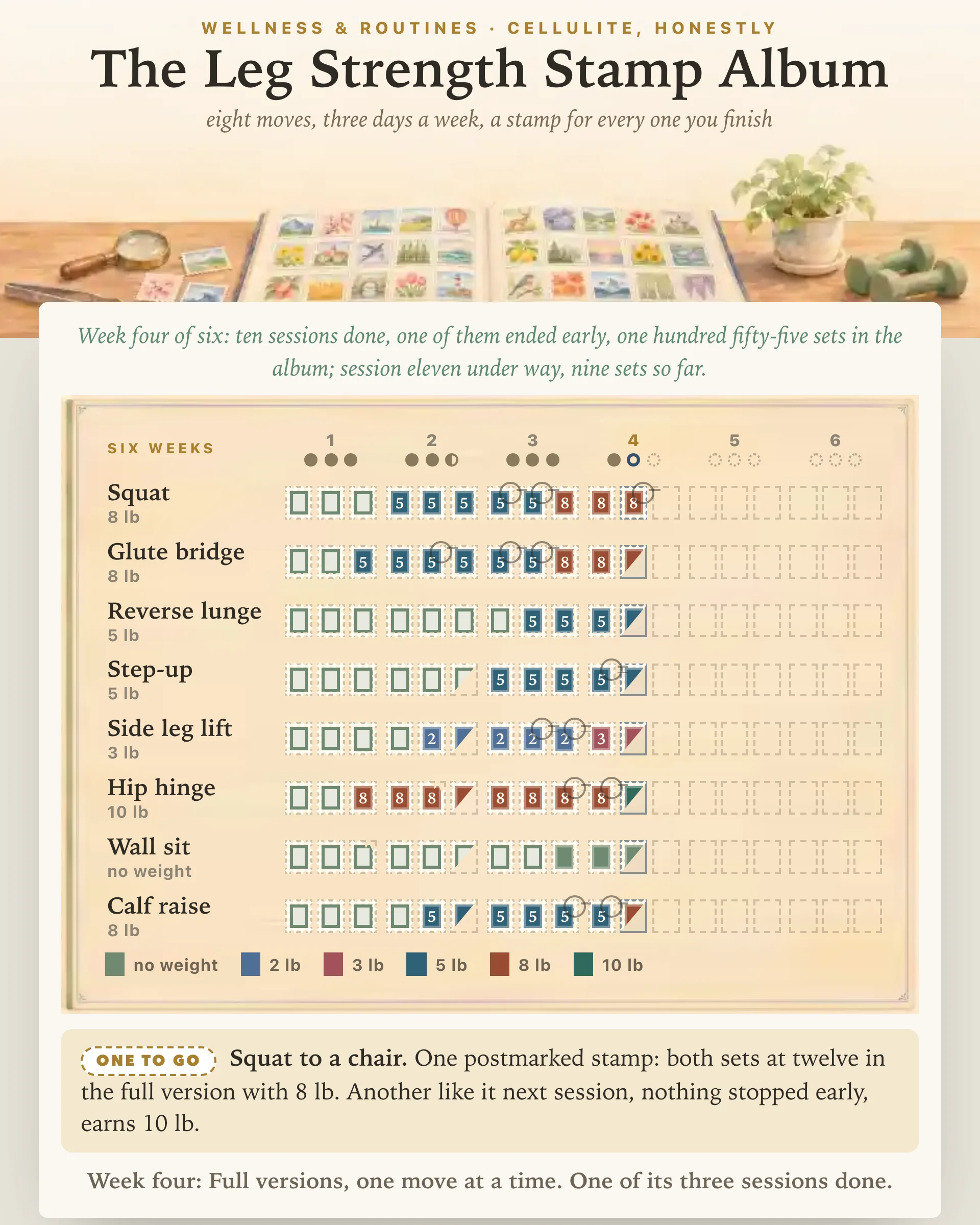
The tracker is a stamp album. Each move has a row, and each session has a column. Your first set prints half a stamp, your second completes it, and its ink and numeral show the weight you lifted, so the rows change color as your weights climb. A move done its easier way prints in outline, and a set stopped early leaves a torn corner. When both sets reach the top of the range in the full version, the stamp gets a postmark.
Two postmarked stamps side by side at the same weight mean that move is ready for the next weight up. A session the move missed, a set stopped early or an easier-version stamp breaks the pair. Two sessions in a row with a set stopped early or short of the range suggest easing off instead. The wall sit runs on a hold clock: you pick an aim, get three seconds to settle, and only the whole seconds you hold go in. The rest dial reads the real time, so a locked phone still rests you honestly.
The album records what you did and what you lifted, and nothing else. It never asks for a measurement, a photo, your weight or anything about your skin.
The Balloon Glute Workout works the glutes alone over a chair day and a stair day, the Tuning Fork Inner Thigh Workout works the inner thighs, and the Strength Doorframe is a twelve-week plan for the whole body. This album covers the whole lower body in six weeks, with the cellulite question answered first.
The scan study was small, looked only at the buttocks and shows where the bands sit, not why they thicken. The Texas review is a narrative review, not a trial, and it makes the case for one procedure. None of these studies shows an exercise plan changing how skin looks, and this page makes no such claim.
Check with a doctor or physical therapist before you begin if you are pregnant or had a baby in the past year, have a heart or blood pressure condition, have had a recent injury or surgery, or have pain in a knee, a hip or your back. Stop any move that hurts.
No exercise has been shown to remove it. The dimpling comes from fat pressing up between bands of connective tissue that tie the skin down, and squats or lunges do not undo those bands. What strength work does build is the muscle beneath, which is worth having for its own sake.
Yes. Dermatology reviews find it on eighty to ninety percent of women after puberty, across every race, and one review notes it is not caused by a higher body mass index, though gaining weight can make it easier to see. It is an ordinary feature of skin, not a sign that something is wrong with you.
Eight lower-body moves: a squat to a chair, a glute bridge, a reverse lunge, a step-up, a side-lying leg lift, a hip hinge with dumbbells, a wall sit and a calf raise. Each comes in an easier and a full version, and the standing ones lean on a chair, a stair rail, a wall or a counter.
Heavy enough that the last two reps of a set take real effort, light enough that your form holds. Plenty of people begin with no weight at all. A backpack with books or a jug of water works as well as a dumbbell, so step to the nearest weight on the page and log that.
Anyone who is pregnant or gave birth in the past year, or who has a heart or blood pressure condition, a recent injury or surgery, or pain in a knee, a hip or the back. Stop any move that hurts, and ask a physical therapist about pain that keeps coming back.
By the team behind Fabulous, the science-based self-care app used by over 30 million people.


