
Leaves on a StreamEmotional Fitness · ~3 min
About this template · Updated September 2026
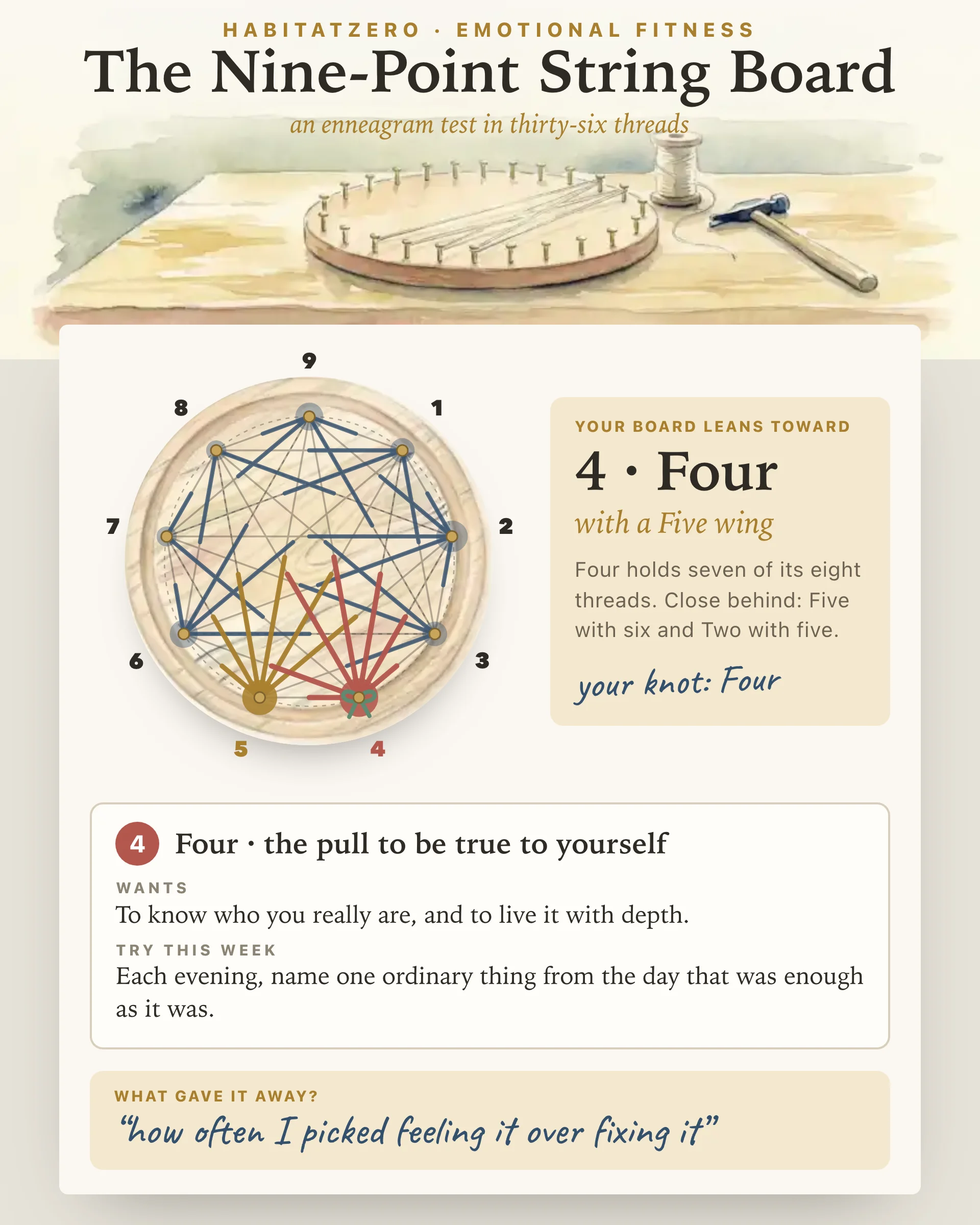
Credit first. The Enneagram of personality goes back to Oscar Ichazo, the Bolivian-born teacher who, by the account of The Enneagram Institute, originally put the system together, and to the Chilean psychiatrist Claudio Naranjo, who went to Arica, Chile, in 1970 to study with Ichazo and later taught his own version of the types. Don Riso and Russ Hudson spread it to a wide audience through their books and through The Enneagram Institute, which they founded in 1997. Their Riso-Hudson Enneagram Type Indicator, the RHETI, is a trademarked test built from 144 paired statements. This string board is an independent tool with no tie to the Institute, to Ichazo's or Naranjo's schools, or to any other Enneagram teacher, and none of its thirty-six pairs was taken from the RHETI or from any published questionnaire.
The Enneagram arranges nine personality types around a circle, numbered clockwise with Nine at the top. Each number names a pull: toward getting things right, being needed, doing well, being true to yourself, understanding, feeling secure, keeping life open, staying strong, or keeping the peace. Everyone is said to carry all nine, with one pull tending to steer.
This test works like a round robin. Nine points can be paired in exactly thirty-six ways, so the board asks thirty-six questions and every point meets every other point once. Each question is a small everyday scene with two reactions, one from each point in the pair: a free Saturday, a friend having a hard week, a new boss on Monday. You tap the reaction that sounds more like you. Neither will fit perfectly, and that is the point of a forced choice. You are telling the board which of two pulls wins when they compete.
Each answer strings a thread between the two points it weighed. While you answer, the threads stay pale, so the tally cannot nudge your later choices. When the last one goes on, the end you chose on every thread lights up. A point that won all eight of its meetings sits at the center of a bright fan; a point that lost every meeting has none. You can read the whole result off the wood.
The point holding the most threads is where your answers lean. If two points tie, the board looks at the one thread they share, the pair where they met head to head, and whichever you chose there takes the lead. If three or more tie in a circle, the board says so and shows them all rather than inventing a winner.
The wing comes from the two points beside your lead on the circle. A Four sits between Three and Five, so whichever of those holds more threads reads as its wing. Below the lean, the board names the two points close behind and describes all three in plain words: what the pull wants, what it guards against, how it looks at its best, what happens when it takes over, and one small thing to try this week.
Then comes the step no quiz can do for you. Read the three closest descriptions and tie your own knot on the one that fits from the inside, the one whose fear stings a little when you read it. Your knot can land on a point your answers placed fourth. The board treats your call as worth more than its count. If you rushed a pair, open the list of answers and change it. The threads, the lean and the wing all move with you.
A 2021 systematic review of 104 independent samples found mixed evidence for the Enneagram's reliability and validity. On the encouraging side, its scales relate to established traits like the Big Five in the ways the theory predicts, and several studies found it helpful for personal and spiritual growth. On the other side, statistical analyses usually recover fewer than nine distinct factors, no study has derived the nine types by clustering people, and there is little research behind secondary ideas such as wings or movement between types. So treat the board as a lens for reflection, not a measurement.
The format matters too. When every question forces one line over another, one point's gain is always another point's loss. That makes the board good at ranking your pulls against each other and poor at saying how strong any single pull is. Two people can both lean toward Four for very different reasons. If you want a measure built on decades of trait research, the Big Five Personality Test scores five traits on their own scales.
Pick an unremarkable week for it, and answer as the person you usually are rather than the one you are aiming to be. It works well as a conversation starter: string the board, then ask someone who knows you where they would tie your knot. The Johari Window gives that kind of outside view a structure of its own, and the Temperament Quiz offers an older, lighter lens if you enjoy comparing frames. Come back after a few months or a hard season and string a fresh board. If the lean holds, it may be telling you something. If it moves, that is worth noticing too.
Treat any result as a starting point rather than a verdict. A 2021 review of 104 samples found mixed evidence for the reliability and validity of the Enneagram. Because every item on this board is a forced choice, the counts rank the nine points against each other instead of measuring how much of each you have, so read the closest few descriptions and judge which motivation rings true.
A wing is one of the two numbers beside your main type on the circle, said to color how that type shows up. A Four, for example, can lean toward a Three wing or a Five wing. The board picks the neighbor holding more threads and settles a tie by the pair where those two met. Research has found little support for wings, so read yours as a hint.
Each number names a pull. One is drawn toward getting things right, Two toward being needed, Three toward doing well, Four toward being true to yourself, Five toward understanding, Six toward security, Seven toward keeping life open, Eight toward staying strong and Nine toward peace. Nicknames differ from teacher to teacher, which is why this page leads with the numbers.
No. The RHETI is a trademarked test of 144 paired statements created by Don Riso and Russ Hudson of The Enneagram Institute. This string board has no connection to them or to any Enneagram school, and its thirty-six pairs were written from scratch for this page.
What you see here is a sample board already strung. To answer the thirty-six pairs yourself and keep your knot for later, personalize the board in HabitatZero, which costs nothing.
By the team behind Fabulous, the science-based self-care app used by over 30 million people.


