Leaves on a StreamEmotional Fitness · ~3 min
About this template · Updated September 2026
Every statement on this page comes from the International Personality Item Pool, a public-domain bank of personality items whose website opened in 1998 on an NIMH grant awarded to Lewis R. Goldberg, who wrote most of its items and looked after the site until his death in March 2026. The fifty used here are the IPIP version of the markers he described in The development of markers for the Big-Five factor structure, kept in the IPIP order and scoring, with "I" added to the front of each. This worksheet is an independent build: neither the IPIP nor anyone connected with it made, checked or endorsed it.
Goldberg's markers come from the lexical tradition, which looks for personality in the words everyday language already uses to describe people, and the IPIP keeps his names for the five factors:
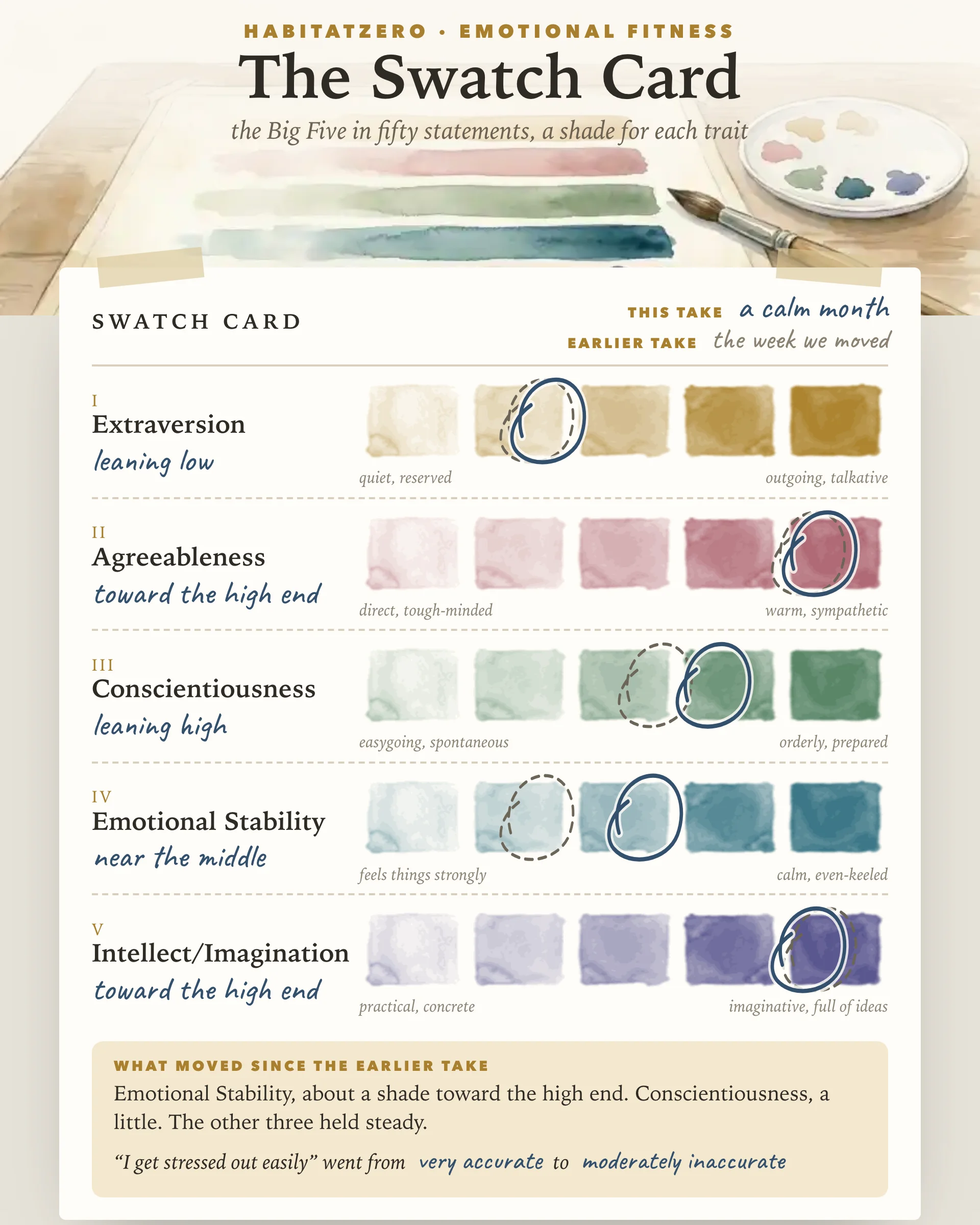
Each of the five is a continuum rather than a club you belong to, and the card paints where you sit along it.
You rate fifty statements one at a time, from very inaccurate to very accurate, as descriptions of you as you generally are now. The statements rotate through the five traits and switch direction as they go, so "I keep in the background" arrives right after "I have a vivid imagination" and pulls the opposite way from "I start conversations." The IPIP suggests that mix because it keeps people reading each statement instead of settling into one answer.
Every answer adds pigment to its trait's strip. Once a trait's ten statements are in, the card totals them the IPIP way, flipping the reversed ones, for a number between ten and fifty. A hand-drawn circle marks that total on the strip, and a short phrase names its stretch, from toward the low end to toward the high end.
The reading underneath is built from your own answers: for each trait it quotes the statements that pulled hardest each way beside what you said, notes when a trait pulled both ways, and flags a long run of one answer. Jot a few words about the week in the note line. Start a new take later and your earlier circles return dashed beside the new ones, with the traits that moved and the statement that changed most.
A shade is a place on this test's own scale, not a percentile. The IPIP deliberately publishes no norms, so there is no honest way to turn your total into a rank against other people, and its guidance on interpreting individual scores recommends showing people where they fall on the full continuum instead of telling them what type they are. That is why the card circles a spot and never stamps a label on you.
Two things follow. A middle shade means your answers were mixed, not that you are average next to everyone else. And some statements are easier to agree with than others, so notice where you wanted to sound tidy or kind, and ask whether a close friend would answer the same way for you.
The ten-statement scales hang together well: the IPIP reports internal consistency between .79 and .87 for these five. Still, the card holds one sitting's self-description, and a draining week can darken the stress statements while a new job sharpens the tidy ones, which is what the note line records.
Traits drift over years as well. A meta-analysis of ninety-two longitudinal samples found that people on average grow more conscientious and more emotionally stable, mostly between the ages of twenty and forty, while openness tends to rise in adolescence and dip again in old age. A card you filled in years ago describes who you were then.
None of this is a diagnosis or a judgment of your worth. Keep the card for your own reflection rather than for sizing up a partner or a job candidate. If the statements about feeling blue fit because the last few weeks have been heavy, set the card aside and talk it over with someone you trust or a doctor.
Take it on an ordinary week, not in the middle of a crisis or a celebration, and write a line about what the week held. Come back a few weeks later for a second take and see which shades stayed put.
If Extraversion is the strip you most want to understand, The Seesaw looks at it through fifteen everyday moments. Because this card only knows what you say about yourself, The Johari Window adds the words someone who knows you would pick. And where the swatch card describes how you tend to act, the Values Quiz asks which values you want your days to serve.
It is a questionnaire that places you on the five broad factors personality psychologists call the Big Five. This one uses the fifty public-domain IPIP statements that mark Lewis Goldberg's five factors, scored the way the IPIP publishes them, and it describes where you sit on each trait as a range in words rather than handing you a type.
Extraversion, agreeableness, conscientiousness, emotional stability, and a fifth factor the IPIP calls intellect or imagination. Tests built on the OCEAN names call the fifth one openness to experience and score the fourth from its other end as neuroticism. Every one of the five is a continuum, so the useful question is how far along it your answers sit.
For these five ten-statement scales the IPIP reports internal consistency between .79 and .87, which is solid for a short measure. It is still a self-portrait from one sitting, and a stressful week or a bright mood can nudge a strip. Treat each shade as a sketch, then take the quiz again a few weeks later to see which parts hold.
No. The traits are continuous, and the International Personality Item Pool advises against sorting people into categories from their scores. This page circles where your answers land on each strip and describes that spot in words, so two people just either side of the middle are never put in opposite boxes.
The finished example card on this page is open to anyone. Answering the fifty statements yourself, keeping a note about the week and laying a second take over the first all happen in HabitatZero, where the test is free to take.
By the team behind Fabulous, the science-based self-care app used by over 30 million people.