Leaves on a StreamEmotional Fitness · ~3 min
About this template · Updated July 2026
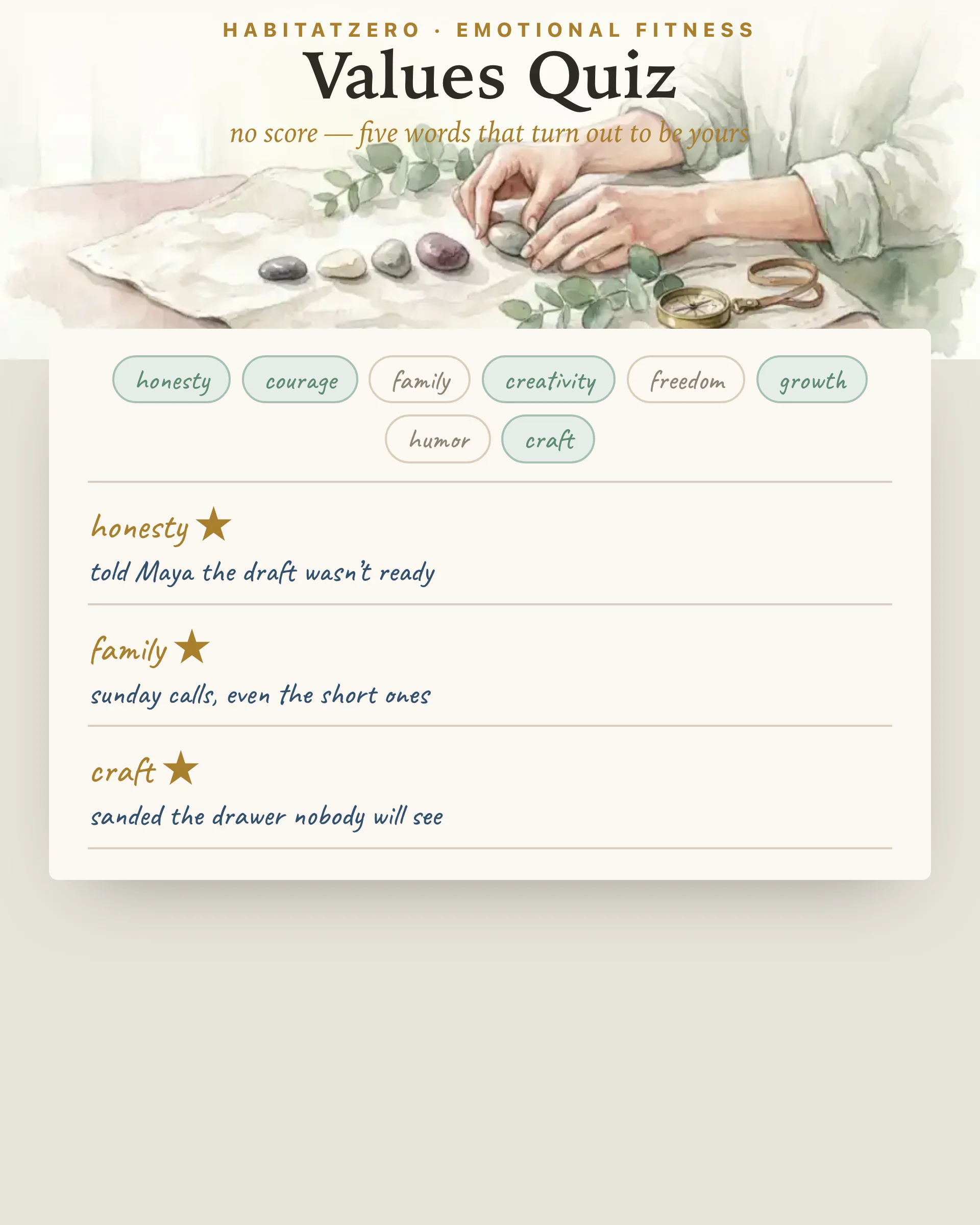
Most values quizzes end by handing you a label. This one ends by handing you a mirror: five words in your own handwriting, each with a line about where it showed up in your actual month. No archetype, no percentile, nothing to screenshot and forget — because the useful output of a values exercise isn't a result, it's a shorter argument with yourself the next time two good options collide.
The quiz opens with a bank of twenty-four words and asks you to take anything that tugs. That permissiveness is deliberate. Cross-cultural work on the structure of human values suggests people everywhere recognize largely the same pool — achievement, benevolence, security, self-direction and their kin — and differ mainly in how they rank it. So the first pass isn't discovering exotic values you've never met; it's laying the familiar ones on the table so the ranking can begin honestly. Skipping straight to "pick your top five" invites you to pick the five that sound best at dinner parties.
You hold five stars. The sixth is refused until you take one back. That small mechanical cruelty is where the actual information gets produced: family against ambition, freedom against belonging, craft against adventure. A list of ten values never has to resolve those collisions, which is why ten-value lists change nothing. The word that keeps its star through three reluctant trades is telling you something no rating scale can.
The last station asks for one line per starred word: where did it actually show up this month? Not where it should show up — where it did. This is the honesty check, and it's also where the exercise starts paying rent. Research on self-concordant goals finds that aims aligned with what a person genuinely values are pursued with more sustained effort and yield more well-being when reached than aims adopted for outside reasons. The sighting lines are how you find out which of your five are load-bearing and which are aspirational décor — and an aspirational value isn't a failure, it's next month's assignment.
Keep the finished sheet. When a fork appears — the job, the move, the awkward conversation — read your five words before your pro-and-con list. Forks look different from up there.
Because values aren't graded, they're chosen. Instead of rating statements and receiving a type, you gather the words that pull at you, then face the real test: keeping only five. The forced trade-offs reveal more than any score, and the final step - writing where each value showed up recently - checks the answer against your actual life.
The handful of things you keep choosing when choices conflict - the reasons behind your hardest decisions rather than the decorations on your easiest ones. Research on universal values finds people everywhere draw from a shared pool but rank it very differently; the ranking is what makes yours yours.
Ten values is a mood board; five is a decision-making tool. The limit forces the collisions - family against ambition, freedom against security - and what survives those collisions is what you actually navigate by. If starring the fifth word hurt a little, the quiz worked.
Point decisions at them. Goals that line up with what genuinely matters to you are pursued with more persistence and less friction than goals adopted from outside - so when the next fork appears, read your five words first and notice which option serves more of them.
The worksheet starts from a full deck and cuts cards away in rounds - subtraction until essence remains. This quiz builds upward instead: gather freely, star five, then prove each with a real sighting. Same destination, opposite road; some people need the knife, others the net.
By the team behind Fabulous, the science-based self-care app used by over 30 million people.