
Leaves on a StreamEmotional Fitness · ~3 min
About this template · Updated September 2026
The idea at the center of this page is borrowed, so the credit comes first. Psychologist Mark H. Davis built the Interpersonal Reactivity Index on the premise that empathy is a set of related but separate tendencies rather than a single trait, and he measured four of them apart: perspective taking, empathic concern, personal distress and fantasy. The Empathy Prism takes only that starting point. Its eight moments were written for this page, none of the index's statements appear in it, it has never been validated as a measure, and neither Davis nor Eckerd College is connected to it or has endorsed it.
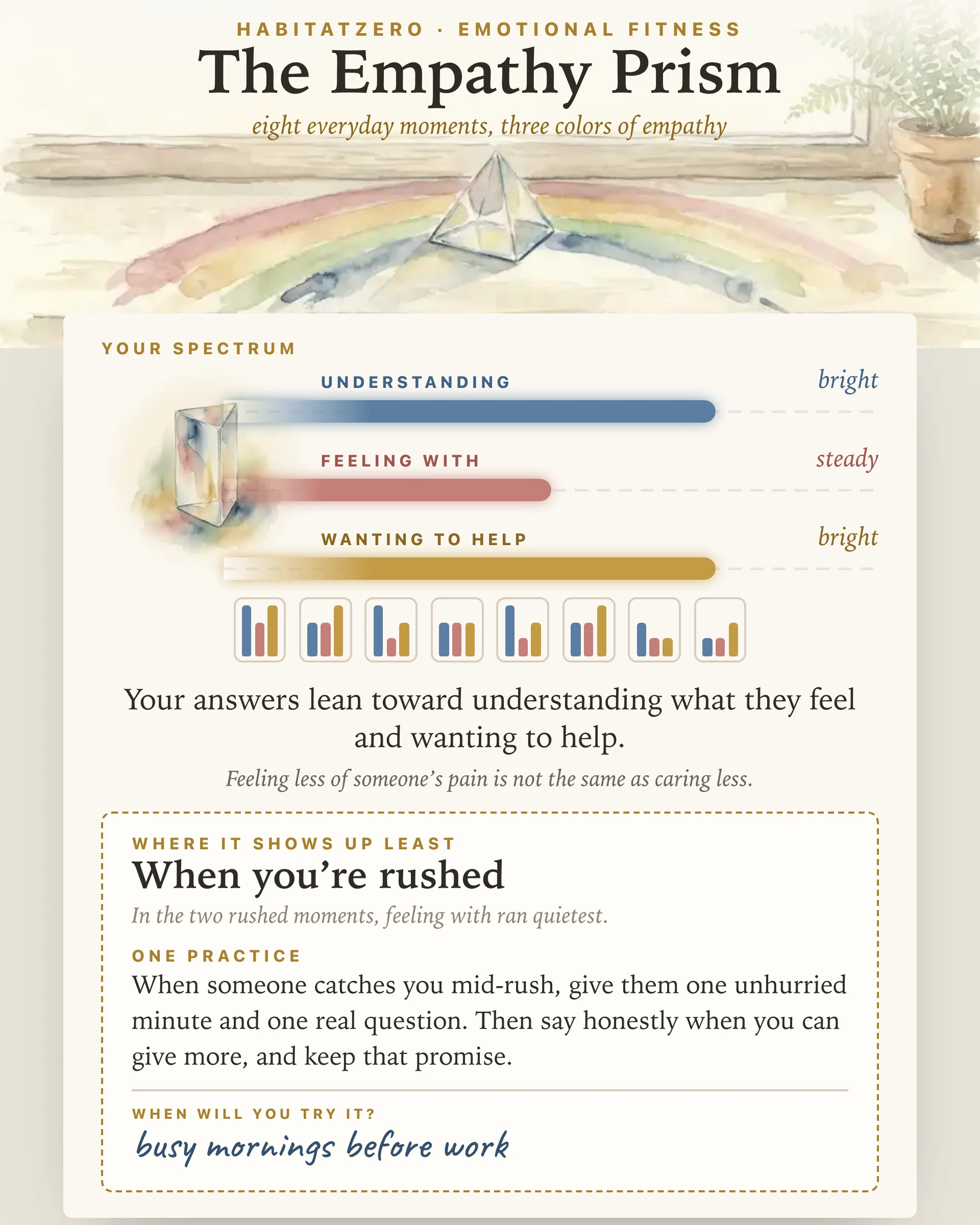
Most empathy quizzes add every answer into one score, which hides the most interesting part. This one splits each moment three ways.
The first two are named as different capacities in the research itself. Tania Singer and Olga Klimecki's short overview separates inferring what is on another person's mind from sharing what they feel, and gives each its own vocabulary. The third can drift from both. You can read a coworker's embarrassment perfectly and feel very little, or carry a stranger's sadness for three stops and never think to pass a tissue across the aisle. One total would average those differences away. Three beams keep them in view.
The eight moments come in four kinds, two of each: someone close to you, a stranger, someone you are at odds with, and a moment when you are rushed. Each moment has three lines, one per color, and you mark each on a four-step scale from not really to very much. There is nothing to type until the very end, and even there a suggestion will do.
A moment sends its light through the glass only when all three of its lines are marked, so the beams always hold finished moments and the count beneath them means exactly what it says. Once all eight are through, you hold them up to the light and the reading opens: which colors your answers lean toward, a word for each beam, and the kind of moment where your marks ran lowest overall. That last part comes with one practice written for that kind of moment and a line for when you plan to try it.
Nothing is locked. Go back to any moment, change a mark, and the reading follows, including which kind of moment is quietest.
The most useful finding here is that empathy is not a fixed quantity you either carry or lack. Jamil Zaki's review of the research argues that it shifts with the person and the situation, because people turn it up or down depending on what engaging would cost them, from shared suffering to money to losing ground in a competition. That is why this page sorts its moments by kind: the same person can be tender with a sister and closed off toward a stranger in line.
Hurry is one of the plainest examples on record. In a classic experiment, seminary students told they were running late were far less likely to stop for a stranger in obvious distress than students with time to spare, and how religious they were did not predict who stopped. If your quiet kind of moment turns out to be the rushed one, you are in very large company.
Now for what the prism cannot do. It records how you imagine you would respond, and imagined responses can run kinder or colder than real ones. Eight short scenes are a thin slice of a life. There are no norms behind the words bright, steady, soft and faint; they place your own marks on the scale, not you against anyone else. It is not a screening tool and says nothing clinical. A quiet beam is somewhere to practice, not a finding about your character.
Take it on a calm evening after a week full of people, and answer the way you would on an ordinary day rather than your best one. Give the practice a few weeks, then start over and see whether the quiet kind of moment has moved.
If understanding turns out to be your quietest color, the Perspective Journal replays one real moment from your side and then from theirs. If wanting to help runs low, the Loving-Kindness Circle sends goodwill outward in widening rings, from yourself to people you barely know. And if you often sense that someone is upset without finding the word for it, the Feelings and Needs Card lends a vocabulary of feelings and the needs underneath them.
Researchers usually separate understanding what someone feels (cognitive empathy), catching some of that feeling yourself (affective or emotional empathy) and caring enough to want to help (empathic concern, sometimes called compassionate empathy). The three often travel together but can come apart, which is why this quiz draws three beams rather than one score.
Cognitive empathy is working out what another person feels and why, reading the situation through their eyes. Affective empathy is feeling a share of it in your own body. A calm negotiator can have plenty of the first without much of the second, while someone swept up in a friend's grief may feel it long before they understand it.
Yes, although nobody can promise how far. Empathy rises and falls with hurry, closeness and what caring would cost you, so the most dependable lever is the moment itself: slowing down, asking one more question, noticing whom you tend to tune out. The practice this quiz hands you aims at the kind of moment where your answers ran quietest.
No. The IRI is a research questionnaire by psychologist Mark H. Davis, with twenty-eight statements across four scales. This page borrows only his broad idea that empathy has separate parts, uses eight moments written for it and has never been validated. Davis and Eckerd College, which hosts the index, have no connection to it and have not endorsed it.
The public page shows a finished example spectrum you can look through. To mark the eight moments yourself, keep your reading and write down when you will try the practice, personalize the quiz in HabitatZero at no cost.
By the team behind Fabulous, the science-based self-care app used by over 30 million people.


