
The Overwhelm Recovery ProtocolWellness & Routines · ~5 min
About this template · Updated November 2026
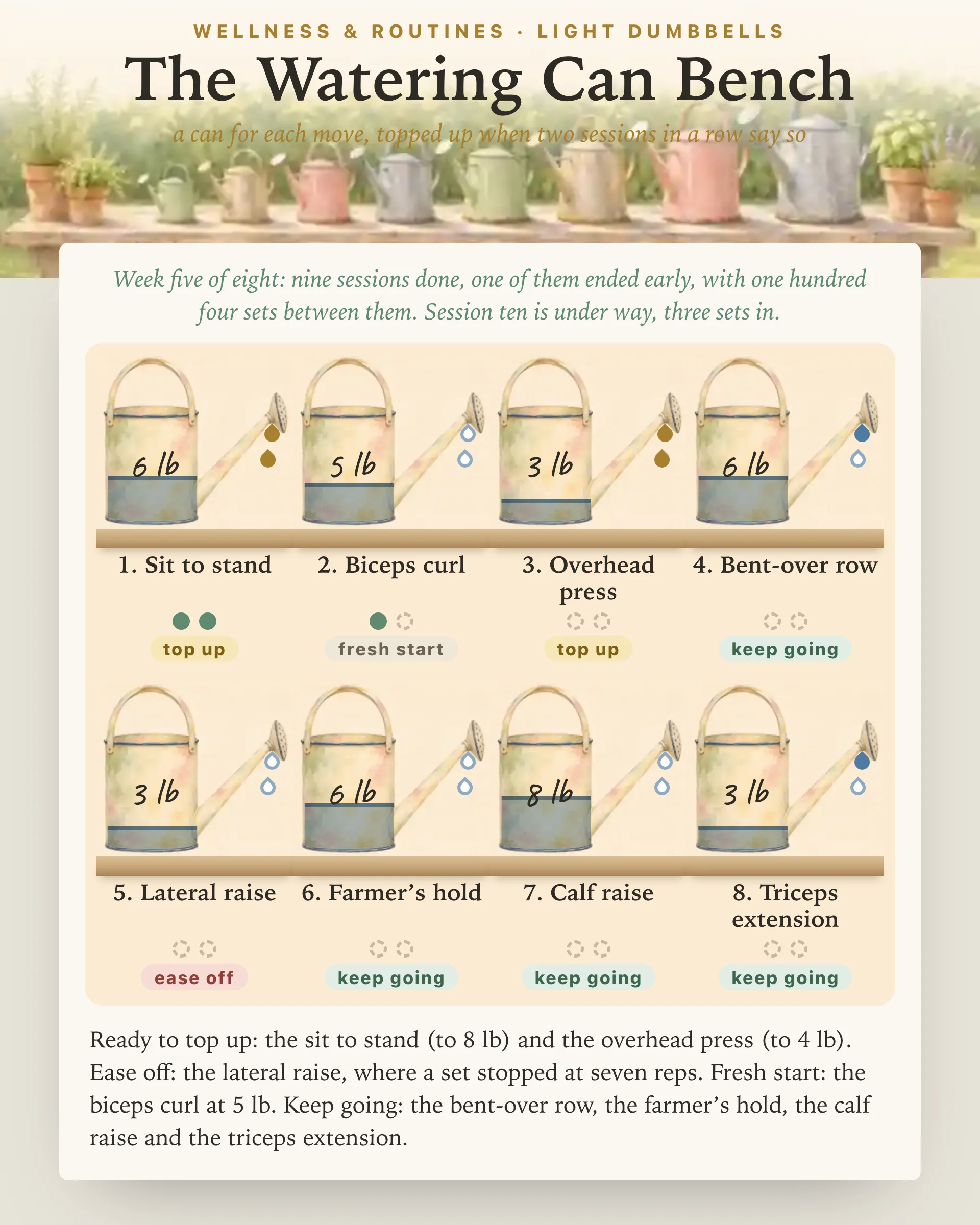
Carrying a full watering can across the yard, bringing groceries in from the car, rising from a low couch: most of the strength that matters after sixty is the everyday kind. This page is an eight-week, two-day-a-week plan of eight light-dumbbell moves for older adults, each with a seated or supported version.
Before week one, talk with a doctor or physical therapist if you have a heart or blood pressure condition, have fallen or had dizzy spells in the past year, have had a joint replacement or other recent surgery, or live with pain that keeps coming back. Stop any move that hurts. Keep a sturdy chair or a counter within reach whenever you are standing, and breathe out as you press, pull or rise.
Sessions follow this order:
Start lighter than your pride suggests. The right dumbbell lets you finish eight slow reps with clean form, the last two taking real effort. If twelve come easily, it is too light; if your form slips or you hold your breath before eight, it is too heavy. Many people begin with two to five pounds for the arm moves and five to ten for the sit to stand and the hold.
Every move has its own watering can on a shelf, and the water in each can stands at the weight you use. Tap count me through and the page paces each rep after a short count-in, two counts up and three down. When the last rep is done, the set goes in with its weight and a one-minute rest clock starts. Both clocks keep real time, even while your phone is locked.
Stop partway and the page keeps only the reps you finished, marked stopped early, and a stopped set never counts toward going heavier. You can also log a set at your own pace, pick the next move by its can, take back a set or end a session early.
The rule: when a move has every set at the top of its range (twelve reps, or forty seconds for the hold) in two sessions in a row, at the same weight and version, its can tops up one step and you start again at eight. A session ended early, or one where the move never came up, breaks the run. A set under eight suggests a lighter dumbbell or the supported version.
The broadest summary is a Cochrane review of progressive resistance training for older adults by Liu and Latham: 121 randomized trials with 6,700 older participants, most training two or three times a week at a high intensity. Strength improved a great deal, rising from a chair improved moderately to strongly, and walking speed improved a little. Side effects were poorly recorded, so the authors urge care for people with health conditions.
The most quoted single study is far smaller. Fiatarone and colleagues trained ten frail nursing home residents, about ninety years old on average, for eight weeks; nine finished, and their strength rose by 174 percent on average. It shows that very old muscle still responds, not what a typical reader at home should expect.
Falls are a separate question. A Cochrane review of exercise for preventing falls pooled 108 trials and more than 23,000 people living in the community, average age 76. Balance and functional exercise reduced falls, but the authors stayed uncertain about programs built mainly on resistance training. So this page promises nothing about falls, and it pairs well with The Balance Ladder. The CDC's guidance for adults 65 and older asks for muscle-strengthening activity on at least two days a week, alongside aerobic activity and balance practice.
None of these studies tested this exact plan, and none promises a change in how your arms or legs look.
The Dumbbell Bookshelf is a four-week standing circuit, three days a week, with lunges and a floor press, and The Whole-House Strength Routine uses a band, a chair and grocery bags. This page is dumbbells only, seated or supported whenever you need it. Unlike the site's arm-only dumbbell plan it works legs and grip too, and unlike its plan for building muscle after fifty it stays lighter and never asks how many reps you had left.
Pick two days with a rest day or two between, such as Monday and Thursday, warm up by marching in place for five minutes, and log each set as you finish it. Before the next session, read the cans.
Moves that copy daily life work well: a sit to stand holding one dumbbell, a seated biceps curl, a seated overhead press, a row with one hand on a chair, a lateral raise, a farmer's hold, a calf raise at the chair back and a seated triceps extension. Together they cover legs, back, chest, shoulders, arms and grip.
Pick the pair that lets you finish eight slow reps with clean form and steady breathing, where the last two take effort. For many people that means two to five pounds for arm moves and five to ten for the sit to stand and the hold. Start lighter if unsure.
US activity guidelines for adults 65 and older ask for muscle-strengthening work on at least two days a week. This plan uses two sessions with a day or two between them, such as Monday and Thursday, for eight weeks.
Mostly, yes. The curl, the press and the triceps extension are done seated, the sit to stand begins and ends in the chair, and each standing move has a seated version: a seated row, seated lateral raises, a seated hold and seated calf raises. A firm cushion makes the sit to stand easier.
Anyone with a heart or blood pressure condition, a fall or dizzy spells in the past year, a recent joint replacement, hernia or surgery, osteoporosis with a past fracture, or pain that keeps returning. A physical therapist can also suggest which version of each move suits you.
By the team behind Fabulous, the science-based self-care app used by over 30 million people.


