
The Overwhelm Recovery ProtocolWellness & Routines · ~5 min
About this template · Updated September 2026
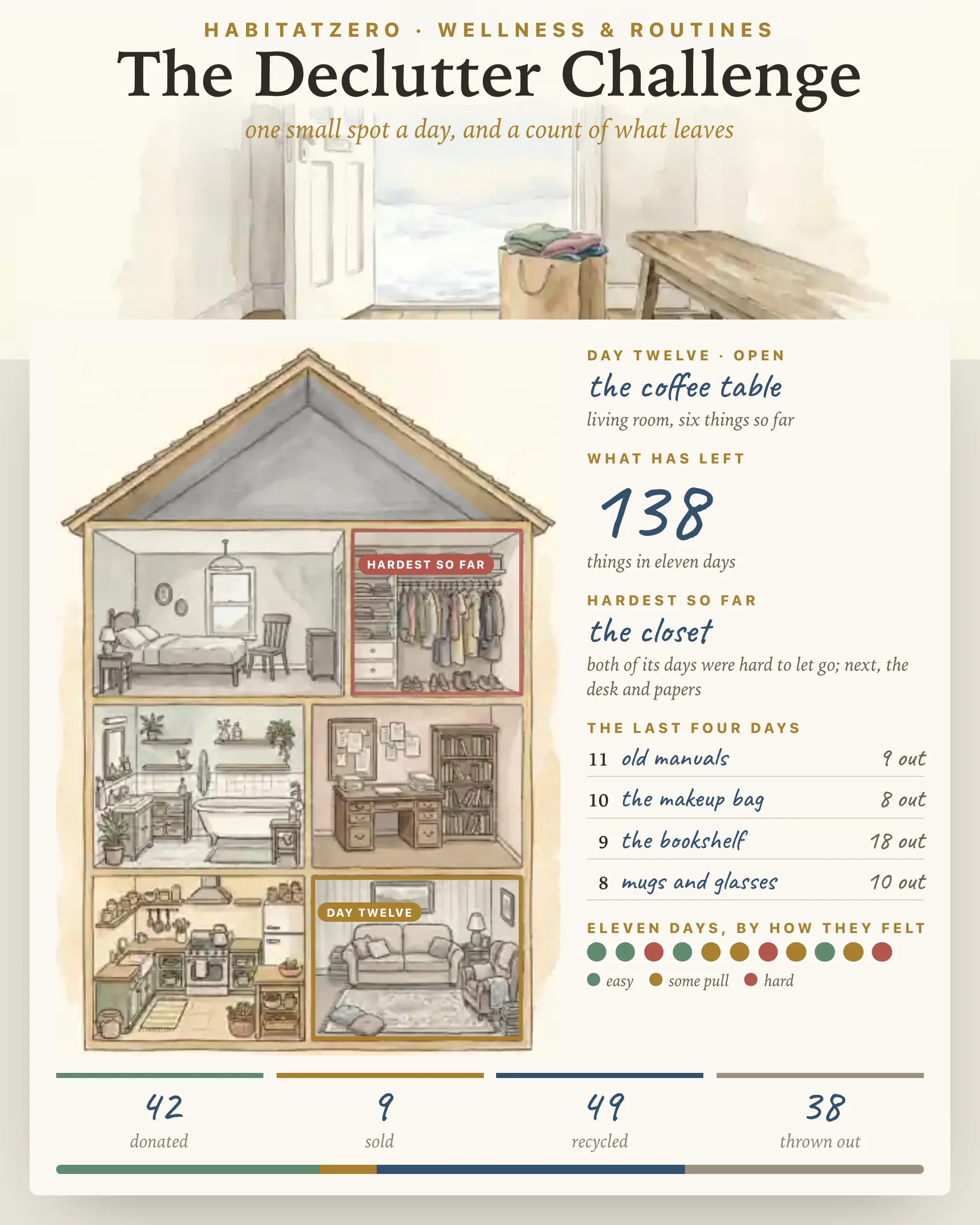
Most attempts to declutter a whole house die the same way. You clear a Saturday, empty three closets at once, and by midafternoon you are sitting in a bigger mess than when you began. A declutter challenge fixes the scale instead of your willpower: one small spot a day for thirty days, each one small enough to finish before you lose interest.
This page gives that month a shape you can see: a painted cutaway house with seven rooms, all faded at the start. Each day you clear a spot, you count what left and where it went, and the room you worked in gets some of its color back. By the end, the house shows where your effort went and which rooms were hardest to let go of.
Tap the room where today's spot lives. Each room offers six suggestions, from the junk drawer to the car trunk, or you can write your own. Aim for something you can sort in about fifteen minutes.
When you finish, count what leaves: tap donate, sell, recycle or trash once for each item that goes. A plus-five button saves thumbs on a big haul, and a minus fixes a miscount. Then say how letting go felt: easy, some pull, or hard to let go.
Closing the day logs it with its date, adds it to the four running totals and gives that room back a third of its color, so three days in a room restore it completely. Rooms are ranked by how hard their days felt on average, which means one brutal afternoon in the closet can outrank four easy kitchen drawers.
Day one is simply the first day you close. Skip a Wednesday and nothing breaks: the challenge is thirty days of work, not thirty calendar squares to fall behind on.
Start where the stakes are low. Expired coupons, pens that no longer write and a drawer of food storage lids train the decision you will need later, when the spot is a box of cards and letters, so save sentimental things for the second half of the month.
Get things out of the house the same day if you can. A donation bag riding around in the car trunk has not really left, and a sell pile with no listing date becomes a new pile. Give each one a deadline, and send unsold items to donation when it passes.
The counting variation here belongs to The Minimalists, Joshua Fields Millburn and Ryan Nicodemus, who explain it on their page for the 30-Day Minimalism Game. You let go of one thing on day one, two on day two, and so on, four hundred sixty-five things in all. They suggest playing with a friend and warn that the second week is where it gets hard. Switch this page's pace to the game and it sets each day's target and tracks your total against it. We built this sheet ourselves, and The Minimalists had no part in it and do not endorse it.
The evidence on clutter and wellbeing is suggestive rather than settled. One study analyzed the words sixty working spouses used while giving tours of their own homes: wives whose tours leaned on clutter and unfinished projects tended to have flatter daily cortisol curves, and their low mood deepened as the day went on. That study was small and correlational, and the patterns it reports are for the wives.
A larger survey of 1,111 adults, most of them women, found that people who felt their homes were cluttered tended to report lower wellbeing. The authors call their design cross-sectional and correlational, and they note that popular claims about the benefits of decluttering have had little scientific testing. Neither study shows that clearing a drawer will improve your mood; a crowded home can be a sign of a hard season as easily as a cause of one.
The counting rests on firmer ground. A meta-analysis of 138 experiments found that monitoring progress toward a goal helps people reach it, and the effect was larger when progress was physically recorded. That is why this page asks for a count every day instead of a vague sense that things are better.
If throwing away almost anything brings real distress, or rooms can no longer be used for what they are for, that may be hoarding disorder, a recognized mental health condition rather than a tidiness problem. A doctor or a licensed therapist who works with hoarding is the right place to start. A daily quota is not a treatment for it.
January is the classic start, when the decorations come down, but a move, a new baby or a closet that no longer closes are all good reasons to begin on an ordinary Tuesday. For one especially crowded spot, the Decluttering Checklist walks you through it item by item. If you would rather sort by category than by room, the KonMari Checklist follows that order, and once the thirty days are done, the Home Routines Journal helps keep the rooms from filling back up.
It is a fixed stretch of days, most often thirty, in which you clear one small part of your home each day rather than attempting one exhausting weekend purge. The small daily size is the whole trick, because a single drawer is easy to begin and possible to finish.
Choose spots you can finish in about fifteen minutes, like the junk drawer, the spice shelf, under the bathroom sink, the nightstand, your shoes, the mail pile or the car trunk. This page suggests six spots in each of seven rooms, and you can write in your own.
It is a counting version created by The Minimalists, Joshua Fields Millburn and Ryan Nicodemus. You let go of one thing on day one, two things on day two and so on, which comes to four hundred sixty-five things by day thirty. This page can keep that count for you, and it has no affiliation with them.
Interest in declutter challenges climbs every January, and a new year makes a tidy starting line, but any day works. The page counts day one from the first spot you close, so a late start or a skipped day never ruins the month.
You can browse a filled-in example of the house here without signing up. Logging your own thirty days, with the counts, the colors and the hardest rooms, happens once you personalize it in HabitatZero, and that costs nothing.
By the team behind Fabulous, the science-based self-care app used by over 30 million people.


