The Overwhelm Recovery ProtocolWellness & Routines · ~5 min
About this template · Updated July 2026
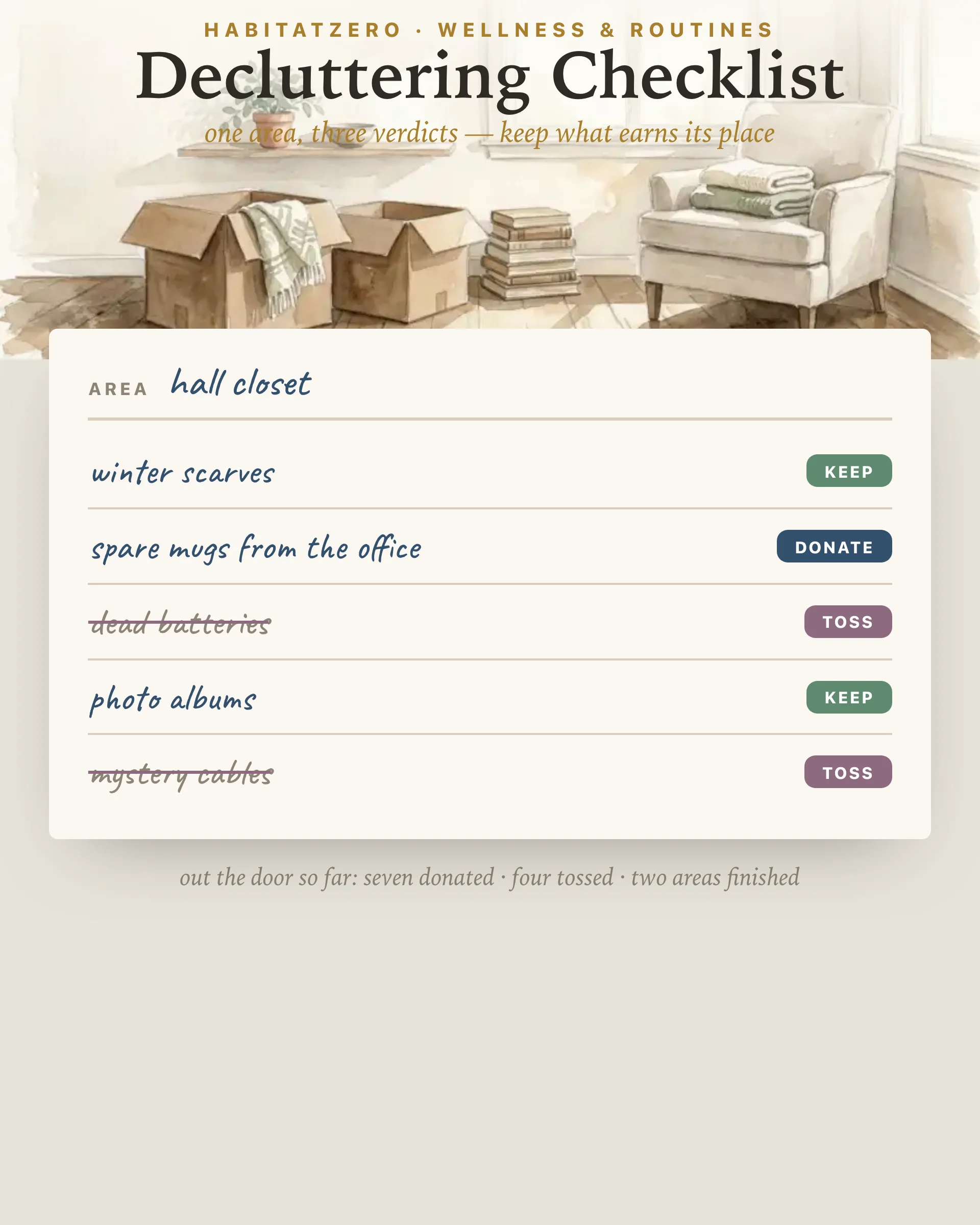
Clutter is not a character flaw — it is a backlog of unmade decisions. Every object in the pile is a small question you have been postponing, and the pile grows because postponing twenty questions feels easier than answering one. The research suggests the postponement has a cost: in a well-known study of dual-income households, women whose walkthrough descriptions of their own homes leaned on clutter language showed flatter, less healthy daily cortisol slopes than those who described their homes as restful (Saxbe and Repetti, 2010). Later work found the same direction at the level of wellbeing: possession clutter was negatively associated with people's sense of home, and through it their life satisfaction (Roster, Ferrari and Jurkat, 2016).
None of that research says a tidy house fixes your life. It says the pile is not neutral — and that the useful unit of work is the decision, not the Saturday.
That is why this checklist is built around verdicts instead of vows. You name one small area — the hall closet, not the hallway; the junk drawer, not the kitchen — and you write down what is actually in it. Then every line takes exactly one of three stamps: keep, donate, or toss. The sheet will not let an area close while any item is still waiting, which is the whole discipline: a decluttered drawer is not a drawer with fewer things, it is a drawer with zero undecided things.
The running tally at the bottom is deliberately about departures. Kept things go back with their place earned; what compounds across weeks is the count of what left — donated, tossed, and how many areas are genuinely done. That number only moves if the bags actually go, so bag the leavers the night the area closes.
If what your space needs is recurring upkeep rather than verdicts, that is a different page: the cleaning checklist handles the chores that repeat, and the chore chart shares them out. This page is for the questions the objects have been asking.
A working list of the items in one cluttered spot, where each thing gets an explicit decision instead of a vague intention. This one gives every line three possible verdicts — keep, donate, or toss — and will not mark an area finished while anything is still undecided.
Yes, area by area. Whole-home lists stall because no Saturday survives them; this page holds one drawer or closet at a time and keeps a running tally of finished areas, so the home total builds without ever being the assignment.
Ask what the item has done lately, not what it might do someday. If it has not earned its shelf space in a year, someone else will get more from it — and the donate stamp feels lighter the third time you use it.
Bag them the same night the area closes. A donate pile that lingers by the door quietly rejoins the household; the tally on this page counts things that actually left.
No — cleaning is about chores that repeat, decluttering is about possessions that decide. Wiping the shelf is Tuesday work; choosing what deserves to live on the shelf is this page.
By the team behind Fabulous, the science-based self-care app used by over 30 million people.