The Overwhelm Recovery ProtocolWellness & Routines · ~5 min
About this template · Updated July 2026
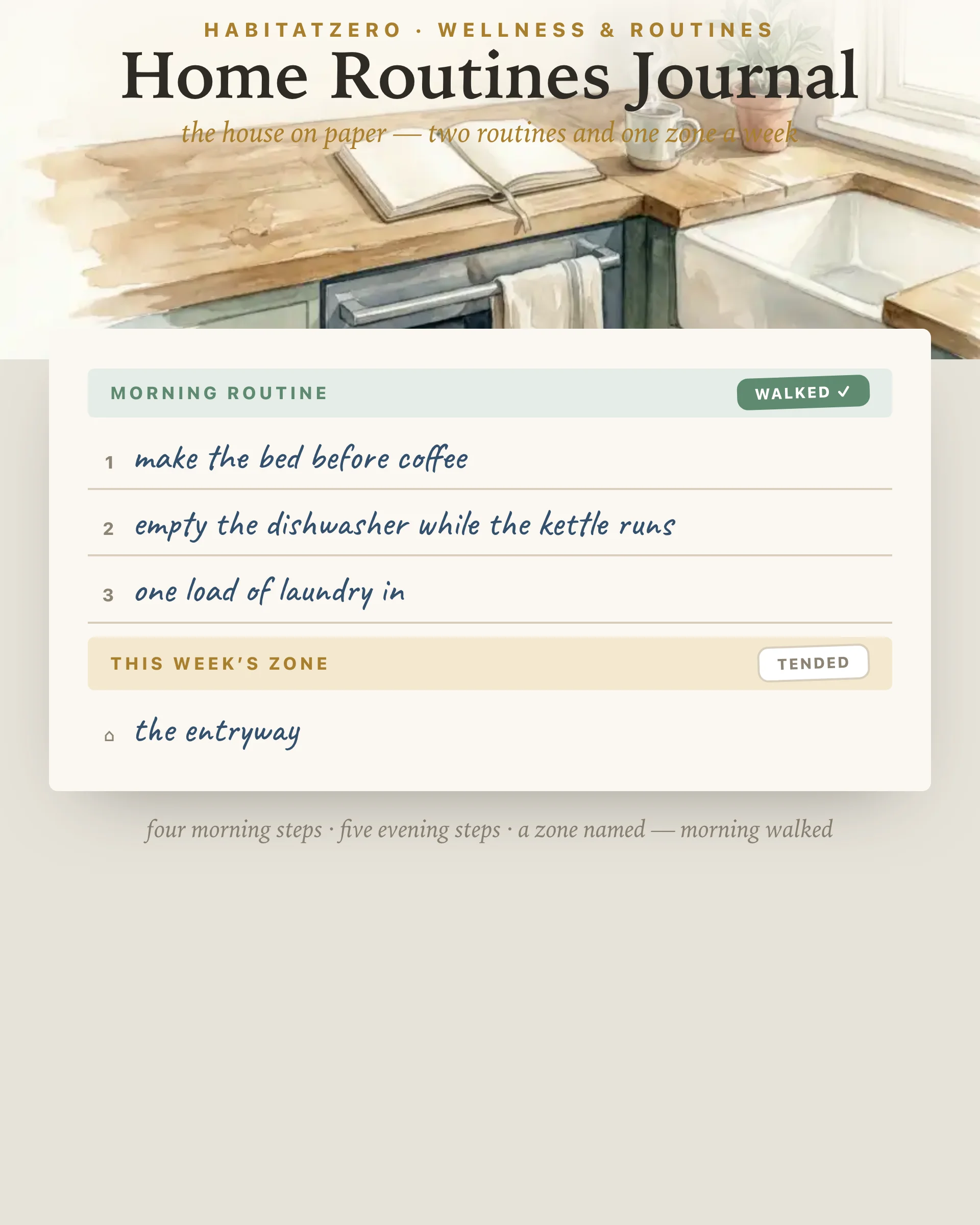
Credit first, because the idea has an author: the control journal comes from Marla Cilley — the FlyLady — whose system at FlyLady.net has been teaching people to run a home on written routines since the late 1990s. The morning routine, the evening routine, the rotating weekly zone: that vocabulary is hers. This page is an independent interactive starter inspired by the idea, offered with plain credit; it is not affiliated with, endorsed by, or connected to Marla Cilley or FlyLady.net.
With that said honestly, here is why people still search for control journal examples twenty-five years on: the idea works, and a blank binder is terrifying.
Strip away the binder tabs and a control journal is one claim: a home runs better on a few written routines than on a resident's memory. Not a chore chart, not a cleaning schedule — a short set of pages you could hand a houseguest so the household keeps running without you. The morning routine gets the day standing upright. The evening routine makes tomorrow cheaper. The zone gives one small area of the home a week of daily minutes, so the deep upkeep happens in rotation instead of in a single heroic Saturday.
The reason examples matter — the reason this sheet opens already filled in — is that the failure mode is always the same: people write routines sized for the person they wish they were. Fifteen lines, an hour of morning virtue, abandoned by Thursday. A worked example teaches the correct size by showing it: five lines, each one almost embarrassingly small.
The pre-filled example reads like this: make the bed before coffee. Empty the dishwasher while the kettle runs. One load of laundry in. Evening: lay out tomorrow's clothes. Kitchen sink empty, counters clear. Lights out by ten. Zone: the entryway — five minutes a day, shoes away, mail sorted.
Notice what the lines have in common. Each is anchored to something that already happens — before coffee, while the kettle runs, at lights-out. That anchoring is not decoration; it is the load-bearing wall. Peter Gollwitzer's work on implementation intentions showed that deciding in advance where and when a behavior happens hands the starting of it over to the situation itself, so the tired evening version of you is never asked to decide anything. A routine written this way is a chain of such intentions: the kettle starts the dishwasher line, the dishwasher line starts the laundry line.
Read the example, feel the size of it, then overwrite every line with your own home. Your routine will look different — it should. The example is scaffolding, not scripture.
Each routine carries a stamp — walked for the routines, tended for the zone. Tap it on the days the routine actually happened. The stamps matter for an unglamorous reason: home upkeep is invisible work, and invisible work erodes. A stamp is the day's proof that the maintenance happened, visible to the one person who needs to see it.
They also mark the road to the point where the journal stops being needed. Phillippa Lally's research tracking new behaviors found that repetition in a consistent context is what makes a behavior automatic — and that the timescale is weeks of ordinary, imperfect repetition, missed days included, not two weeks of perfection. The journal is the bridge across those weeks. Eventually the sink gets cleared without consulting any page; until then, the page does the remembering.
One warning from everyone who has kept one of these: resist the urge to grow it. The five-line ceiling on each routine is the feature. A control journal that tries to control everything ends up controlling nothing, because nobody rereads a novel every morning.
The zone line pairs naturally with a proper decluttering pass — but decluttering and daily tending are different jobs, so keep the zone line about maintenance minutes, not about verdicts on objects. If the morning five lines make you want a fuller treatment of the first hour, the morning routine checklist runs that single routine at higher resolution, and the wind-down routine does the same for the hour before sleep.
Write the two routines once, small enough to walk half-asleep. Name the week's zone. Then let the paper hold the house up while your head does something more interesting.
No. The control journal is Marla Cilley's idea — she is the FlyLady, and her original system lives at FlyLady.net. This page is an independent interactive starter inspired by that idea, with credit given plainly; it is not affiliated with, endorsed by, or connected to Marla Cilley or FlyLady.net.
A control journal is a written home-management routine — the pages you would hand a houseguest so the household keeps running without you. People search for examples because a blank binder is intimidating. This sheet opens pre-filled with a worked example for that reason: read it, feel the size of it, then overwrite every line with your own home.
Five lines each, maximum, and smaller than you think: make the bed, empty the dishwasher, lay out tomorrow's clothes, leave the sink empty. The test is whether you could walk the routine half-asleep on a bad day. Anything that needs willpower belongs somewhere else.
One small area of the home gets a few minutes of attention every day for a week — this week the entryway, next week the hall shelf. Rotating one zone at a time is how the deeper upkeep happens without a single exhausting cleaning day; the idea comes from the FlyLady system and it works because the area is small enough that starting is easy.
Yes. Fill it in on the page and your answers save as you go, or print the sheet — blank or with your routines written — and keep it where the real mornings happen.
By the team behind Fabulous, the science-based self-care app used by over 30 million people.