The Overwhelm Recovery ProtocolWellness & Routines · ~5 min
About this template · Updated September 2026
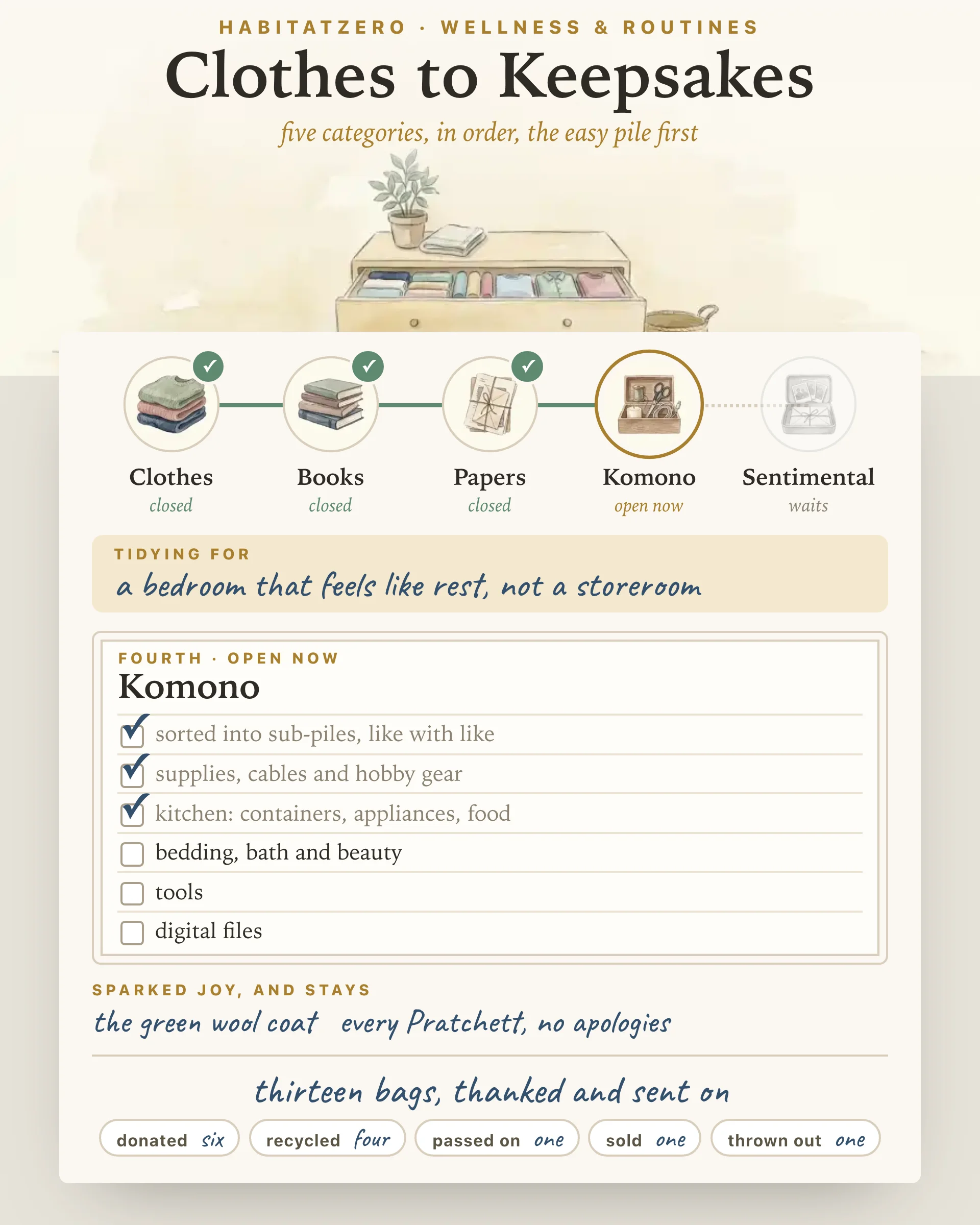
Credit first. The KonMari Method is Marie Kondo's approach to tidying, set out in her book The Life-Changing Magic of Tidying Up, and everything structural on this page comes from her: the five categories, the order they go in, and the six rules summarized at the foot of the sheet. KonMari is a trademark of KonMari Media, Inc. We use the name only to say which method this checklist follows. The page is our own independent tool, and neither Kondo nor her company made it, reviewed it or endorsed it.
Most tidying advice sends you room by room. Kondo's method refuses that for a practical reason: the same kind of thing lives in several places at once. Sweaters sit in the bedroom, the hall closet and a box in the basement, so a room-by-room tidy asks you to make the same decision three times and never shows you how many sweaters you actually own. Pile a whole category in one place and the total becomes visible.
The categories then run in a fixed order: clothes, books, papers, komono (the miscellany, from kitchen gear to cables), and sentimental items last. Her six rules of tidying explain the logic. Clothes come first because those decisions are relatively easy and the reward, a closet of things you like, greets you every morning. Sentimental items wait until the end because they are the hardest, and by then you have had weeks of practice at knowing what you want to keep.
The deciding question is famously simple. Pick up one item at a time and ask whether it sparks joy. Keep what does, thank what does not, and let it go. Papers are the practical exception: there you keep only what is in use now, what you need for a limited time, and what must be kept for good.
The five painted tokens across the top are the order itself. Only one is open at a time. Tap a later one and the sheet tells you what comes first, because skipping ahead is how this method slides back into room-by-room tidying.
Each category opens as a short list of sub-piles, sequenced the way the eight-week tidy challenge on Kondo's site runs them: tops before the rest of your clothes, books read for pleasure before practical ones, warranties before greeting cards. Tick each sub-pile as you finish sorting it. When every one is ticked, two taps close the category and the next token lights up.
Two records sit beside the checklist. Under sparked joy you can name up to three things you kept, the clearest yeses of that category. The small number is deliberate. Kondo is firm that her method is not minimalism: the point is choosing what to keep, and a shelf of three hundred books is fine if every one of them earns its place.
Under thanked and sent on you count bags by where they went: passed on to someone you know, sold, donated, recycled, repurposed or thrown out. Kondo's discarding guides ask you to look for a new home before reaching for the bin, and the lines run in that spirit. The totals add up across all five categories, so you end up seeing not only how much left the house but where it went.
The line at the top, what you are tidying for, is Kondo's second rule, picturing your ideal lifestyle; the sheet hands your words back when the last category closes.
We could find no controlled trial of the KonMari Method itself. Its claims rest on Kondo's years of lessons with clients: real experience, but not a study.
Nearby research is suggestive rather than conclusive. In a study of dual-income couples, Saxbe and Repetti found that wives who described their homes with more words about clutter and unfinished projects had flatter daily cortisol curves, a pattern associated with poorer health, and their mood sagged as the day went on. It was a small, correlational study of how people talked about their homes, not of how much they owned, so it cannot promise that tidying will lower your stress.
The sentimental category has better-aimed evidence. Winterich, Reczek and Irwin found that people cling to sentimental possessions partly because parting with them feels like losing a piece of who they are, and that encouraging people to photograph an item first led to more donations in a real donation drive. That fits Kondo's reassurance that the memory stays when the object goes, and suggests a practical step: before a keepsake leaves, take its picture.
Start when you can give clothes a proper sitting, since it sets the pace for the rest. Keep the sheet open over the following weeks; your ticks, keepers and bag counts wait where you left them between sittings.
If you only have an afternoon and one overflowing closet, a location-first approach fits better, and the Decluttering Checklist works area by area with a verdict on every item. Once the tidying is done, keeping it that way comes down to small shared routines, which is what The Household Chore List and the weekly Sunday Reset Checklist are built for.
Clothes first, then books, then papers, then komono, with sentimental items saved for last. The sequence climbs from the easiest decisions to the hardest, so by the time you reach old letters and photographs you have had plenty of practice at knowing what you want to keep.
Komono is the Japanese word the method uses for the miscellany: kitchen gear, cables and electronics, bath and beauty supplies, bedding, tools, hobby equipment and even digital files. It is such a mixed category that this checklist has you sort it like with like into sub-piles before judging any of it.
You hold each item on its own and ask whether it sparks joy, keeping what does and thanking the rest before letting it go. Papers get a practical test instead: keep only what is in use now, what you need for a limited time, and what must be kept for good.
No. The method and its category order are Marie Kondo's work, and KonMari is a trademark of KonMari Media, Inc. This checklist is an independent tool built to follow that published order; neither Kondo nor her company made it, reviewed it or endorsed it.
The page shows a sample sheet partway through komono so you can see how it behaves. To tick your own sub-piles, name your keepers and keep the bag count between sittings, open it in HabitatZero, which costs nothing.
By the team behind Fabulous, the science-based self-care app used by over 30 million people.