
The Overwhelm Recovery ProtocolWellness & Routines · ~5 min
About this template · Updated September 2026
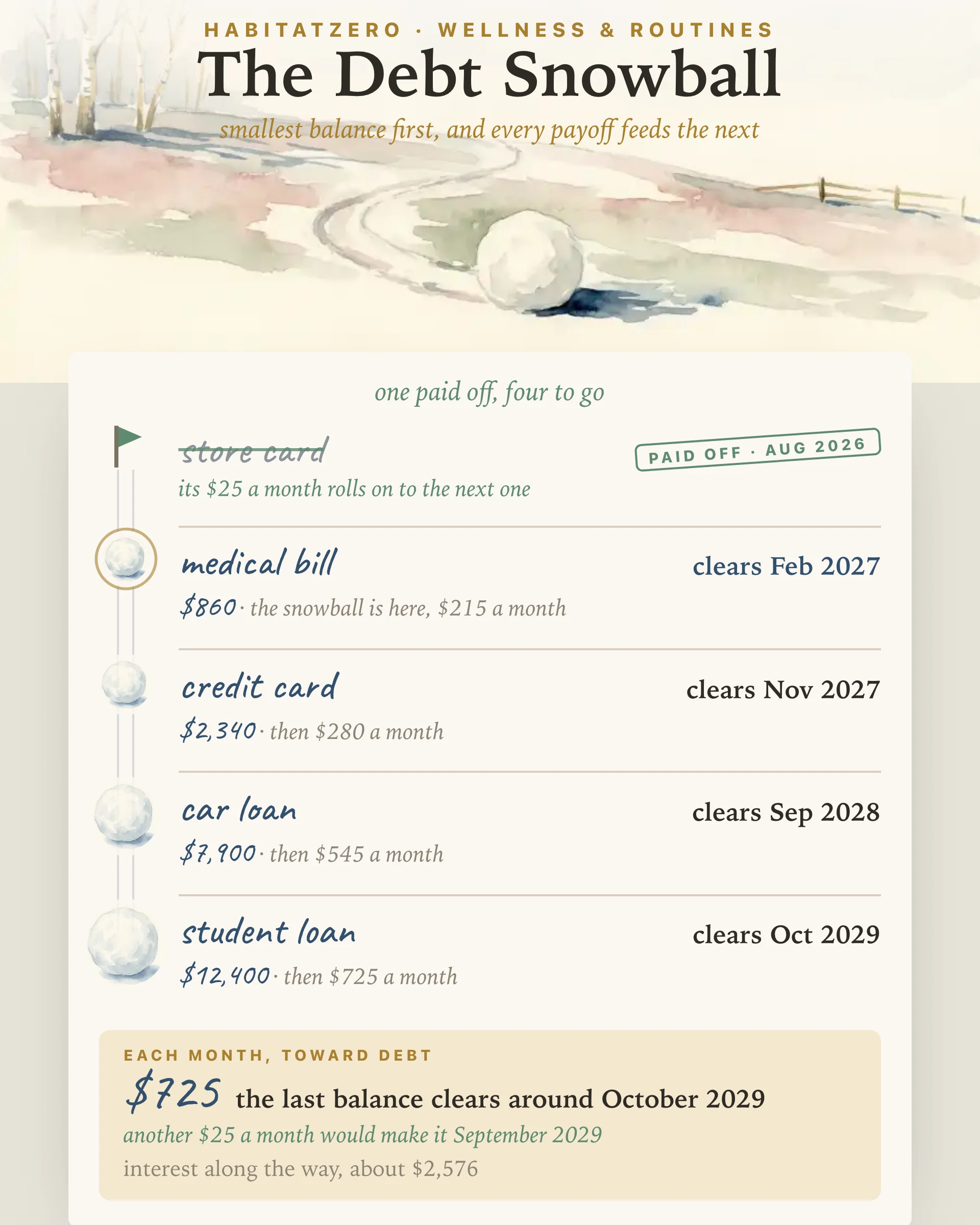
The debt snowball is best known through Dave Ramsey, who teaches it at Ramsey Solutions as the way through Baby Step 2: paying off everything you owe except the house. His own step-by-step version is in Ramsey Solutions' guide to the debt snowball. We built this worksheet ourselves to carry out the arithmetic his method asks for. Ramsey and his company had no hand in it and have neither reviewed nor endorsed it.
Write down every debt with the smallest balance at the top, and ignore the interest rates while you sort. Pay the minimum on all of them. Send every spare dollar to the one at the top until it reaches zero. Then take everything you were paying on it, minimum and extra together, and add it to the minimum on the next one down.
That last move is the whole idea. The total you pay each month never shrinks, so every debt you finish makes the payment on the next one bigger. Say you find $150 a month beyond the minimums. With the store card's $25 minimum, that is $175 on the store card. When it is gone, the $175 joins the medical bill's $40 minimum, so $215 a month rolls onto the bill, and after that $280 onto the credit card. The payment gathers weight the way a snowball does on its way downhill.
Start by tapping the kinds of debt you carry, or name your own. Each line asks for three numbers from your latest statement: the balance, the minimum payment and the interest rate. The sheet sorts the lines smallest balance first and paints a snowball beside each one, sized by the payment it will carry when its turn comes.
Below the list, set how much you can add each month on top of the minimums. The page then plays your plan forward one month at a time. It charges each balance a month of interest, pays every minimum, and sends whatever is left to the smallest balance, spilling into the next line in the month one is cleared. Every line gets a payoff month, and the box underneath gives one for the whole list.
Then add a little more and watch what moves. The page shows what another $25 a month would do to the final date and the interest, and marks which lines moved and by how much. If a minimum is smaller than the interest a debt gathers each month, that line says so, because the balance grows while it waits its turn.
When a statement finally shows zero, tap paid off. A flag goes up on that line, its minimum joins the snowball, and the next debt's date comes closer. The dates count from the month you last updated a balance and assume no new charges and steady rates.
On arithmetic alone, the snowball usually loses. Paying the highest rate first, often called the avalanche, sends each extra dollar to the balance that costs the most to carry, so it tends to finish with less interest paid. This page runs that comparison on your own numbers and shows the difference. When your smallest balances also carry your highest rates, the two methods take the same path.
The case for smallest first is about people rather than math. In records from a debt settlement firm, David Gal and Blakeley McShane found that closing accounts predicted getting out of debt altogether, whatever the dollar size of the accounts that were closed. Those records are observational, so they show a link rather than a cause. Keri Kettle and colleagues added a field study and three experiments in which concentrating repayments on one account raised people's motivation to become debt free. The effect was strongest when the payments went to the smallest accounts, because people judged their overall progress by the largest share of any single balance they had paid down.
What the research does not show is that the snowball suits everyone. If you know you will keep going either way, the avalanche is the cheaper road. If you have started a payoff plan and stalled before, a first debt gone in month four may be worth some extra interest.
Reach for it when you owe on several accounts and the total feels too big to start on. Ramsey leaves the mortgage out of the snowball, and most people using this sheet will too.
Keep every minimum on time while the snowball rolls; The Bill Ledger holds all your due dates on one page. To find the extra each month, The 50/30/20 Budget shows where your paycheck goes now. And once the last flag is up, the Savings Tracker gives that same monthly amount a new place to land.
If the minimums alone no longer fit your month, talk to a nonprofit credit counselor first. The National Foundation for Credit Counseling connects you with member agencies that can go over all of your debt with you.
Nothing here is financial advice. The page does arithmetic on the numbers you give it, and its dates are estimates that shift whenever your balances, rates or budget do.
You keep paying the minimum on every debt and send any extra money to the smallest balance until it is gone. Then its whole payment moves to the next smallest, so the amount aimed at each new target keeps growing as the list gets shorter.
It follows the method Dave Ramsey teaches at Ramsey Solutions: smallest balance first regardless of rate, minimums on the rest, and each freed payment rolled into the next. The worksheet itself is ours. Ramsey and his company did not make it and have not reviewed or endorsed it.
Paying the highest rate first, the avalanche, usually ends with less interest paid. The snowball gives up some of that saving for early payoffs, and studies of real borrowers suggest those first closed accounts help people keep going. This sheet works out the interest gap on your own debts so the trade is visible before you choose.
Yes, without any formulas to set up. It steps through your plan one month at a time, adding interest, paying each minimum and rolling every freed payment forward, then writes a payoff month beside each balance and a final month for the whole list.
The filled example on this page can be read without signing in. To enter your own balances and come back each month to plant a flag, open it in HabitatZero, which costs nothing.
By the team behind Fabulous, the science-based self-care app used by over 30 million people.


