
The Overwhelm Recovery ProtocolWellness & Routines · ~5 min
About this template · Updated September 2026
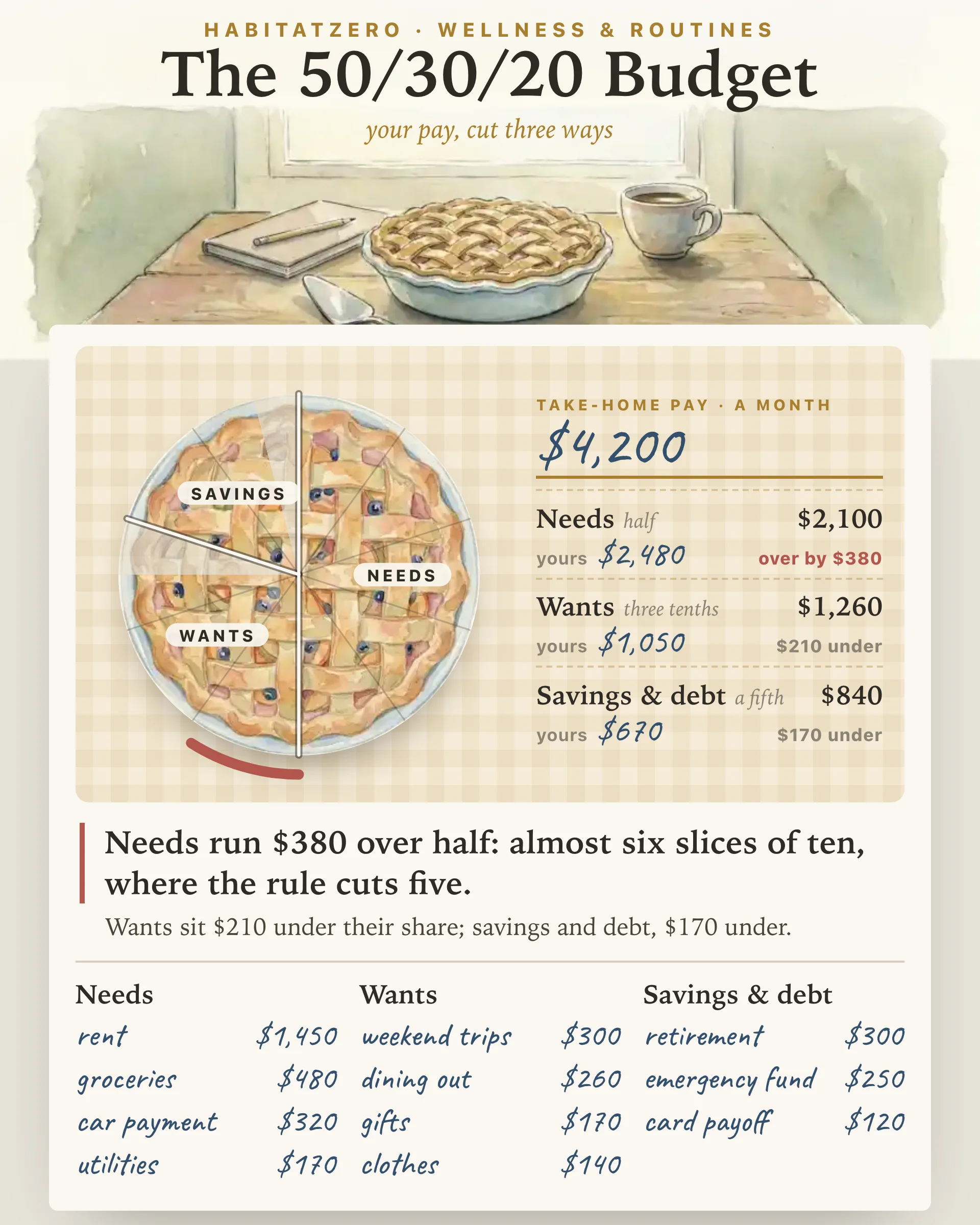
The split on this page comes from All Your Worth: The Ultimate Lifetime Money Plan, the 2005 book in which Elizabeth Warren and her daughter, Amelia Warren Tyagi, divided a household's money into Must-Haves, Wants and Savings (the publisher's page for the book). We built this worksheet on their arithmetic, but it is our own: neither author nor their publisher made it, reviewed it or stands behind it.
The idea fits in a sentence. Take the money that actually reaches your account each month and give half of it to the things you cannot skip, three tenths to the things you choose, and the last fifth to your future self, whether that means a savings balance or a debt paid down faster. There is no category spreadsheet and no receipt for every coffee. You get three numbers, and a way to check whether your real month looks anything like them.
Type your take-home pay and pick dollars, pounds or euros. The pie on the tablecloth is cut at once: five slices of ten for needs, three for wants and two for savings and debt, with the price of each share written beside it.
Then sort your own costs. Tap a common one, such as rent, groceries or streaming, and it drops into its portion with a round starting figure. That figure is a placeholder, and a small note under the line says so until you change it with the stepper or type the real number. Anything the suggestions miss, you can write in. Anything sitting in the wrong portion moves with two taps. Each portion takes ten lines, plenty once the small stuff is folded together.
As costs land, the pie colors in. Where a portion still has room, the pie stays pale, because that money has no job yet. Where a portion runs past its share, a red arc spills over the crust, as long as the overrun itself. Under the pie, plain sentences name the portion that is over and by how much, in money and in slices, so that needs running $380 over half also reads as almost six slices of ten where the rule cuts five.
Most of the thinking happens while you sort. Rent, groceries, utilities, insurance and the minimum on every debt are needs, the bills that arrive whatever kind of month you had. Meals out, streaming, trips and the gym are usually wants. The trouble is the middle. A phone is a need; the newest phone is not. A car that gets you to work is a need; the payment on a bigger one is partly a want.
The page does not rule on any of that. Put each cost where you honestly think it belongs, and when you are torn, split it into two lines. Anything you pay on a debt beyond the minimum sits with savings and debt, since it buys down a bill you would otherwise keep paying.
The rule has a following in public financial education. The Consumer Financial Protection Bureau builds a classroom activity on analyzing budgets around it: students check sample budgets against the split, and the teacher guide says to work from net income, the pay left once taxes and other deductions come out. The same guide is candid that the split is one rule to live by and that not everyone can follow it.
No study we could find compares people who aim for 50/30/20 with people who budget some other way, so treat the split as a yardstick rather than a proven prescription. It is also a demanding yardstick for renters. The Census Bureau reported that the median renter household put 31 percent of its income toward rent in 2024, and the Bureau counts income before taxes. Measured against take-home pay, that share is larger. For a household at the midpoint, rent alone uses at least thirty-one of the fifty points the rule gives needs, leaving nineteen or fewer for groceries, transport, insurance and minimum payments. And because it is a midpoint, half of renter households spend a bigger share than that.
So if your needs come out at six slices instead of five, you have not failed anything. You have learned something specific: how big the extra slice is, and which portion is quietly paying for it.
A late-December sit-down suits it well. The holidays are fresh, your Christmas Budget has shown what they really cost, and January's pay has not landed yet. It is just as useful after a new job, a raise or a move, or whenever the month keeps ending before the money does. Work from a recent bank statement rather than from memory, so the small recurring charges make it onto the pie too.
If the savings slice needs somewhere to go, give it a destination on the Savings Tracker. If wants keep spilling over the crust, a short No-Spend Challenge will show which of them you actually miss.
It divides take-home pay into three parts: half for needs such as housing, food and utilities, three tenths for wants such as meals out and trips, and a fifth for savings and paying down debt. Elizabeth Warren and Amelia Warren Tyagi set it out in their 2005 book All Your Worth.
Net income, the pay that lands after taxes and payroll deductions. Classroom materials from the Consumer Financial Protection Bureau make the same point. Starting from gross pay would make every portion look larger than the money you can actually spend.
On the needs side, often not for renters. Census figures show the typical renter household paying 31 percent of its pre-tax income on rent alone, so needs regularly pass half of take-home pay. Treat the split as a yardstick; what helps is knowing which portion is over and by how much.
This page counts minimum payments as needs, because missing one makes the debt worse. Whatever you pay above the minimum goes under savings and debt, since it shrinks what you will owe later. If a cost could fit either place, the move button leaves the call to you.
Yes, and the pie shown here can be explored without signing up. Personalizing it in HabitatZero, at no cost, keeps your own pay, costs and sorting ready for the next time you sit down with your month.
By the team behind Fabulous, the science-based self-care app used by over 30 million people.


