
The Overwhelm Recovery ProtocolWellness & Routines · ~5 min
About this template · Updated September 2026
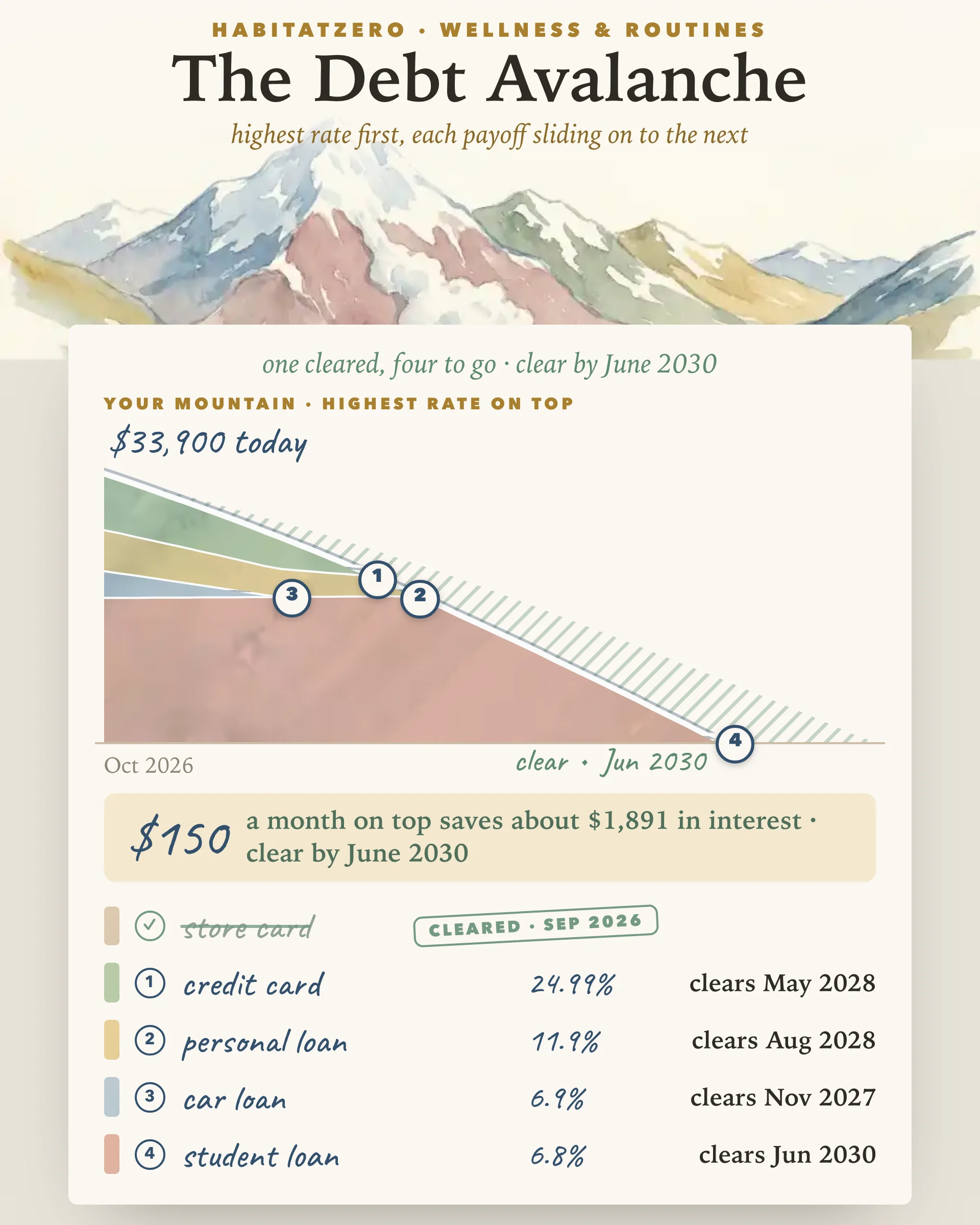
The debt avalanche method answers one question: which debt gets your spare money first? The answer is always the one with the highest interest rate. You keep paying the minimum on everything else, aim every extra dollar at the most expensive balance, and when that balance is gone you move its whole payment onto the next-highest rate. The amount you send to debt each month stays the same while the list gets shorter, so each new target is paid down faster than the one before it.
Interest is the price of carrying a balance for one more month. A card at 25 percent adds about two dollars a month for every hundred you owe on it, while a car loan at 7 percent adds under sixty cents. So an extra dollar does the most work where the rate is highest: it stops the most interest from landing next month, and the month after that. Ordering by rate is ordering by cost. On the arithmetic alone it usually leaves you paying the least interest overall, which is why researchers who study repayment treat it as the benchmark.
Tap the kinds of debt you carry or name your own, then copy three numbers from each statement: the balance, the minimum payment and the APR. The sheet stacks them into a painted mountain with the highest rate on top and plays your plan forward one month at a time. Each month it charges every balance a month of interest, pays each minimum, and sends whatever is left to the top layer. A layer pinches out in the month its debt is gone, and a numbered pin marks the spot.
Then set what you can add each month on top of the minimums. The slope steepens, a hatched strip shows how much sooner the mountain comes down than it would on the minimums alone, and the page tells you how much interest that extra saves. It also prices the next small step, so you can see what another $25 would buy before you commit to it.
Two honest checks are built in. If a minimum is smaller than the interest its debt gathers each month, that row says so in red, because the balance grows while it waits for the avalanche to arrive. And the page runs the smallest-balance-first order on the same numbers, so you can see both what the avalanche saves you and what it asks you to wait for.
When a statement finally reads zero, tap cleared. The debt gets its stamp, its minimum joins the avalanche, and the next date on the list moves closer.
The rate-first order has a well-documented weakness: people rarely follow it on their own. In four experiments built around a repayment game, Moty Amar and colleagues found that participants kept paying off their smallest debts first even when the larger ones carried higher rates, a habit the authors called debt account aversion. Steering attention to the interest each debt had piled up helped people reduce their debt faster.
That pull toward small balances is not simply a mistake. Working with records from a debt settlement firm, David Gal and Blakeley McShane found that closing accounts predicted getting out of debt, whatever the dollar size of the accounts that were closed. The data were observational, so they show a link rather than proof that the early closings caused the success. Keri Kettle and colleagues followed with a field study and three experiments in which concentrating repayments on fewer accounts raised people's motivation to become debt free, most strongly when the payments went to the smallest accounts.
Put together, the avalanche usually costs the least, and paying the smallest balance first can feel more motivating for some people. The right plan is the one you are still following in month fourteen. If you trust yourself to keep going, the avalanche is the cheaper road. If earlier payoff plans have stalled on you, a quick first win may be worth some extra interest, and this sheet shows you exactly how much.
Use it when you owe on several accounts at different rates, and especially when a high-rate card sits beside cheaper installment loans. Look again whenever a statement arrives, a rate changes or a promotional zero percent period is about to end, because any of those can reshuffle the order.
To find the extra each month, The 50/30/20 Budget shows where your take-home pay goes now, and a stretch of The No-Spend Challenge can free a lump sum for the top layer. The Bill Ledger keeps every minimum on its due date, which matters here: a missed payment brings late fees that eat into what the avalanche saves.
If the minimums alone already crowd out rent and groceries, the order of payoff is not the first question. A nonprofit credit counselor at an agency in the National Foundation for Credit Counseling network can look at everything you owe with you and explain the options.
This page does arithmetic on the numbers you give it. It is educational rather than financial advice, and its dates are estimates that assume no new charges and rates that hold still.
It orders your payoff by cost. You pay every minimum, send whatever else you can spare to the debt with the highest interest rate, and once that one is gone its whole payment moves to the next-highest rate. The monthly total aimed at debt never shrinks, so each target gets paid down faster than the last.
It walks through the plan one month at a time. Each month it adds a month of interest to every balance, pays each minimum, then puts the rest of the money on the highest-rate balance still open. The month the last balance reaches zero is the payoff date, and the interest added along the way is what the plan costs.
On interest it usually does, because each spare dollar goes where carrying a balance costs the most. Smallest balance first, often called the snowball, gives up some of that saving for quicker early payoffs, and studies of real borrowers suggest those early wins keep some people going. This sheet prices both orders on your numbers, and the better plan is the one you will keep following.
Then that balance grows every month it waits for the avalanche to reach it. The sheet flags any debt whose monthly interest is larger than its minimum. If that is true of several debts at once, a nonprofit credit counselor can go over your options before the gap widens.
The sample mountain on this page can be read without an account. To stack your own debts, keep them between visits and stamp each one as it clears, open the sheet in HabitatZero, which is free.
By the team behind Fabulous, the science-based self-care app used by over 30 million people.


