Leaves on a StreamEmotional Fitness · ~3 min
About this template · Updated September 2026
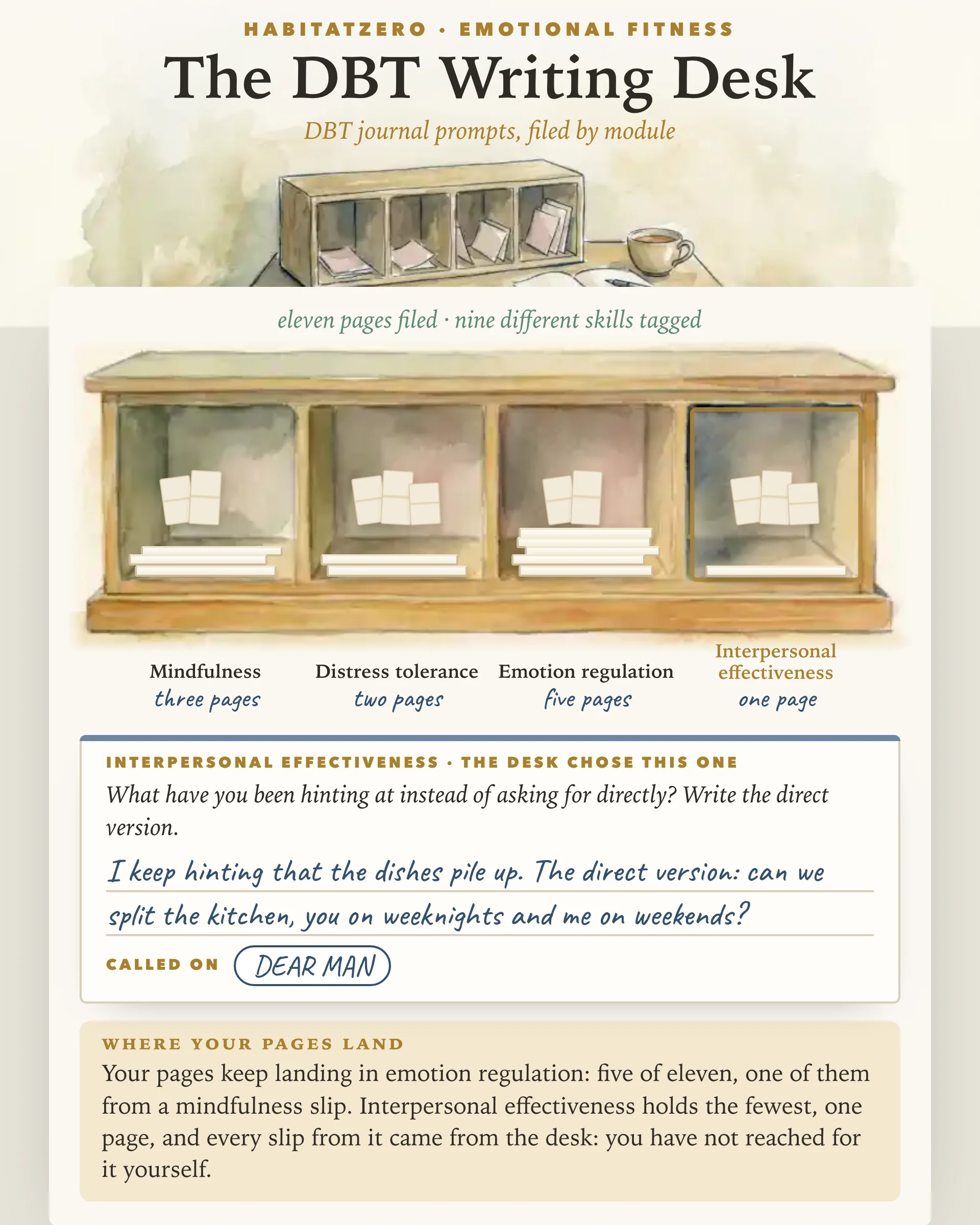
The four cubbies on this desk are the four skills modules of dialectical behavior therapy (DBT), the treatment psychologist Marsha M. Linehan developed for people whose emotions become too intense to manage. Her DBT Skills Training Manual, now out in a revised edition from Guilford Press, teaches mindfulness, distress tolerance, emotion regulation and interpersonal effectiveness as separate sets of skills. Every prompt on the desk was written for this page. HabitatZero made the desk independently: Dr. Linehan, Guilford and the DBT organizations have no connection to it, and none of them has reviewed or endorsed it.
A blank journal page fills up with whatever hurt most today, so the same few themes get all the ink. Sorting DBT journal prompts by module spreads the attention on purpose:
Tap a cubby and it hands you a slip with one prompt from that module, or let the desk choose the cubby you have filed least in. If the prompt doesn't fit today, trade it before you start writing. Each cubby holds twelve slips and hands out each one once.
Write a few lines, not an essay. Then tag the skill the writing called on, like observe, self-soothe, check the facts or DEAR MAN. The page is filed in the cubby where that skill lives. A mindfulness slip about a harsh thing you told yourself may end up leaning on check the facts, and then the page belongs with emotion regulation. Over a few weeks the stacks show where your writing actually goes, which is not always where you meant to send it.
The desk also reads the stacks back in plain words: which module your pages keep landing in, which cubby stays empty, and whether you ever reach for that one yourself or only when the desk hands it to you. That last detail is the useful one. Avoidance rarely announces itself. It hides in small choices, like always tapping the cubby that feels safest.
DBT rests on the idea that people get better by using skills, and there is direct support for that. In a study of 108 women with borderline personality disorder across three randomized trials, those treated with DBT reported using about three times as many skills by the end of treatment as those in comparison treatments, and the growth in skills use accounted for their drop in depression and their gains in anger control. That was full DBT, with a therapist, a skills group and coaching, not a journal on its own.
Putting what matters to you into words has a longer research record. A meta-analysis of 146 randomized studies in which people disclosed thoughts and feelings about personal, meaningful topics found a real but small average benefit, with several factors changing how much it helped. So treat the desk as a place to practice naming and using skills between sessions. The evidence for it is indirect, and it is not a treatment by itself.
Sit down with a slip a few times a week, or on the evening after a day that tested a skill. Writing works best once the moment has passed. If you keep a daily record of feelings and urges, The Diary Card is built for that, and the desk is where you slow down with one moment from it. If a feeling is peaking and you need a skill now rather than reflection, The Skills Compass points you to one in a few taps.
Some moments are not for writing at all. If a hard stretch brings thoughts of hurting yourself, leave the desk for later and call or text 988 in the US, or your local emergency number, and let someone help you through the next hour.
Journaling can sharpen the skills, but it cannot teach them the way a DBT-trained therapist can. If strong emotions are running your days, start there, and bring your pages along.
For mindfulness, describe a feeling from today the way a weather report would, with no verdict attached. For distress tolerance, list one thing that soothes each of your senses and where it lives at home. For emotion regulation, check your strongest feeling this week against the facts. For interpersonal effectiveness, write the direct version of something you have only hinted at. Each cubby on this desk holds twelve prompts like these.
Answer one prompt in a few lines, then name the skill the writing called on. Naming the skill is the step that turns a diary entry into skills practice, and a few entries a week is enough. If you are in DBT, bring the pages to your therapist or skills group. If you are not, a DBT-trained therapist is the place to learn the skills properly, especially when strong emotions are running your days.
The desk is interactive rather than a fixed PDF, which is what lets it keep count of where your pages land. When you want paper, print your filed pages from the list below the desk, and the print dialog can save them as a PDF with the buttons left out.
No. The four modules come from Marsha M. Linehan's DBT skills training, but HabitatZero wrote these prompts and built the desk on its own, and neither Dr. Linehan nor any DBT organization has reviewed or endorsed it. Use it as practice between sessions, not as a substitute for therapy.
The filled desk on this page is a sample you can read through. Taking slips of your own, filing pages and getting a reading of where they land all begin when you personalize the desk in HabitatZero, which is free.
By the team behind Fabulous, the science-based self-care app used by over 30 million people.