
Leaves on a StreamEmotional Fitness · ~3 min
About this template · Updated September 2026
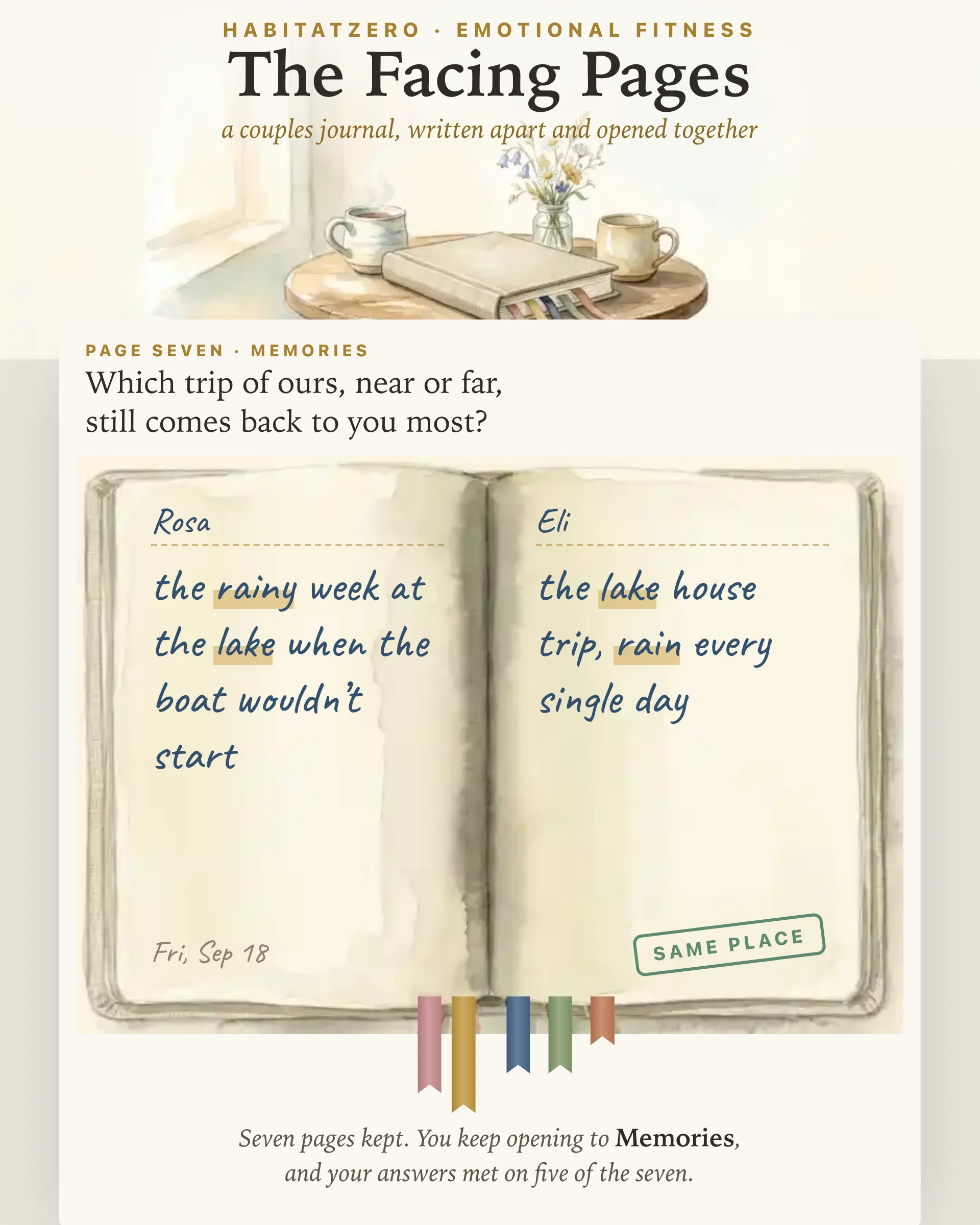
A couples journal works best when neither of you gets to answer second. This one is laid out as an open notebook: the same prompt sits above two facing pages, one for each of you. You write your page while your partner looks away, fold it, and pass the phone across. Only when both pages are folded does the seal in the middle open them, side by side.
That small delay is the whole trick. Read your partner's answer first and yours bends toward it, however hard you try not to let it. Writing blind keeps both voices honest, and the reveal becomes the part you look forward to.
Start on the flyleaf by writing two first names or nicknames. Then pick one of five index tabs, and the journal turns to the next prompt in that tab. Each of you writes a line or two, folds it, and waits. If you would rather talk than type, choose say it aloud instead and, if you like, jot down one line to remember it by.
When the pages open, the journal highlights any words you both used, so a shared lake or a shared Thursday stands out. Then the two of you tap where your answers landed: the same place, close by, or news to one of us. That tap keeps the page, with its date, in the list of kept pages below.
Either of you can pass on any prompt, and nobody asks for a reason. A passed prompt moves to its own short list, where you can bring it back whenever you both feel ready. A kept page you regret can be torn out with two taps.
Five ribbons hang from the bottom of the journal, one for each tab, and every kept page lengthens its ribbon. After a few weeks their lengths tell you something no single entry can: which kinds of conversation you keep reaching for. Underneath, a short reading names the tab you open most, counts how often your answers met, and says which prompts you have passed on. None of it is a score. A long Memories ribbon beside a bare Repair one describes a season, not a verdict.
Fondness asks what you admire and appreciate in each other. Memories takes you back to evenings, trips and small rituals you share. Dreams looks ahead to where you would like to go together. Everyday covers the weekday machinery: mornings, calendars, how you like to be greeted at the door. Repair is for finding your way back after a rough patch, and its prompts ask what helped rather than what hurt.
The shape borrows from the Gottmans' Sound Relationship House, which counts knowing the little things about each other's lives, sharing fondness and admiration, and making room for each other's dreams among its nine parts of a healthy relationship. The journal has no tie to The Gottman Institute; its prompts are written fresh around those ideas.
Noticing what your partner does for you seems to matter from one day to the next. In a daily-experience study of both members of cohabiting couples, gratitude from ordinary interactions predicted more connection and satisfaction the following day, for the partner who felt grateful and for the partner who had done the kind thing.
Writing about a relationship has been tested too. When one person from each of 86 dating couples spent three days writing about their deepest thoughts and feelings about the relationship, those couples were more likely to still be dating three months later than couples in which that partner wrote about daily activities instead.
Be clear about the gaps. The gratitude study followed feelings day by day rather than testing a journal, the writing study asked only one partner to write, on their own, and nobody has tested a shared prompt journal like this one. A journal can help you notice what is good and put it into words. It is not couples therapy, and it cannot settle a problem that needs a professional.
Every prompt is written for a page your partner will read, and none asks for a secret or a confession. If a Repair page opens up something bigger than a line or two can hold, a couples therapist is a good next step.
This kind of journal assumes two people who feel safe with each other. If your partner frightens you, hurts you, or controls your money, your phone or who you see, leave it out of a shared journal and call the National Domestic Violence Hotline at 1-800-799-7233 or text START to 88788, at any hour, free and confidential. The Hotline also advises against couples counseling with an abusive partner, so a counselor of your own is the safer room.
Open it once or twice a week at a set time, with ten minutes and one phone between you; a single page is plenty. Pair it with a weekly Couples Check-In for the practical business of the week, turn to Our Fair Fighting Rules if the Repair tab keeps circling the same argument, and pick up The Puzzle for Two on nights when you would rather talk than keep a record.
It is one notebook kept by two people about the life they share, usually with both partners answering the same prompt. Writing separately and then reading the two answers next to each other is what turns a diary into a conversation.
Pick a regular slot, such as one quiet evening a week, and begin with a gentle theme like fondness or shared memories. Keep answers to a line or two so the habit never feels like homework, and agree that either of you can skip any prompt.
Short replies to a single prompt: something your partner did this week that you appreciated, a memory you both hold on to, a hope for next year, a tweak to your weekday mornings, or what helped you reconnect after a disagreement.
Yes, once you have both written. Waiting until both pages are done keeps one answer from steering the other, and the reveal shows you where you already see things alike and where your partner still surprises you.
The filled-in sample on this page shows what a few weeks of entries look like. To keep a journal of your own, personalize it in HabitatZero for free, and your folded pages, kept entries and ribbons stay saved between evenings.
By the team behind Fabulous, the science-based self-care app used by over 30 million people.


