Leaves on a StreamEmotional Fitness · ~3 min
About this template · Updated September 2026
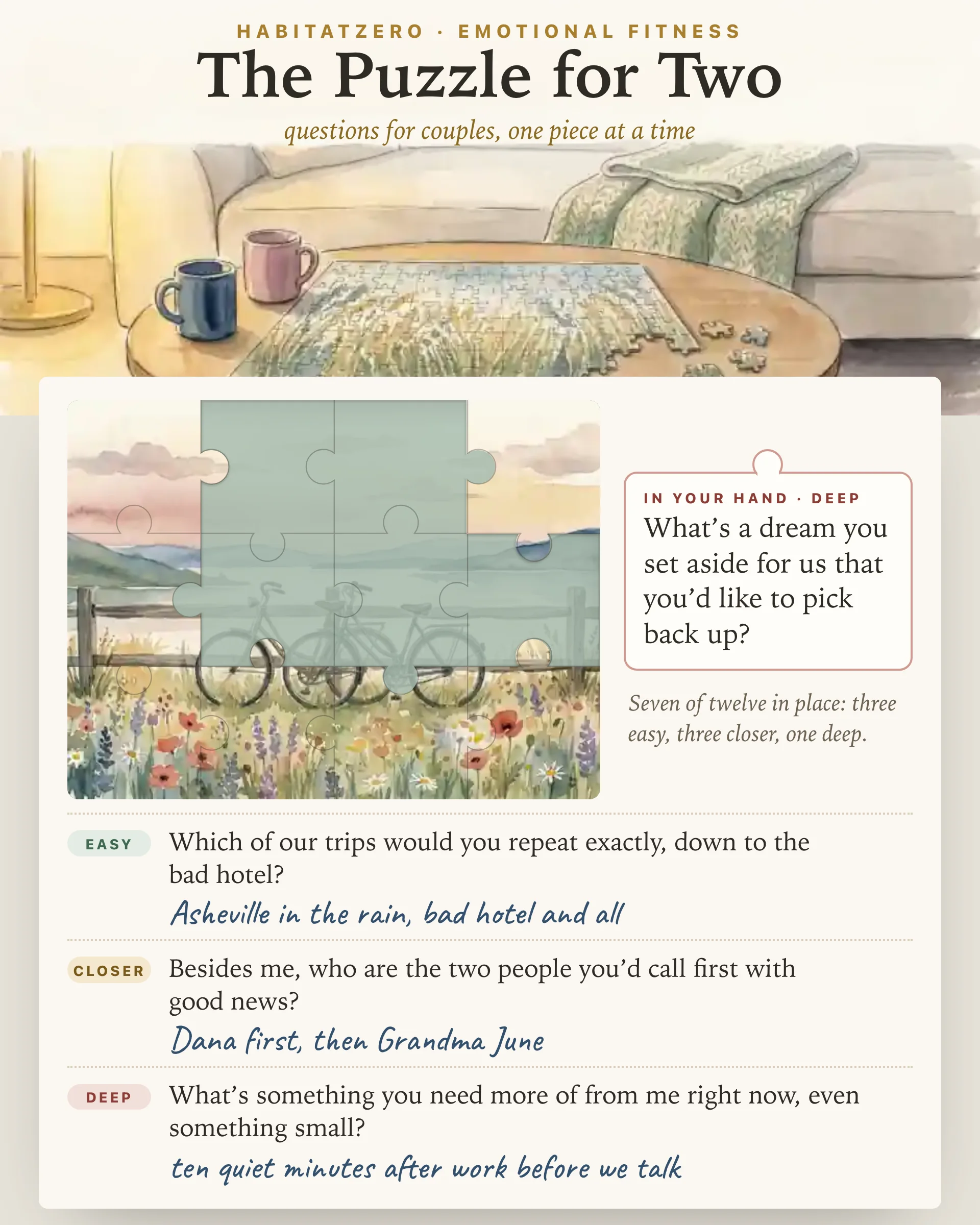
You have probably tried a list of questions for couples before. One of you reads number fourteen off a phone, the other answers in a sentence, and the list moves on to fifteen. The questions were fine. What was missing was a reason to stay with one until it became a conversation, and a way to remember the ones that did.
This page is built around that missing part. Every question is a puzzle piece, and it only goes into the picture if it opened something between you.
The ninety-six questions sit in three piles. Easy is light and quick: this-or-that pairs, favorites, a little flirting, the kind you can answer from the passenger seat. Closer is stories and the everyday: the house you grew up in, what is taking up room in your head this week, who you would call first with good news. Deep is hopes, fears and needs: what you need more of from each other, the risk you would take if you knew the other had your back, what you miss.
Above the piles you can say how long you have been together. Still new sets aside questions that lean on years of shared history, like which of your trips you would repeat down to the bad hotel. Years in swaps the early-days questions, like what made you give this a real chance, for ones only a long run together can answer. Leave both off and all ninety-six are in play.
Tap a pile and a question lands in your hand. One of you reads it out and you both answer, the one who asked included. If it went somewhere, tap it fits and it becomes the next piece of a twelve-piece watercolor jigsaw, set down the way most people build a puzzle: corners first, then the edges, the middle last. If it did not land, tap another one. The box keeps track, so no question comes around twice until you have been through its whole pile, and nothing already in the picture gets dealt again.
Under each piece there is a short line for what it opened, a trip you finally booked or a story you had somehow never heard. Below the board, a line tallies the picture by pile, and once a few pieces are down it names the pile most of them came from, or notices when none has come from the deep pile or the easy one. That is the only reading the page gives. It does not score your relationship, and a question that went nowhere says nothing about the two of you.
When all twelve pieces are in, the picture is whole. Tip it back into the box to start another; the page keeps count of the pictures you finish.
The best-known evidence that questions can bring people closer comes from a 1997 study by Arthur Aron and colleagues. They paired strangers for forty-five minutes of self-disclosure tasks that grew steadily more personal, and those pairs reported more closeness than pairs given small-talk tasks. That study measured closeness between strangers, not love between partners, so read it as an argument for going deeper gradually rather than as a promise. The original sequence lives on its own page as The Thirty-Six Questions.
Couples have been studied with the same kind of task. In one set of experiments, partners who worked through high-disclosure questions showed larger gains in passionate love when they did it alongside another couple, and the other couple's responsiveness helped explain why. That makes a double date a fair place to bring out the closer pile.
A third line of work looks at the hesitation before a deep question. Across a long series of experiments, people expected deep conversations with strangers to be more awkward than they turned out, and came away more connected than they had predicted. With close partners their predictions were more accurate, which is why this page never pushes the deep pile on you. It only points out when you have not tried it.
Psychologist John Gottman uses the phrase love map for everything you carry in your head about your partner's world: their worries, hopes, friends and history. The Gottman Institute treats keeping that map current as ongoing work, because people keep changing, and that is why the years-in questions ask what has changed since you met rather than what your favorite color is. The Puzzle for Two is a HabitatZero tool of our own; the Gottman Institute had no hand in it and does not endorse it.
Bring it out on a quiet night in, on a long drive with the passenger holding the phone, or at dinner when the talk keeps sliding back to logistics. Start with two easy pieces, then take turns choosing the pile. If you would rather guess each other's answers than simply ask, The Couples Quiz is built for that, and if a conversation ends in plans, The Date Night Jar can pick the evening.
The best ones ask for a story instead of a yes or no, and they match the depth you both have energy for tonight. Open light, with which fictional couple you most resemble, move closer with what comforted each of you as a kid, and keep the deep pile for an evening with time to linger.
Try a cabin with no signal or a hotel with room service, a slow dance in the kitchen or karaoke in the car, a handwritten note or a surprise text in the middle of the day. The follow-up is where they earn their keep: ask why, and a quick pick turns into a real exchange.
Early on, ask about the everyday things there has not been time to learn yet: how the other likes to be taken care of when sick, which friend they most want you to know, what they are hoping this turns into. Tapping still new keeps questions that lean on years of shared history out of the draw.
Alternate the piles. An easy question after a deep one gives you both a breather, and a round of this-or-that makes a good warm-up on a drive. Nothing on this page keeps score, so a question that fizzles costs nothing: set it aside and pick up the next.
You can explore the filled-in example on this page without signing up. To draw your own questions, set the pieces and keep your notes from one evening to the next, personalize it in HabitatZero, which costs nothing.
By the team behind Fabulous, the science-based self-care app used by over 30 million people.