Leaves on a StreamEmotional Fitness · ~3 min
About this template · Updated September 2026
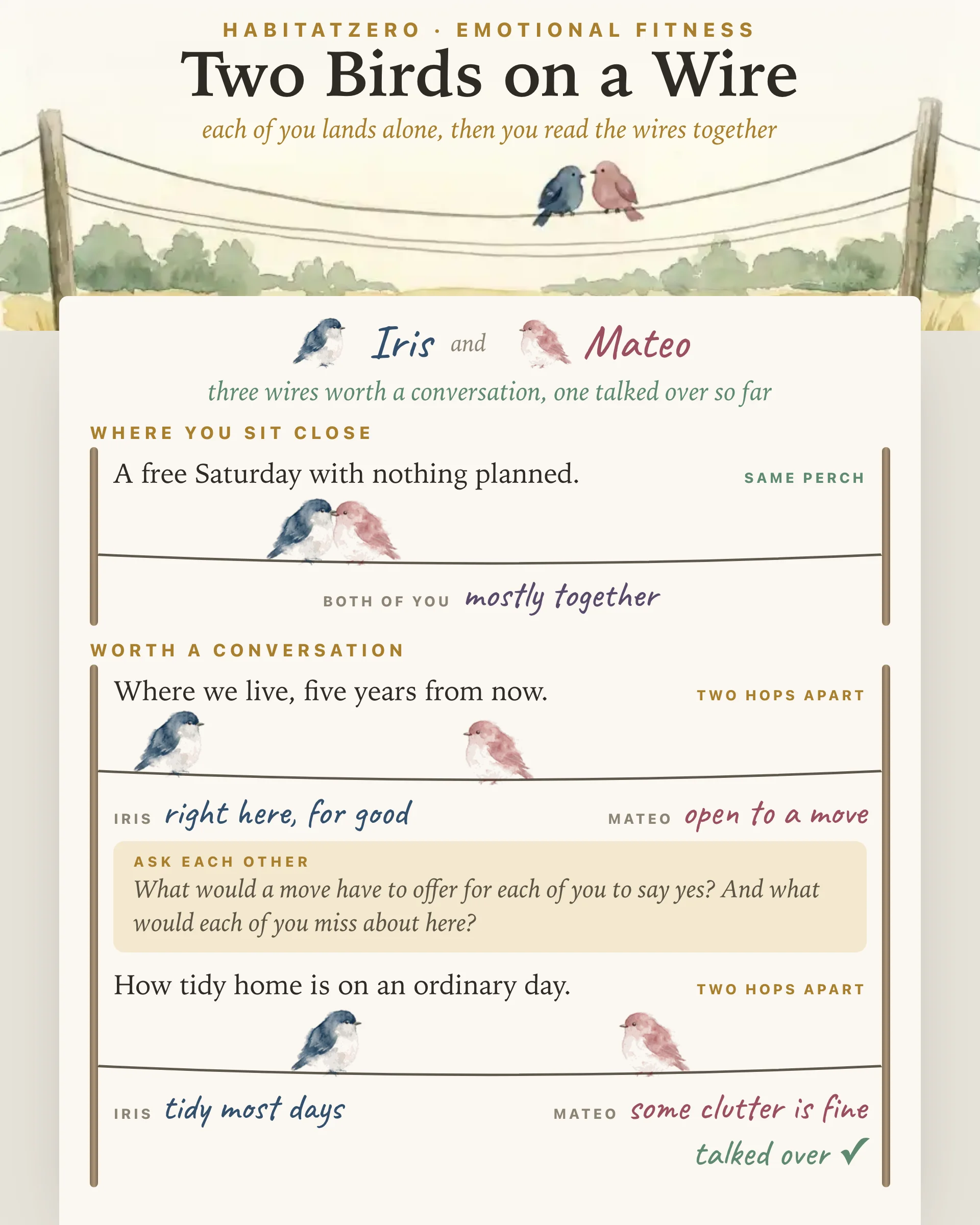
Most couples compatibility quizzes end with a number: a match percentage, a grade, a pair of zodiac signs that supposedly get along. This one ends with a picture. Each of you lands a bird on ten wires, alone and out of the other's sight, and then both birds land at once, so you can see where you already sit close and where your answers are far enough apart to talk about. Think of it as a relationship compatibility test built for a conversation rather than a verdict.
Every wire is one question with a pole at each end. The first asks what you would do with an unexpected five hundred dollars, and its poles read save it and enjoy it. Five perches sit along the wire between them, and each perch is a phrase: every cent saved, mostly saved with one treat, half and half, and on toward spending all of it on a good time. Tap the perch that fits and your bird hops onto it, with your answer written underneath in handwriting.
The blue bird answers first. Once all ten wires are done, that partner signs a name and sends the birds off, and the screen hides them. The phone goes across the couch, and the rose bird answers the same ten wires without seeing any of the first set. Answering apart matters more than it sounds. When you can see where your partner landed, it is hard not to drift toward them, and a quiz you have both nudged toward agreement only tells you what you were hoping to hear.
When the second set is in, both birds land together. Wires where you share a perch or sit one hop apart gather under where you already sit close. Wires two hops or more apart gather under worth a conversation, each with a question written for that wire and a way to mark it talked over once you have had the talk.
A percentage would promise something the research cannot deliver. In a meta-analysis of more than three hundred studies, Matthew Montoya and colleagues found that actually being alike mattered for attraction between strangers and new acquaintances, but inside existing relationships its effect was not significant; what still counted there was feeling alike. A machine-learning study of more than eleven thousand couples, led by Samantha Joel, went further. People's own judgments about their relationship explained a large share of how satisfied they felt at the time, their partner's answers and both people's personality traits added nothing, and none of the measures could predict whose relationship would improve and whose would decline over time.
So this page does not tell you whether you are compatible, because no page can. What it can do is put both sets of answers in front of you at the same moment, which is the part a good conversation needs.
The wires cover the ground couples renegotiate every week: money, time together, home, family and the next few years. Money gets two wires for a reason. When Lauren Papp and colleagues had a hundred married couples keep diaries of their arguments at home, money was not the most frequent topic, but money arguments were more likely to come back and to stay unresolved, even though the couples tried harder to solve them.
Some questions are too big for a wire. Whether to have children, what place faith has in your home, or a move across the country each deserve an evening of their own, not a perch. If one of those is open between you, let this page warm you up for that conversation rather than stand in for it.
It is tempting to read a far wire as a warning. The Gottman Institute takes the opposite view: it reports that sixty-nine percent of relationship conflict is about perpetual problems rooted in the basic differences any two people bring, and that what matters is whether a couple can keep a dialogue going about them. A wire where your birds sit apart is simply the next thing to ask about, and the prompt under it asks for the story behind each answer instead of a ruling on who is right.
Take the far wires one at a time, on separate evenings if you like, and start with the one that feels lightest. If the same difference keeps dragging you into the same argument no matter how you come at it, that is a good moment to see a couples counselor, who can help each of you hear what the other is protecting.
Land your birds before a shared step, such as moving in, merging accounts or planning a wedding, and again a year or two later, when some answers will have shifted.
If you would like something lighter first, The Couples Quiz is a guessing game about how well you know each other's everyday preferences. For a steady rhythm afterward, the Couples Check-In is a short weekly ritual for two. And if one of your conversations runs hot, agree on Our Fair Fighting Rules before you pick it back up.
A useful one records where each partner stands on the everyday ground couples negotiate, such as money, time together, chores, family and plans, and then shows the two answers next to each other. This page never turns them into a percentage; it shows which wires you share and which ones are worth talking through.
Yes, that is how it is built. The first partner answers alone and passes the phone, and those answers stay hidden while the second partner lands on the same ten wires. Nothing appears until both sets are in, so neither of you can drift toward the other.
No quiz has earned that claim. A large study that pooled forty-three couples datasets found that the measures it compared could not predict whose satisfaction would rise and whose would fall over time. Treat any result, this one included, as an opening for conversation rather than a forecast.
Distance on a wire is information about where each of you stands today, not a judgment on the relationship. Most couples carry a few lasting differences, and the real question is whether you can keep discussing them kindly. When one keeps turning into the same fight, a couples counselor can help you untangle it.
This page shows the finished wires of an example couple so you can see how a landing looks. To land your own birds, pause between turns and tick off the conversations as you have them, open the quiz in HabitatZero, which costs nothing.
By the team behind Fabulous, the science-based self-care app used by over 30 million people.