Leaves on a StreamEmotional Fitness · ~3 min
About this template · Updated September 2026
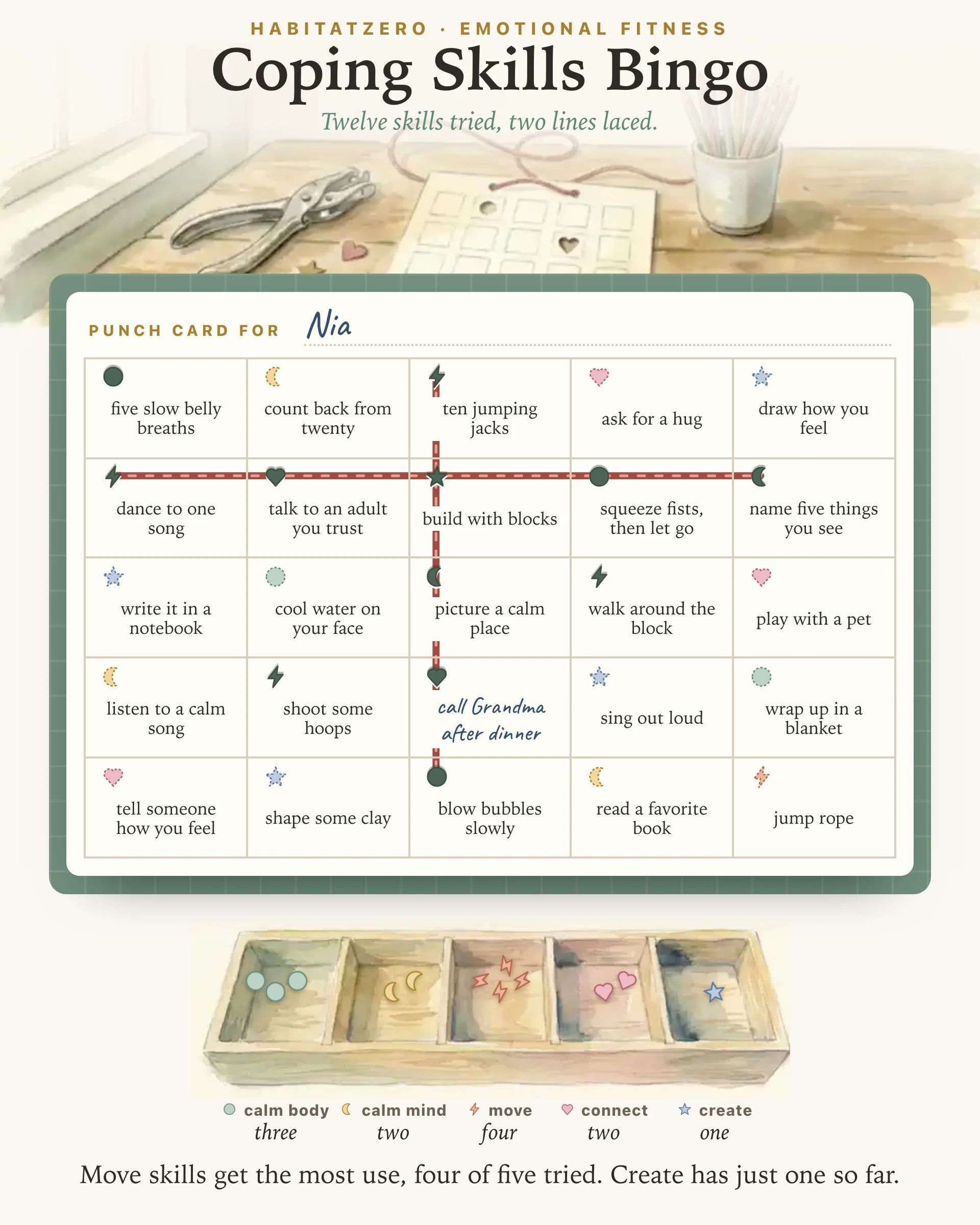
Coping skills bingo is a bingo card where every square is a small, concrete thing a child can do when a feeling gets too big: five slow breaths, a lap of the yard, a hug, a drawing. Counselors use it in groups, therapists send it home between sessions, and parents stick it on the fridge. One rule makes it work: a square gets marked when the skill is actually tried, not when it is merely named. On this punch card, you punch the square when the skill happens, a cord laces through every finished line, and the punched-out shapes collect in a tray that shows which kinds of coping the child reaches for.
A coping skill grows the way reading or free throws do: with repetition, ideally on ordinary days. A child who has only heard about belly breathing is unlikely to try it for the first time mid-meltdown. A child who has done it a dozen times at bedtime, for a punch on a card, has something ready.
A meta-analysis of 213 school-based social and emotional learning programs, covering more than 270,000 students from kindergarten through high school, found better social and emotional skills, attitudes and behavior than in comparison groups, plus an 11-percentile-point gain in achievement (Durlak and colleagues, 2011). Programs that followed recommended practices for building skills got better results. A bingo card is no such program, just a small routine on the same idea: practice on purpose, in small steps, where the practice shows.
The card mixes five kinds of coping, each with its own punch shape:
The squares are arranged so that every row, column and diagonal holds exactly one skill of each kind. A finished line therefore means five different kinds of coping got tried, not five versions of the same favorite.
Tap a square once the child has used that skill, and it punches through. Tap a punched square twice to patch a mistake. Five in a line laces a cord through the holes, and all twenty-five is a blackout.
Switch to swap squares to fit the card to the child: any open square can trade its skill for another of the same kind, or take one in the child's own words, shown in handwriting. For a group, deal and print a fresh card per child; each deal arranges the same five kinds differently. A printed blank card has a shape in each square to color in when the skill gets tried.
Below the card, the tray sorts punched shapes by kind and says which kind gets the most use and which lags behind.
A large review of coping in children and teens pooled 212 studies with more than 80,000 young people (Compas and colleagues, 2017). Coping that works on the problem or the feeling directly, and coping that adapts to it through acceptance, rethinking or distraction, went along with fewer symptoms of anxiety, low mood and behavior problems. Avoidance, denial and bottling feelings up went along with more. Most of those studies measured coping and symptoms at the same moment, so they show a link rather than proof that teaching a skill causes the difference.
Variety matters, though less than you might hope. A meta-analysis of coping flexibility found a small-to-moderate link with better adjustment overall, and only a small one for simply having a broad repertoire; fitting the skill to the situation mattered more (Cheng, Lau and Chan, 2014). So read the tray as a conversation starter rather than a score. If move skills fill up first, ask what made them easy, and when a calm-mind skill might suit the moment better.
No study shows that a bingo card on its own changes how a child copes. It is practice, not treatment. If a child's upsets are frequent, intense, or getting in the way of school, sleep or friendships, bring it to their pediatrician or school counselor.
At home, one card on the fridge and a two-minute check at bedtime is plenty; celebrate a line with something small and shared, like choosing Friday's dinner. In a classroom or counseling group, demonstrate one skill per session, let everyone try it, and read the tray together at the end of the week. Feelings Bingo makes a good warm-up, because naming a feeling comes before choosing what to do with it.
For teens, swap anything that sounds young, let them write their own squares, and keep the card theirs.
In the middle of a meltdown, help the child settle first and punch the square later. Once a few skills prove themselves, move them into The Coping Skills Toolbox, and when the squares need fresh ideas, 101 Coping Skills has plenty to borrow.
It is a bingo card whose squares are small things a child can do when feelings run high, such as slow breathing, a walk or talking to someone. Counselors, teachers and parents use it to turn practicing those skills into a game with lines and a blackout to aim for.
Give each child a differently arranged card. Each round, the leader demonstrates one skill, everyone tries it together, and any child who has that skill on their card punches it. The first child to complete a line explains which skills made it up and when they might use one.
Yes, once the squares sound their age. Swap younger skills such as blowing bubbles for ones a teen would really use, like texting a friend or making a playlist, and let them write a few squares in their own words. Teens tend to take the card more seriously when it stays private.
No. It is a way to rehearse skills and notice which ones a child reaches for. It can support work a child is doing with a counselor or therapist, but it does not treat anything, and a child who is struggling often or badly should see their pediatrician or a mental health professional.
Yes. The card is free, and the print button gives you a clean letter-size page with a shape in each square for the child to color in once the skill is tried. Keeping the punches, the laced lines and the tray from week to week is what personalizing it in HabitatZero adds, also at no cost.
By the team behind Fabulous, the science-based self-care app used by over 30 million people.