Leaves on a StreamEmotional Fitness · ~3 min
About this template · Updated September 2026
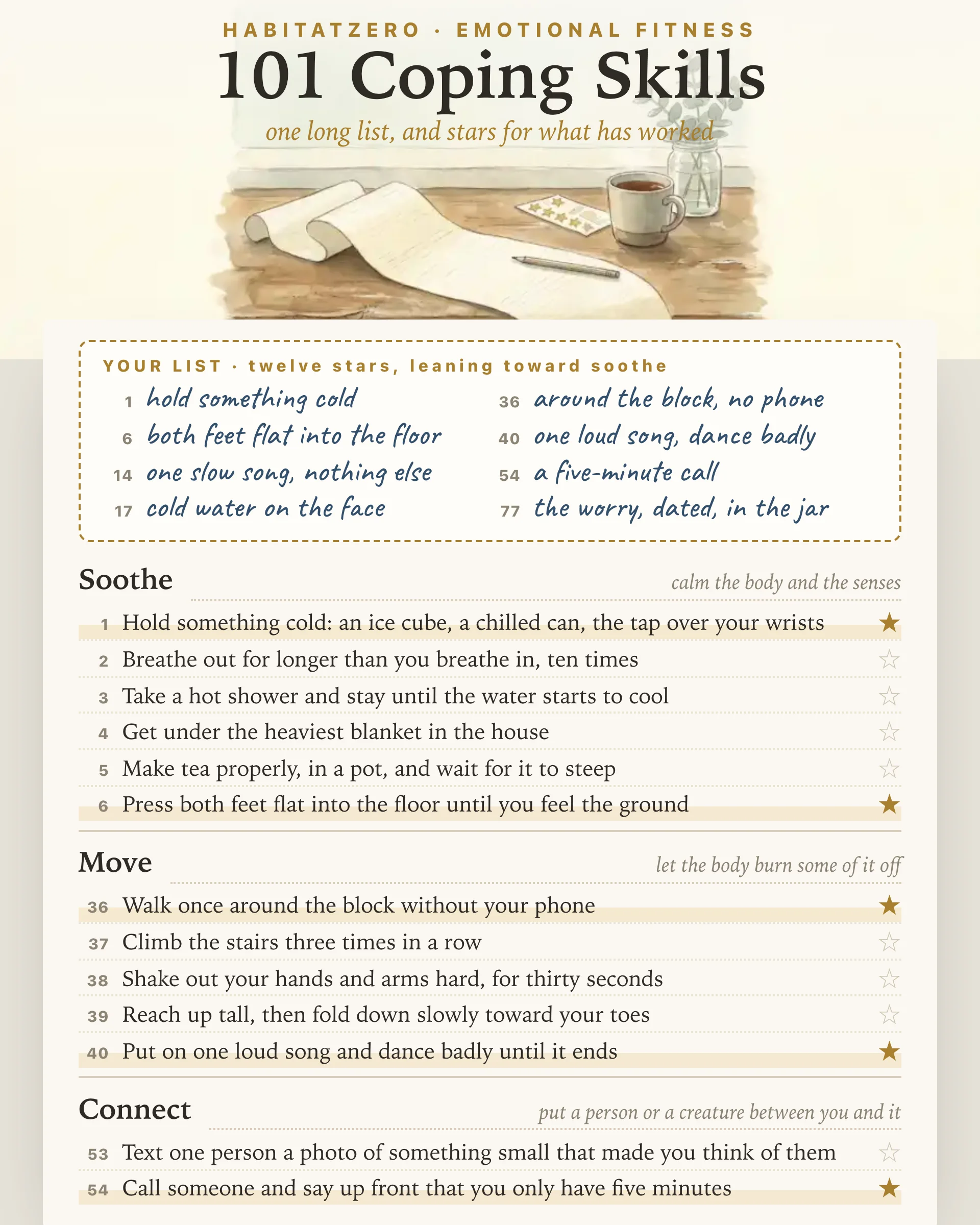
Most of the "101 coping skills" sheets you can find are photocopies of a school counselor's handout: a hundred and one lines in one long column, with nothing to say about which of them you could do at a desk or which need another person. The number is the point. Nobody uses all of them, but a list that long almost guarantees a few you would never have thought of, and the ones that work are rarely the obvious ones.
This page keeps the hundred and one and fixes the rest. The list is sorted by the kind of help each skill gives, every line carries tags for how long it takes, whether it needs company, whether it works at your desk and whether it costs anything, and there is a star beside each one for the ones that have actually worked on you.
The groups follow how researchers have sorted coping for decades. When Charles Carver and colleagues built the COPE inventory, they separated problem-focused coping from emotion-focused coping, and both from turning to other people, with distraction and disengagement measured as strands of their own. The six headings here are those strands in plain verbs.
None of the six is the good one. Reviewing three decades of coping research, Susan Folkman and Judith Moskowitz argued that whether a strategy helps depends on the situation it meets: the distraction that steadies a wait for test results makes a problem you could fix worse. So the list gives you a range and lets the moment choose.
Under the title are two rows of chips. The first is what you have: a minute, ten minutes, alone, with people, at work, no money. The second is what you need: to calm down, to get out of your head, to feel less alone, to get moving. Tap any of them and the list narrows to the skills that fit all of it, and a line under the chips says how many of the hundred and one are left. Tap again to release.
The stars are the part a printed list cannot do. Star a skill and it lands in a short list at the top, copied out in handwriting; the line under the title counts your stars and says which kind of help they lean toward and which kind has none yet. The sheet holds fifteen stars on purpose: they turn a list you read once into a list you would actually grab, and fifteen is about as long as a grab list gets.
At the bottom there is room for six lines of your own, numbered from one hundred and two onward. And if you came for the PDF, print the page: the chips disappear and what comes out is the full numbered list in two columns, hollow stars for marking by hand, your stars filled in, and your own lines at the end.
Two of the six groups have research worth knowing about. A Cochrane review of thirty-nine trials found that exercise reduced symptoms of depression by a moderate amount compared with no treatment, though the effect shrank to nothing significant in the six most rigorous trials, so moving is fairly called a reliable help and unfairly called a cure. On the connect side, a meta-analysis across 148 studies and more than three hundred thousand people found that stronger social relationships went with a fifty percent higher likelihood of survival over the follow-up periods, an association the authors put on a par with established risks like smoking. A five-minute call is not a health plan, but it is not nothing either.
What the evidence cannot say is which line will work for you. That is what the stars are for.
It is a list for ordinary hard afternoons and heavy weeks. It diagnoses nothing and is not a treatment. If the moments you reach for it are frequent, frightening, or getting heavier, that is a conversation for a professional, and a starred list is worth bringing to it.
Read the whole list once on a calm day and star the ones with a track record. On the hard day use the chips: two taps, then the first line that fits. If you would rather sort your keepers into drawers with a grab-first tray on top, the Coping Skills Toolbox does that, and Coping Skills Worksheets is the place to write a when-note beside each one. The second line on this list, the long out-breath, has a page of its own in the Physiological Sigh.
It is the same idea with the paper problem fixed. All hundred and one skills are here, numbered and grouped by what they do, and printing the page gives you the whole list on paper, with the difference that the stars you added come out too.
The lists that circulate under both names are counselor handouts of small, concrete things to do in a hard moment, and they overlap almost completely. This page rounds up to a hundred and one and sorts them by the kind of help each gives, so you can find the right kind without reading all of them.
Do not read it in the moment. Tap what you have, say ten minutes and alone, and what you need, say to calm down, and the page shows only the lines that fit both. Most combinations leave you a dozen or two, and the first one that seems possible is the right one.
Soothe settles the body, distract takes you somewhere else for a while, move lets the body burn it off, connect brings in another person, express gets it out onto a page or into a sound, and solve takes one step toward the actual problem. Coping research sorts strategies into roughly these strands, and none of them is the single healthy one.
Reading and printing the list needs nothing. Keeping your stars and your own six lines between visits means signing in to HabitatZero, which is free, because the public page shows a worked example that cannot be changed.
By the team behind Fabulous, the science-based self-care app used by over 30 million people.