Leaves on a StreamEmotional Fitness · ~3 min
About this template · Updated September 2026
Cope ahead is one of the emotion regulation skills in Marsha M. Linehan's dialectical behavior therapy, or DBT. In the second edition of her skills training handouts, published in 2015, it shares Emotion Regulation Handout 19 with building mastery, and her preface to that edition names it among the new skills. Guilford's 2025 revised edition regroups the handouts by skill, so look for it by name there. The Dress Rehearsal is a practice page HabitatZero made on its own: Linehan, her publisher and the DBT training organizations had no hand in it, and none of them has reviewed or endorsed it.
Most emotion skills are built for the moment itself. But plenty of hard moments arrive on a calendar. The performance review is on Thursday. Thanksgiving is at your brother's again. You already know who will be in the room and which feeling tends to grab the wheel.
Cope ahead puts that warning to use. While you are calm, you decide what you will do when the feeling rises, then practice doing it in your mind until the plan feels familiar. On the day, you reach for something you have already done a few times.
Linehan points to the skill from other modules as well, suggesting it for events that feel impossible to accept and before ending a relationship that is doing harm.
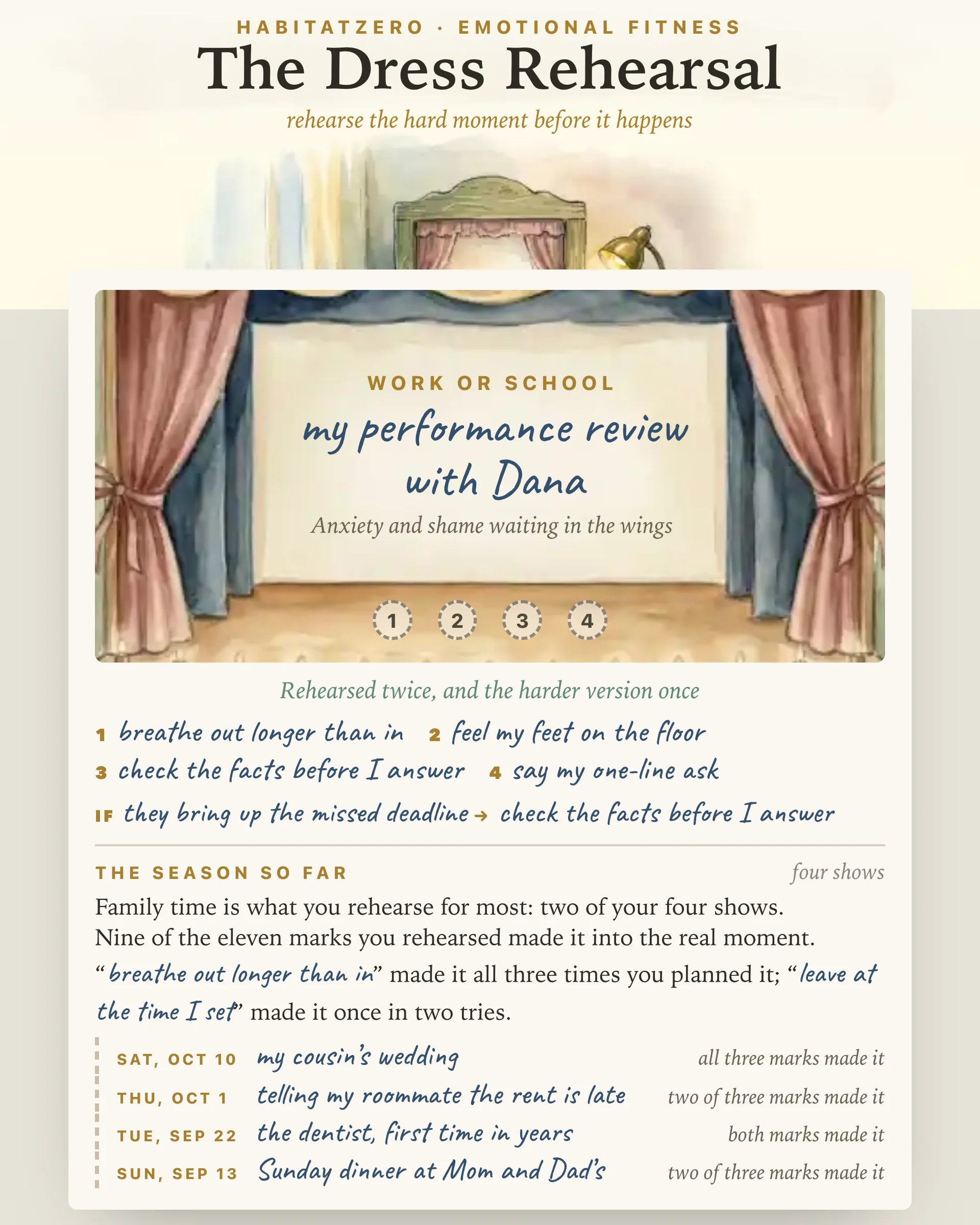
The page is a painted toy theater. Tap what kind of situation is coming and say it in a few words, and the words go up on the backdrop. Then choose the feelings waiting in the wings and the urges they bring, like snapping back or going quiet.
Each skill you choose becomes a numbered mark on the stage floor, up to five, in the order you plan to use them. Last, pick the harder version, the turn you dread, and the one mark you will answer it with.
Rehearsing runs the plan one line at a time across the backdrop, each mark lighting up as you picture yourself using it. The harder run dims the lights while the worst version plays out. Five slow breaths then take the lights down, which is Linehan's closing step.
After the real thing, the Afterward tab asks which marks made it, whether the harder version showed up, and whether the day went easier, about the same or harder than rehearsed. The season underneath reads back every show you log: which kinds of situations you prepare for most, how many rehearsed skills you really used, and which ones keep slipping.
Rehearsing a performance in your head has a real research base, most of it outside therapy. A 1994 meta-analysis by Driskell, Copper and Moran found that mental practice, the cognitive rehearsal of a task before doing it, had a positive, significant effect on performance, shaped by the kind of task, the gap between rehearsal and performance, and how long the rehearsal lasted. A later review of stress inoculation training, a method for preparing people ahead of a known stressor, pooled thirty-seven studies and found it reduced performance anxiety and helped people perform under stress.
We found no study that tests cope ahead by itself; it appears in research only inside DBT skills training, which does have trial support: in a small randomized pilot trial with forty-four anxious or depressed adults, a DBT skills group reduced emotion dysregulation more than a support group did, and the gains tracked how much people used their skills. That cannot tell you how much of the benefit came from rehearsing ahead.
Set the stage a day or two before something you expect to be hard, and run it again the night before if the plan still feels shaky. Keep the marks few and concrete; a skill you can picture in that room is easier to find under pressure than a vague intention. Log the show even when it went badly, since the season is most honest when it holds the rough nights too.
This page is a place to practice, not a treatment. If you are in a DBT program, bring your season to your skills group or your therapist. When the scene is a conversation, The DEAR MAN Script helps you build the words, and if you feel worn thin before the day starts, The PLEASE Kite tracks the body care that sits beside cope ahead in Linehan's list. If a scene you are preparing for ever brings up thoughts of hurting yourself, do not wait for the day: call or text 988 in the US, or your local emergency number, and let someone help you now.
It is an emotion regulation skill from Marsha Linehan's DBT, meant for situations you can see coming. You describe the situation, choose the skills you will use, imagine yourself there as vividly as you can while you use them, rehearse a version where it goes worse, and relax once you are done.
Keep it concrete. Say plainly what will happen and who will be there, name the feelings and urges likely to get in the way, and list a few specific skills in the order you will use them. Add the outcome you fear most and the skill you would answer it with, then rehearse the whole plan in your mind.
Mental rehearsal has solid support in performance research, where a 1994 meta-analysis found that practicing a task in your head improved how well people did it. Cope ahead has little research of its own, though the DBT skills training it belongs to has done well in trials.
No. It is an independent practice page built around the cope ahead steps on Linehan's Emotion Regulation Handout 19, and it has no tie to Linehan or to any DBT organization. It is practice, not therapy; if you are in DBT, your therapist or skills group is the best place to take what you log here.
You can look through a filled-in example right here. Setting your own scenes, running the rehearsals and keeping a season of logged shows happens once you personalize it in HabitatZero, which is free.
By the team behind Fabulous, the science-based self-care app used by over 30 million people.