
The Overwhelm Recovery ProtocolWellness & Routines · ~5 min
About this template · Updated November 2026
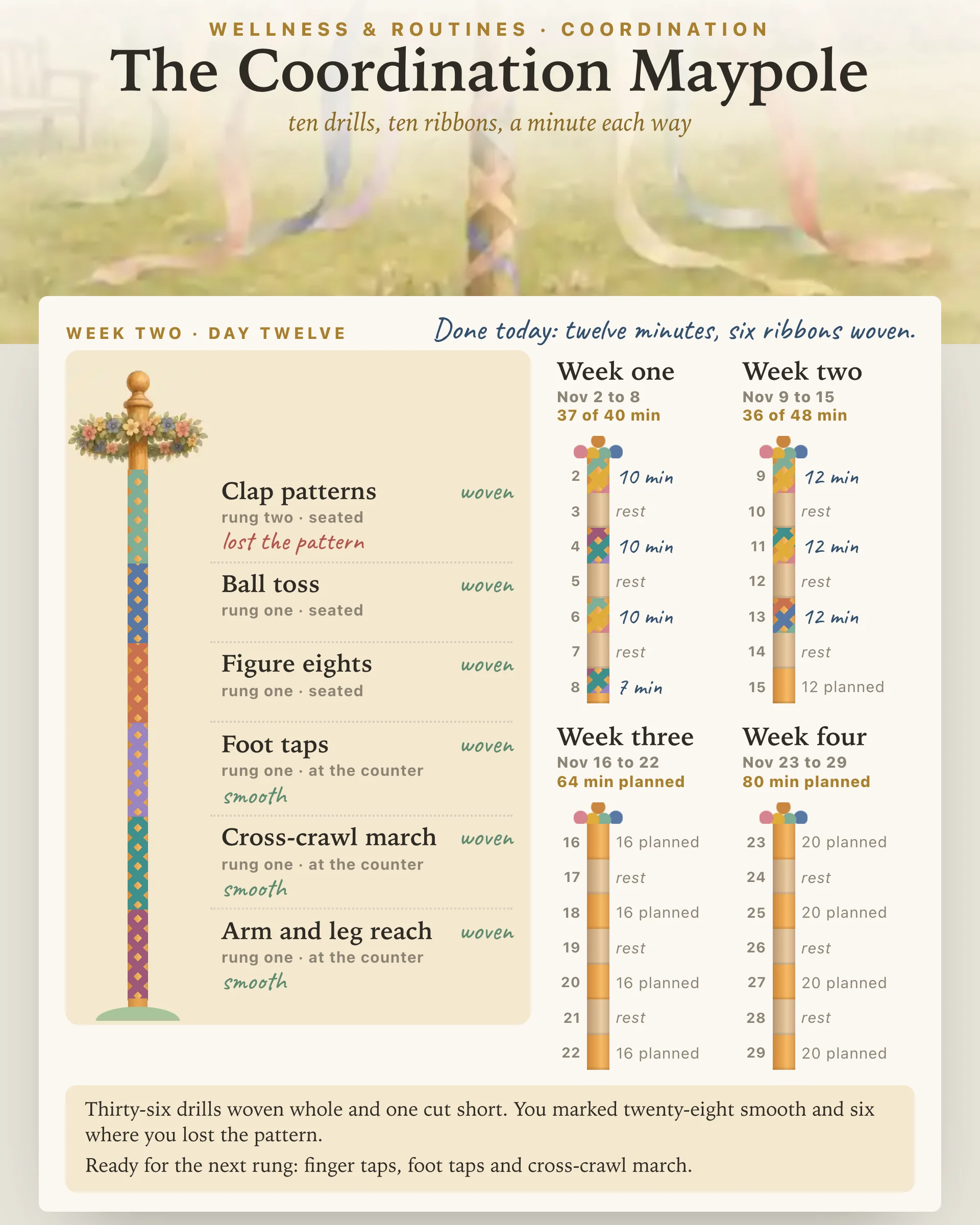
Coordination is the part of moving that nobody notices until it slips: one hand reaching for a cup while the other steadies the saucer, a foot finding the curb while your eyes stay on the crossing light. The coordination exercises on this page practice that timing on purpose. Ten short drills each pair two sides or two directions, and you run them on a timer that winds a ribbon onto a painted maypole for every drill you finish.
The first five keep you in a chair and ask your hands to share a pattern: finger taps, pat and rub, clap patterns, a soft ball passed from hand to hand, and figure eights traced sideways in the air. The other five bring your feet in: foot taps in a set order, a cross-crawl march where a hand meets the opposite knee, an arm and leg reach on opposite sides, side steps with an arm reaching overhead, and heel-to-toe steps along the kitchen counter.
Every drill has three rungs: slow and plain, then a second rule, then a twist such as a clap before the catch. Each also has its ways: seated, at the counter with one hand resting on it, or hands free with the counter right beside you. Every standing drill keeps a supported way and all but one have a seated version; heel-to-toe steps are only ever done holding the counter.
A drill takes two minutes, one leading with one side or going one direction and one the other way. Beside the pole, the left ribbon end winds in during the first minute and the right during the second, so a drill done both ways shows a crossed weave and one cut off halfway shows stripes running one way only. The clock reads the real time since you pressed start, so a locked phone keeps true time, and a pause stops it outright.
Only what you finish counts: a session ended early keeps its whole minutes, and a drill counts as woven only when both its minutes have run. After a session, mark each drill smooth or lost the pattern. When a drill's two latest sessions were both whole, both on your current rung and way, and both smooth, the page says the next rung is ready. If the latest was marked lost, even one cut short, it points to the rung below for a while. It never moves you up by itself.
Week one asks for four ten-minute sessions: five hand drills one day and five foot drills the next. Week two has six drills a session, week three eight, and week four all ten, twenty minutes on four days, 232 minutes over the month. The plan walks through the ten in order, so every drill keeps coming round, and each day's minutes weave into that week's small pole below the session.
A 2019 Cochrane review gathered 108 trials with 23,407 people living at home in 25 countries, on average 76 years old and 77% women. Programs built on balance and functional exercise lowered the rate of falls by about a quarter compared with control groups, and the authors rated that finding high certainty. Most of the trials had unclear or high risk of bias, none of the programs was this set of drills, and an average across thousands of people promises nothing to any one of them.
The closest trial to practicing patterns on purpose is a Geneva study of music-based multitask training. It followed 134 people over 65 who lived at home and were at higher risk of falling. Six months of a multitask exercise program set to piano music made their walking steadier while they did a second task, improved their balance tests and came with fewer falls than in a group still waiting for the program. It was a single trial of one structured program, not drills done alone at a counter.
For a sense of how much, the World Health Organization's 2020 guidelines ask adults over 65 to do varied activity that stresses balance and strength on three or more days a week. These drills can be one part of that. They are not strength training, so pair them with something that is.
This page makes no claim about memory or thinking. If exercise and the brain is your question, The Three-Legged Stool builds weeks of brisk walks, strength and a new step, and sets out what that research does and does not show. This page is narrower: it practices coordination itself, side against side and direction against direction.
If standing steady on one foot is the skill you want, The Balance Ladder climbs ten counter holds over six weeks, and The Shorebird Shelf times each foot, with a month of counter practice between checks.
Talk with a doctor or physical therapist before you begin if you have had a fall or dizzy spells, a joint replacement, a heart or blood pressure condition, or pain when you move. Keep a sturdy chair or the counter within reach for every standing drill, wear shoes that grip, and stop any drill that hurts or makes you lightheaded. If the ball rolls away mid-drill, let it lie until the two minutes are up rather than bending for it.
They are movements that ask two sides of you, or your hands and eyes, to keep a pattern together: thumb to each fingertip in turn, a hand crossing to the opposite knee, a ball passed from hand to hand, a sideways step with an arm reaching up. The skill being practiced is timing between parts rather than strength.
Start with drills you can do seated, then add standing ones with a hand on the kitchen counter: foot taps in a pattern, a cross-crawl march, side steps with an arm reach and heel-to-toe steps along the counter. A large review of exercise trials in people over 60 found that balance and functional training lowered the rate of falls, though no trial has tested this exact set of drills.
Short, regular sessions are easier to keep up than long, rare ones. This plan asks for four sessions a week, ten minutes at first and twenty by week four. World Health Organization guidance asks adults over 65 to do varied activity that stresses balance and strength on three or more days a week, and these drills can be one part of that.
Yes. Finger taps and pat and rub are always seated, and clap patterns, the ball toss, figure eights, foot taps, the cross-crawl march, the arm and leg reach and side steps all have a seated way. Only heel-to-toe steps need standing, and those are always done with a hand on the counter.
Talk with a doctor or physical therapist first if you have had a fall or dizzy spells, a joint replacement, a heart or blood pressure condition, or pain when you move. Keep a sturdy chair or the counter within reach for anything done standing, and stop a drill that hurts or leaves you lightheaded.
By the team behind Fabulous, the science-based self-care app used by over 30 million people.


