
Leaves on a StreamEmotional Fitness · ~3 min
About this template · Updated September 2026
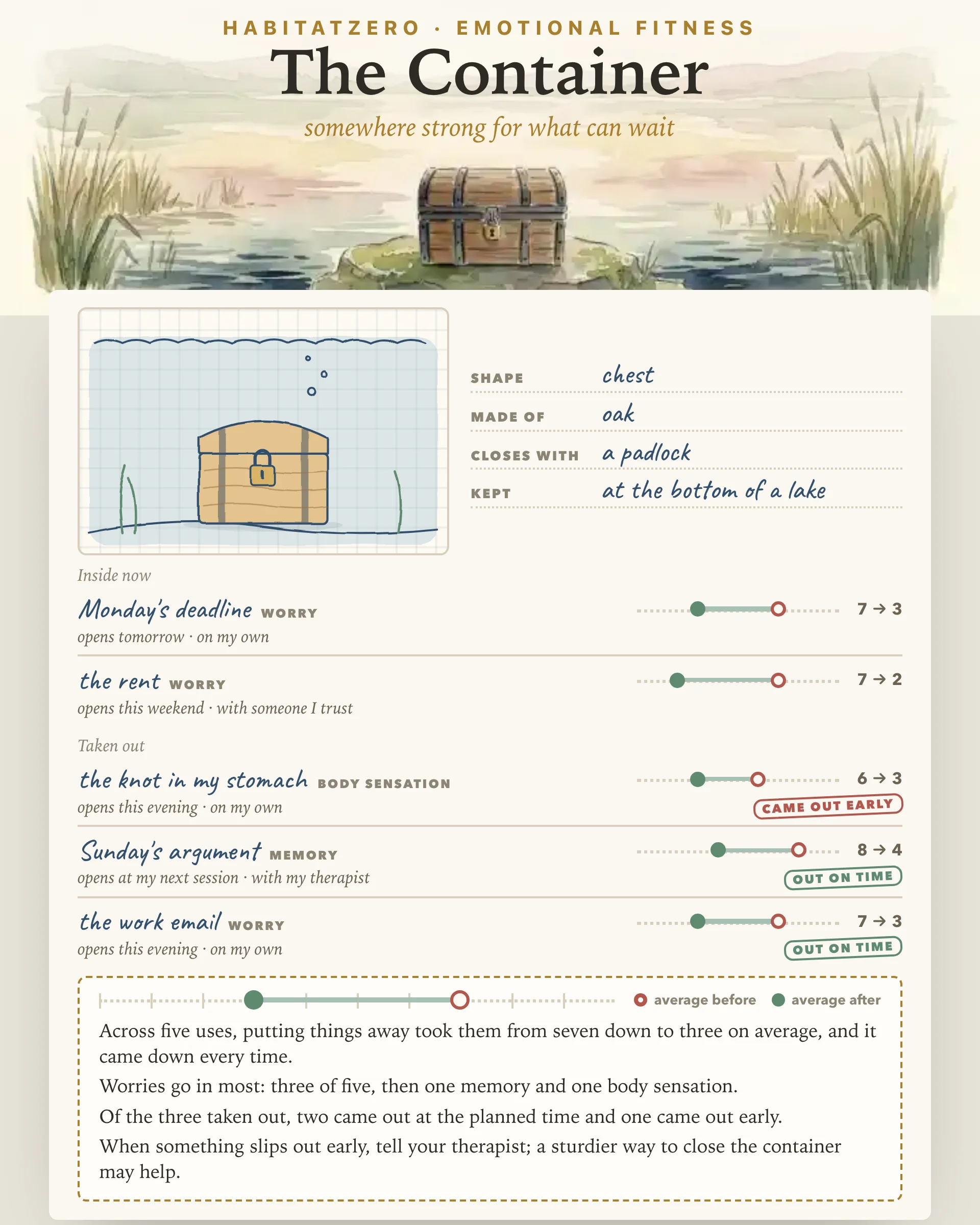
The container exercise is a short visualization for the moment something heavy arrives at a time you can't give it room. You picture a container strong enough to hold it, put the thing inside with a label of a word or two, close it, and leave it somewhere safe until an agreed time, most often your next therapy session. Nothing gets erased. The point is that you choose when to deal with it, instead of it choosing for you.
Trauma therapists teach it as a stabilizing skill. EMDR (eye movement desensitization and reprocessing) runs in eight phases, and the second one, preparation, is where a therapist builds up ways for you to settle and stay steady between sessions before any memory work begins. The container is one of the skills often taught there, and clinicians outside EMDR use it too, including at the end of a session that stirred things up. The zero-to-ten rating on this page is the same one EMDR uses, which EMDRIA's glossary of EMDR terms calls the SUD scale: zero means no disturbance at all, ten the worst you can imagine.
It is a way to steady yourself, not a way to process anything. The EMDR International Association says EMDR itself should only be offered by trained, licensed clinicians, and it does not support do-it-yourself versions. Learn the container with a therapist, especially if what you are holding is trauma, and never use this page to walk back into a painful memory alone.
The sheet sketches your container in pen as you build it. Pick a shape, a material, a lock and a hiding place, or write your own. Then it walks one thing in at a time, with every step written in your container's own words, like "Snap the padlock shut" or "Leave it where it is kept, at the bottom of a lake." The sketch opens, closes and locks along with you. If you change the container halfway through, the walk starts over, so the words always match what you pictured.
Your before and after ratings sit on a small track, so the drop is visible at a glance. A memory or an image is saved only once you pick the clinician who will open it with you. An eight or higher after the lid is shut brings up a line about getting help instead of a pat on the back.
Over weeks, the log becomes the useful part. It shows how far the container usually brings things down, which kinds of material you put in most, and whether things came out at the planned time or pushed their way out early. That last pattern is worth bringing to your therapist: something that keeps slipping out may need a sturdier container, or attention sooner than you planned.
Almost no research tests the container by itself. It turns up inside short stabilization programs instead. In an open trial of a four-session imagery program for people with PTSD after accidents, the second session included a thirty-minute containment exercise; among the fifteen who finished, symptoms fell and no one got worse, but there was no comparison group. A pilot randomized trial in 80 hospitalized teenagers with depression added six sessions of stabilization skills, container techniques among them, to antidepressant treatment, and trauma-related symptoms eased faster than in a group given medication plus health education. The skills group also got more sessions, and neither study can say what the container contributed on its own.
So treat it as a tool that is widely taught in therapy rooms and thinly tested outside them. Your own before and after ratings are the closest evidence you will get about whether it helps you.
Reach for it when something crowds in at a bad moment: the last minutes of a session, the drive to work, the hour before sleep. It also suits smaller things, such as a worry you can't act on until Monday.
If a memory won't stay put, stop. Feel the floor under your feet, look around the room, and tell your therapist; the 5-4-3-2-1 Grounding walk can bring you back through your senses first. The Butterfly Hug is another skill from EMDR's preparation phase, and The Door to Your Calm Place builds the calm place that is often taught alongside the container.
Some things don't belong in any container. If what you are carrying turns into thoughts of ending your life, call or text 988 in the US or your local emergency number, and say it plainly to whoever answers.
It is a visualization for setting distressing thoughts, feelings, images or memories aside until a safer time. You imagine a sturdy container, put the material inside with a short label, close it, and agree when it will be opened again. EMDR therapists often teach it in the preparation phase and use it to close a session that is not finished.
Plenty of people use it alone for everyday stress, like a worry they cannot act on tonight. For trauma, learn it with a therapist first, and never use it as a way to go back into a memory by yourself. If something will not stay in, stop, look around the room, and tell your therapist.
Some material keeps pushing its way out, especially at first. Make the container stronger or keep it somewhere farther away, and raise it with your therapist, who can help decide whether it needs attention sooner. The log on this page shows how often things come out early, which is useful to bring to a session.
No. EMDR is a full therapy that a trained clinician delivers over several phases. This page practices one steadying skill and keeps a log of how it goes. It does not process memories, and it is not affiliated with EMDRIA or any EMDR training program.
The filled-in example and the method are free to read here. To build your own container, walk things into it and watch how well it holds over time, personalize the page in HabitatZero, which is free.
By the team behind Fabulous, the science-based self-care app used by over 30 million people.


