
The Overwhelm Recovery ProtocolWellness & Routines · ~5 min
About this template · Updated September 2026
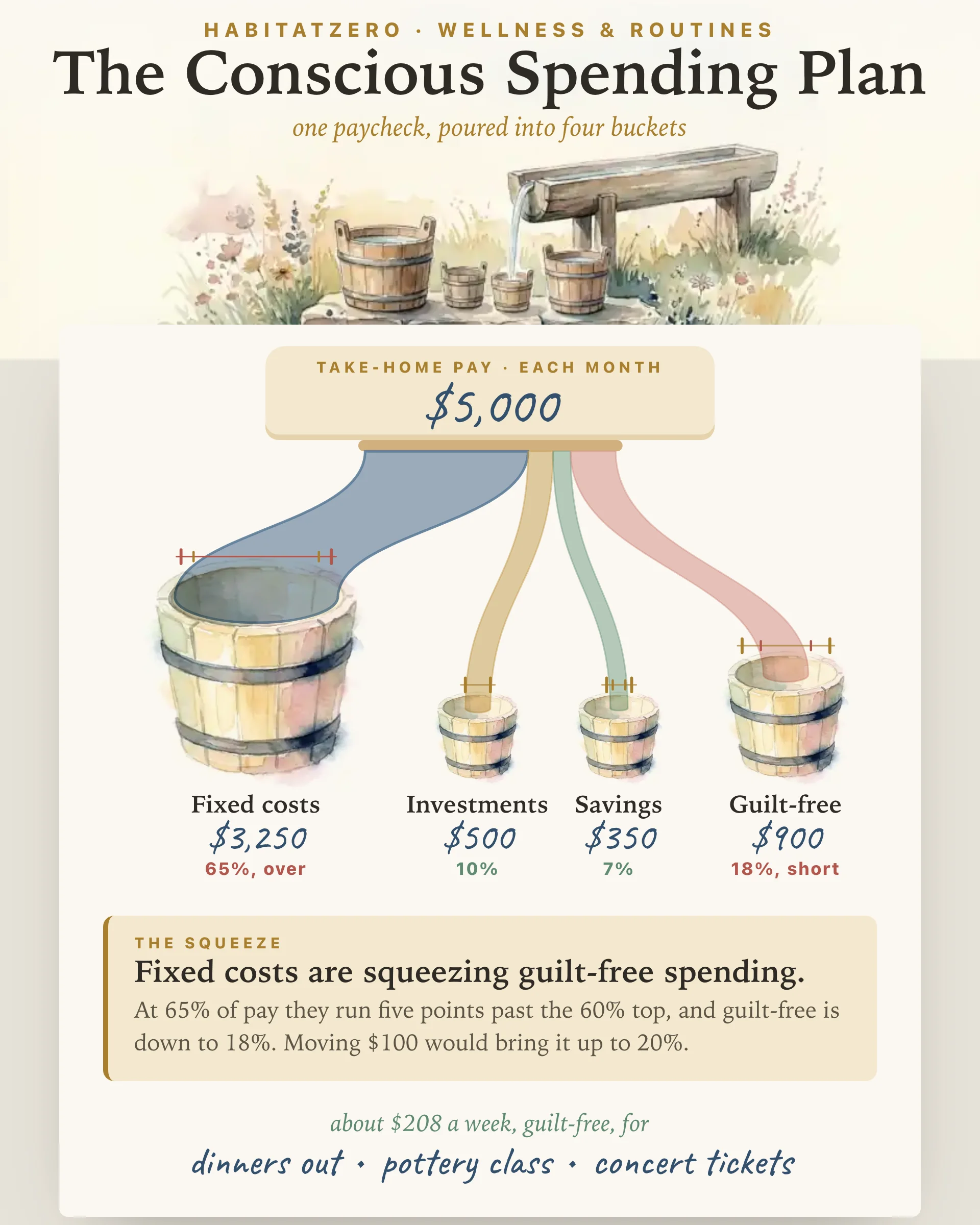
The conscious spending plan is Ramit Sethi's. He introduced it in his book I Will Teach You to Be Rich and explains the four buckets and their ranges on the site of the same name. This worksheet is an independent, interactive version of his method: it is not affiliated with Sethi or his company, and neither of them has reviewed or endorsed it.
Most budgets ask you to account for every coffee. Sethi's plan asks four bigger questions instead. How much of your take-home pay is already spoken for before the month begins? How much goes to the future you who will one day stop working? How much is set aside for the trips, weddings and repairs you can see coming? And how much is left to spend on whatever you like, with no guilt attached?
Each bucket has a range, measured as a share of the pay that actually lands in your account each month:
The ranges are rules of thumb. Sethi says fixed costs can climb to 65 or 70% in an expensive city, as long as the other buckets make room. What matters is how the four fit together, because they share one paycheck: when one grows, another has to shrink.
Type your monthly take-home pay into the slip at the top, or tap a starting figure. The pay pours out as four streams, one per bucket, and each stream leaves the slip as wide as that bucket's share. Small gold marks above each bucket show the width its range allows, so a stream spilling past its marks is over, and one that falls inside the inner marks is being squeezed.
Fill the first three buckets by tapping the lines you pay, then replace each starting guess with your own figure; the sheet labels a guess until you do. Guilt-free spending is the remainder, the way Sethi frames it, so you never type it in. The sheet also turns it into a weekly amount, which is easier to hold in your head than a monthly one.
Then read the squeeze. The sheet finds the bucket running furthest past its range and the one pushed furthest under its floor, and works out how many dollars would have to move to fix the worst of it. In the sample plan, fixed costs at 65% of a $5,000 paycheck leave guilt-free spending at 18%, and the sheet says that moving $100 brings it up to its floor. It also names the biggest single line inside the bucket doing the squeezing, which is usually rent.
No study has tested Sethi's exact percentages. They come from years of coaching, not a trial, so treat them as a starting point, not a verdict.
Parts of the method rest on firmer ground. The plan runs on automation: Sethi wants transfers to leave your checking account the day after payday, so saving never waits on willpower, and the best evidence for that instinct comes from retirement plans. When one large US employer switched its 401(k) to automatic enrollment, participation rose sharply, and many new hires kept whatever contribution rate and fund the plan picked for them. Defaults do much of the work that good intentions cannot.
The guilt-free bucket has support too. A review of research on money and happiness suggested that money's surprisingly weak link to happiness may come partly from the way people spend it, and it recommended buying experiences, spending on other people and choosing many small pleasures over a few big ones. Naming what that money is for, as this sheet asks, is one way to keep it aimed at what you value.
The four buckets also line up with how the Consumer Financial Protection Bureau defines financial well-being: control over day-to-day finances, the capacity to absorb a shock, being on track to meet your goals, and the freedom to make choices that let you enjoy life. That last one is guilt-free spending under another name.
This sheet is a planning aid, not financial advice. Your figures stay in your own sheet, with no bank connection.
A new year is a natural moment to build the plan, and so is a raise, a move, a new job or a rent increase. After that, glance at it each month before the transfers go out.
For a simpler split, The 50/30/20 Budget cuts pay three ways. If your savings bucket has to cover known bills that arrive once or twice a year, The Sinking Funds Shelf gives each one its own jar. And if you are not sure what your fixed costs really add up to, a month in The Receipt File will show you.
It is Ramit Sethi's alternative to tracking every purchase. Monthly take-home pay is split into four buckets, fixed costs, investments, savings and guilt-free spending, each with a target range, and once the first three are funded the rest can be spent without second-guessing.
As shares of take-home pay, Sethi suggests 50 to 60 percent for fixed costs, about 10 percent for investments, 5 to 10 percent for savings and 20 to 35 percent for guilt-free spending. He adds that fixed costs can reach 65 or 70 percent in an expensive city as long as the other buckets give way.
The 50/30/20 rule cuts pay into needs, wants and savings at fixed shares. Sethi separates money invested for retirement from money saved for goals and emergencies, gives each bucket a range rather than one number, and treats guilt-free spending as the remainder after everything else is covered.
Sethi counts retirement contributions as investments, and his ranges are measured against take-home pay. If your 401(k) leaves your paycheck before it lands, it is already missing from take-home pay, so either keep it off this sheet or add it to both your pay and your investments. Choose one approach and stay with it.
No. Ramit Sethi created the conscious spending plan, and this page has no tie to him or to I Will Teach You to Be Rich; nobody there reviewed or endorsed it. It borrows his four buckets and their ranges, credited in the article, and keeps your figures in your own sheet.
You can study the filled sample on this page without an account. Pouring your own pay into the buckets and keeping the plan happens in HabitatZero, which costs nothing, and the figures you enter stay in your own sheet with no bank connection.
By the team behind Fabulous, the science-based self-care app used by over 30 million people.


