
Leaves on a StreamEmotional Fitness · ~3 min
About this template · Updated September 2026
The five styles on this card come from Kenneth W. Thomas and Ralph H. Kilmann, who sorted conflict behavior along two dimensions in the 1970s. Thomas has told how it began: he found five approaches to conflict in Robert Blake and Jane Mouton's The Managerial Grid, then pulled them loose from its fixed managerial styles into a taxonomy that reached beyond boss and employee (Thomas, 1992). Their licensed questionnaire, the Thomas-Kilmann Conflict Mode Instrument, is offered through Kilmann Diagnostics. The Dance Card is an independent exercise on that published model. Its ten scenes were written for this page, none of the instrument's thirty items appear here, and neither author nor anyone who sells the instrument is connected to it or has endorsed it.
When what you want runs into what someone else wants, you are answering two questions at once. How much does my own goal matter here? And how much do this person, and the way things stand between us, matter? The model's insight is that these are separate answers, not two ends of one rope. Together they give five styles:
Collaborating is the one people misread. It is not halfway. It means neither of you settles, which is why it takes longer and isn't always worth the time.
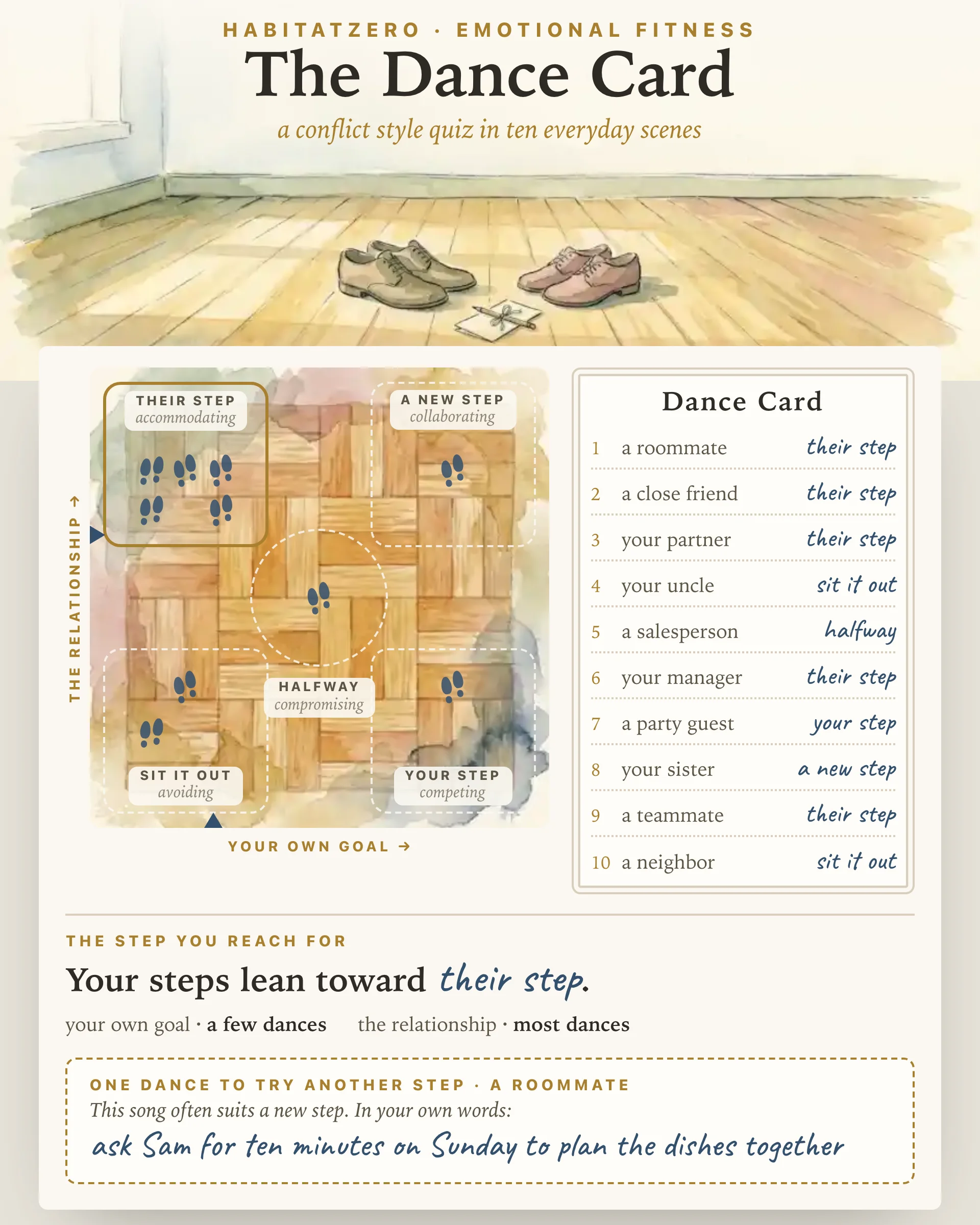
This conflict style quiz treats each disagreement as a dance with a partner: a roommate, your manager, your sister, a salesperson who won't take no. Each of the ten scenes offers five responses, one per style, written as ordinary actions and set in a different order in each scene. Tap the one you would really do, and a pair of footprints lands on a painted floor where your own goal runs across and the relationship runs up.
With all ten dances on the card, the floor reads back the step you reach for, how often you stood up for your goal and looked after the relationship, and when each step tends to fit. It then picks one dance where your step and the moment may not have matched, offers a line to try, and leaves room to say it your own way.
Styles are habits, not types. Kilmann's summary of the model says everyone is capable of all five modes and nobody has only one. People lean on some modes through temperament or practice, and what they do depends on the situation as well as on who they are.
On which style works best, Thomas's review argues both sides. He cites a persuasive body of findings linking collaboration to better outcomes: satisfaction for the people involved, trust and respect between them, and more open decisions in their organizations. Yet contingency theorists, Thomas among them, argued that collaboration can be naive when time is short, trust is missing or the incentives reward winning, and that competing or compromising can serve better then. His resolution is that the two views answer different questions: how to cope today, and how to build better conditions over time. This page takes the practical view and names a step that often suits each scene.
Hold any self-report quiz loosely. Answers drift toward whatever sounds best, a pull researchers call social desirability bias. Thomas and Kilmann built their instrument around forced choices to blunt it, and reported that it cut the bias across groups while individuals could still show some (Kilmann and Thomas, 1977). This page uses concrete scenes, has not been validated, and works as a mirror to argue with rather than a measurement.
Footprints crowded into their step suggest generosity, and maybe fatigue: a long run of giving way can store up resentment the other person never hears about. A cluster in sit it out asks whether you come back to what you set down. Your step protects what matters to you but can cost you with people you see every day. Halfway is quick and fair, though a better answer may have been on the table. A floor full of new steps shows real care, and a lot of long talks. Not every clash needs one.
Take it on a quiet day, not mid-argument. Consider taking it twice, once with work in mind and once with home, since most people dance differently in different rooms. Partners can each fill a card and compare floors. Then practice the one dance the card hands you.
If your question is how your words land, try The Reply Rack. To work through one live disagreement, use the Conflict Resolution Worksheet, and couples who want ground rules can write Our Fair Fighting Rules together.
Everything here assumes two people who are safe with each other. If you are afraid of someone you live with or date, this is no longer a question of style: the National Domestic Violence Hotline is free, confidential and open around the clock at 1-800-799-7233, or text START to 88788.
Competing, collaborating, compromising, avoiding and accommodating. Kenneth Thomas and Ralph Kilmann placed them on two questions: how hard you press for your own goal, and how much you try to meet the other person’s. This quiz calls them your step, a new step, halfway, sit it out and their step.
No. The TKI is a licensed, thirty-item forced-choice questionnaire. This page borrows only the published five-mode model, uses ten scenes written for it, and treats its result as a reflection to think about rather than a scored assessment.
No single style wins everywhere. Collaborating tends to pay off when both people care and there is time to talk, a firm stand fits questions of safety, and letting a trivial clash go by can be the wise move. The skill lies in matching the step to the moment.
Yes. Most people lean on one or two styles through temperament or practice, and the lean often shifts with the setting, so someone who competes at work may give way at home. Taking the quiz twice, with a different relationship in mind each time, usually shows the difference.
The page shows a filled-in example card you can study. Personalize the Dance Card in HabitatZero, free of charge, to answer the ten scenes yourself, keep your floor and write down the line you mean to try.
By the team behind Fabulous, the science-based self-care app used by over 30 million people.


