Leaves on a StreamEmotional Fitness · ~3 min
About this template · Updated September 2026
Most communication style quizzes end with a label. You answer a dozen questions, and a results page files you as a planner or a connector, or as one of the four DISC letters. Those typologies describe working preferences, and they have their uses. This page asks a narrower and more practical question: when something bothers you, how does it come out of your mouth?
The answer comes from assertiveness training, which sorts replies into four styles. Passive replies keep the need to yourself. Aggressive replies say it at the other person. Passive-aggressive replies let it leak out sideways, through sarcasm, loud sighs or a silence everyone can hear. Assertive replies say it plainly and leave the other person room to answer. On the rack these become held back, sharp, sideways and straight, because a reply is something you do on a given day, not something you are.
The quiz hands you twelve ordinary moments, three for each part of life: with a partner, at work, with family and under stress. A partner books your Saturday without asking. A coworker pitches your idea as their own. A relative starts in on your life choices at dinner. You are already running late when someone asks for one quick thing.
Each moment offers four replies, one in each style, mixed up so the straight one never sits in the same place twice in a row. Pick the reply closest to what you would really say, not the one you would like to say. The rack can only show what you put into it.
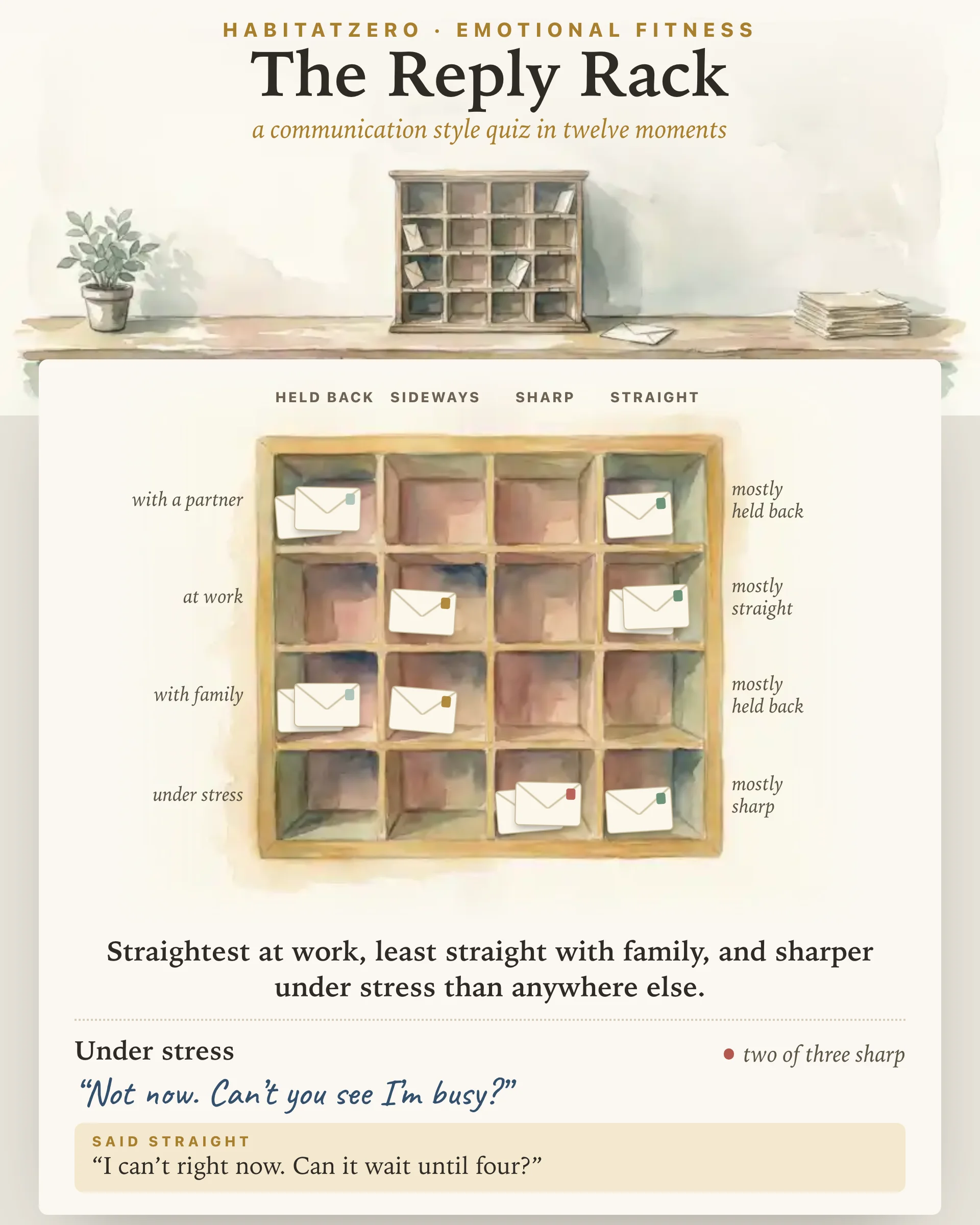
Every reply files an envelope into a painted rack. Rows are the four parts of life; columns are the four ways a reply goes out. By the end you can read the pattern at a glance: a partner shelf where the envelopes crowd the held-back column, a work shelf lined up under straight, a stress shelf that tips sharp.
As each shelf fills, the reading below the rack names its lean in plain words, such as two of three held back, and quotes the reply you picked. Under it sits the same moment said straight, so you can hear the difference between "Sure, sounds fun" and "I'd like a say before our weekends get booked." A short line invites you to rewrite that straight version in your own voice, because a script you would never say out loud is no use on a Tuesday night.
Once two shelves are full, the reading compares them, and once the stress shelf is full it checks whether pressure pushes your replies somewhere they rarely go. Tap any envelope to read it again or to change an answer, and the rack re-sorts itself as you go.
Be clear about what this is. The four styles are a teaching framework, and these twelve moments were written for this page. It is not a validated psychological test, and your rack describes one sitting, not your personality.
The skill underneath it has a longer research record. A review in Clinical Psychology: Science and Practice called assertiveness training a forgotten evidence-based treatment: research links assertiveness to a wide range of clinical problems and supports training it as an intervention that cuts across diagnoses, even though studies of it have fallen off sharply.
Straight is also not the same as loud. Studies of how people rate leaders found that too little and too much assertiveness both cost something: low assertiveness got in the way of getting things done, while high assertiveness strained relationships. The target is the middle, where the need gets said and the relationship survives the saying.
One more caution. People often misjudge how their own pushing lands. In negotiation experiments, people whom their counterparts saw as too pushy or too yielding tended to believe they had struck the right balance, and many who really had struck it thought they had come across as too forceful, an effect the researchers named the line crossing illusion. So treat your rack as a first draft, and ask someone you trust whether it matches what they hear from you.
Take the quiz when a conversation keeps going the same wrong way, or when you suspect you are one person at work and another at home. Then pick one shelf and practice there, one moment at a time.
If your partner shelf leans held back, the DEAR MAN Script turns a single straight request into lines you can rehearse before the talk. If sideways or sharp replies cluster around arguments at home, agree on fair fighting rules together on a calm evening. And if held back is the busiest column on your rack, the Boundaries Worksheet helps you decide where your yes ends before the next request arrives.
Come back after a hard month and take it again. Shelves move, and watching one move is most of the point.
Assertiveness training usually names four. Passive replies keep the need to yourself, aggressive replies aim it at the other person, passive-aggressive replies let it leak out as sarcasm, sighs or pointed silence, and assertive replies say it plainly while leaving the other person room to answer. This quiz calls them held back, sharp, sideways and straight.
No. The four styles are a teaching framework rather than a measured trait, and the twelve moments were written for this page. Researchers who study assertiveness use longer questionnaires and the view of other people. Read your rack as a mirror of how you answered today, then ask someone close to you whether it matches what they hear.
It often does, which is why the rack sorts replies by part of life instead of handing back one result. Plenty of people speak up easily at work and go quiet at a family dinner, or stay steady until they are tired and late. The gap between two shelves is usually the most useful thing the quiz shows.
Only in part. A broad communication skills test tends to score listening, clarity and body language together. This quiz zooms in on one skill inside that bundle, asking for what you need without going quiet, going sideways or going on the attack, and it gives you a straight line to practice for each moment.
The page shows a sample rack that someone has already filled. To answer the twelve moments yourself, keep your own rewrites and come back after a hard month to see which shelf moved, open it in HabitatZero at no cost.
By the team behind Fabulous, the science-based self-care app used by over 30 million people.