Leaves on a StreamEmotional Fitness · ~3 min
About this template · Updated September 2026
Credit where it belongs first. Thomas Gordon, the clinical psychologist who started Parent Effectiveness Training in 1962, named the I-message and taught active listening, a skill he took from Carl Rogers' "reflection of feelings." His own account of where those ideas came from is still published by Gordon Training International. The repair attempt comes from John Gottman's research on couples, and the Gottman Institute's piece R is for Repair gives his definition. This worksheet is our own practice tool built on their ideas; neither organization made it, reviewed it or endorses it.
Most communication advice breaks down at the same moment: the other person says something sharp, and you answer the sharp thing instead of what you meant to say. So this sheet is built around one real conversation, the one you have been putting off, and it asks you to look back afterward at what you actually did.
Say it back. Reflective listening means putting the other person's point into your own words and checking it: "So what I'm hearing is that Fridays keep landing on you. Is that right?" You are not agreeing. You are proving the message arrived before you send one of your own.
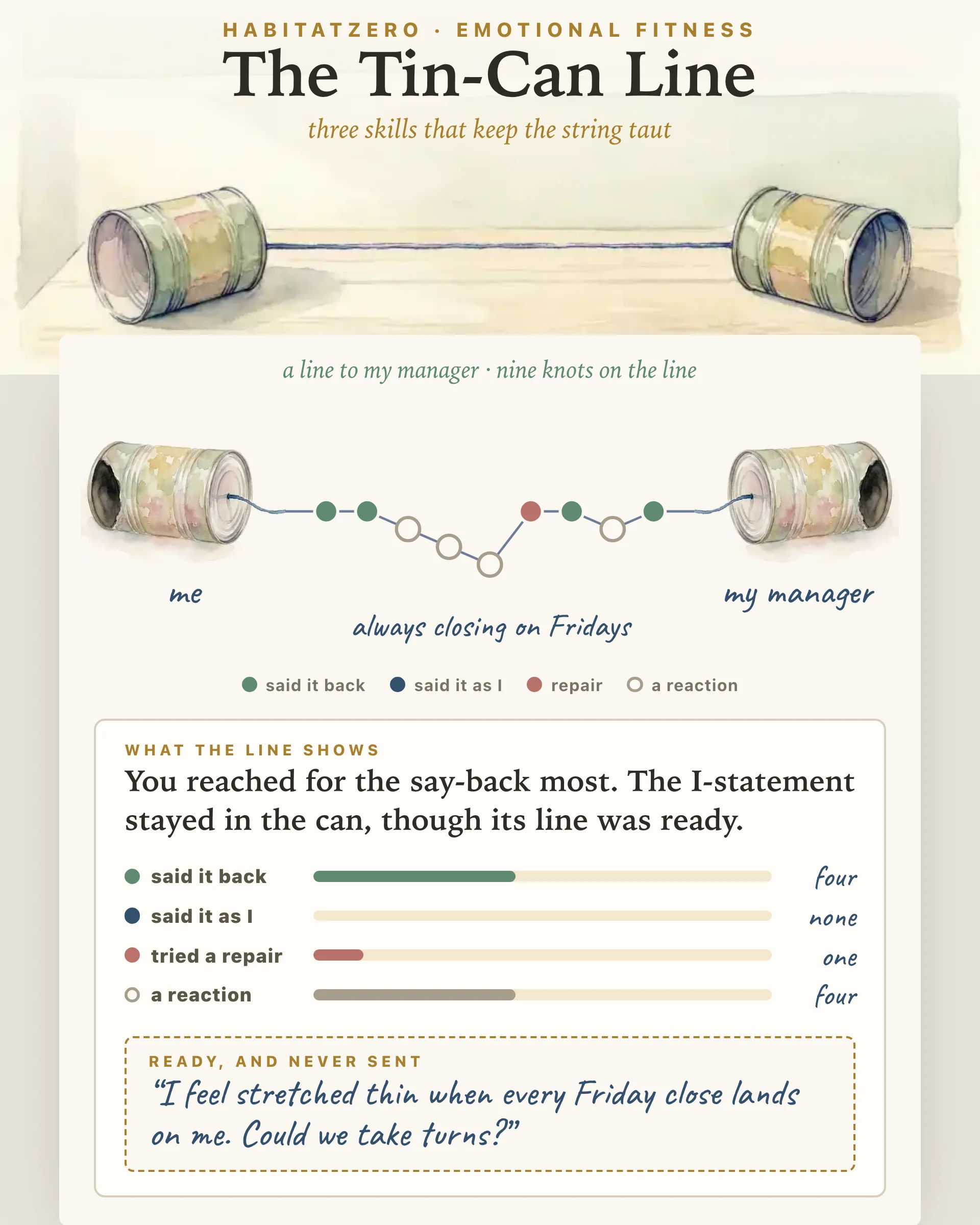
Say it as I. An I-statement names what you feel and what happened, then asks for one thing: "I feel stretched thin when every close lands on me. Could we take turns?" Gordon framed it as telling someone, without blame, how their behavior affects you. Its opposite is the you-statement, "you always leave it to me," which lands as a charge and invites a defense.
Repair. A repair attempt is any small move that stops a talk from sliding further: a softer restart, a request for twenty minutes, a plain "you have a point." It does not need to be graceful. It needs to come early.
The sheet is a tin-can telephone: two cans and a string. Before the talk, you name who is on the other can, then ready one line per skill. Tap "It sounds like" and finish the sentence, or tap a feeling word and your I-line opens with it. The page also flags phrases that tend to backfire, such as a "but" in the middle of a say-back or "you always" in an I-statement.
After the talk, you thread the line. Tap what you did at each moment you remember, in order: one of the three skills, or a reaction such as getting defensive, blaming or going quiet. Each tap hangs a knot on the string, up to twelve. A reaction lets it sag a notch, the next skill lifts it, and a repair pulls it straight, so the shape of the line becomes the shape of the talk.
Under the string, the reading names the skill you reached for most and the one that stayed in the can. If you readied a line for that skill and never said it, the page quotes it back to you. That gap between the prepared line and the spoken one is often the most useful thing here.
Reflective listening has good support for one specific effect. In a study of 115 people talking with partners trained to respond in set ways, those who heard their point paraphrased back felt more understood than those who got advice or a bare acknowledgment. It earned the listener no more liking than advice did, though. Feeling understood is the realistic goal, not being admired for listening.
For I-statements, a 2018 study of opening lines in a conflict found that I-language and stating a perspective each made a statement seem less hostile, and the best-rated openers named both people's views in I-language. Those were ratings of written scenarios, not live arguments, so treat the finding as a sensible starting point rather than a promise.
Repair attempts come out of Gottman's observations of couples, and his institute sums the pattern up plainly: people who do relationships well repair early and often. Most of this research involved couples, or strangers in a lab. Using the skills with a manager, a parent or a roommate is a reasonable stretch, but it is a stretch, and one replayed talk tells you about that talk, not about your character.
Ready your lines before a conversation you have been dreading, and replay it within a day, while the order of events is still clear: a raise request, a dispute over chores, a hard call with a parent. To see your default style first, take the communication style quiz. For a request you need to make firmly, the DEAR MAN script is built for that, and couples who want to practice side by side can use the timed turns in Pass the Floor.
One limit matters more than the rest. These skills assume both people are safe with each other. If you are afraid of the person on the other end, or your talks with them end in threats, you are not facing a skills gap you can practice your way out of. In the US, the National Domestic Violence Hotline is free, confidential and open around the clock at 1-800-799-7233, or you can text START to 88788.
Three that turn up in most counseling and training programs. Reflective listening means saying the other person’s point back in your own words and checking it. An I-statement names your feeling and the situation without blame, then asks for one thing. A repair attempt is any small move that keeps a tense talk from sliding further.
It is written for adults and older teens, and it fits any relationship: a manager, a coworker, a parent, a partner, a roommate or a friend. With a younger child, an adult can read the three skills aloud and act out the lines together before a real conversation.
Yes. Each skill card works as a one-line handout, with a plain how-to and starters. As an activity, everyone readies three lines for a conversation they face that week, has it, replays it, and then the group talks about which skill kept staying in the can.
It is John Gottman’s name for any statement or action, silly or serious, that stops a conflict from escalating. Here a repair can be a softer restart, a request for a pause, or owning your part, and it is the move that pulls a sagging line straight.
The public page shows a finished example of one replayed conversation. To ready your own three lines and thread your own talk, open the sheet in HabitatZero, which is free and keeps what you write.
By the team behind Fabulous, the science-based self-care app used by over 30 million people.