Leaves on a StreamEmotional Fitness · ~3 min
About this template · Updated September 2026
The choice point comes from Russ Harris, Joseph Ciarrochi and Ann Bailey, who built it in 2013 for their book The Weight Escape. Harris later redrew it as Choice Point 2.0, and his own overview and printable diagrams sit on his free worksheets and handouts page. What you are using here is a practice version we made on our own. None of the three authors had a hand in it, and none of them has reviewed or endorsed it.
Harris starts from an ordinary observation: all day long you are doing something. Some of what you do moves you toward the life you want, acting the way the person you want to be would act. He calls those towards moves. Some of it takes you further away, and those are away moves.
Trouble starts when a hard situation arrives with difficult thoughts and feelings attached, because they hook you. A thought like I'm already behind reels you in, and before long you are answering easy emails instead of the one task that matters. The spot where the two paths part is the choice point, and unhooking skills plus a clear sense of what you care about make the towards path easier to take.
Two details keep the map honest. First, only you decide which side a move belongs on. Harris's own example is cake: savored slowly at a birthday it is a towards move for him, and wolfed down while a craving drives, it is an away move. Second, if you have used the ACT Matrix, notice that away means something different there. In the Matrix it means moving away from unwanted thoughts and feelings; on the choice point it means moving away from the person you want to be. Harris points out the difference himself and treats neither tool as wrong.
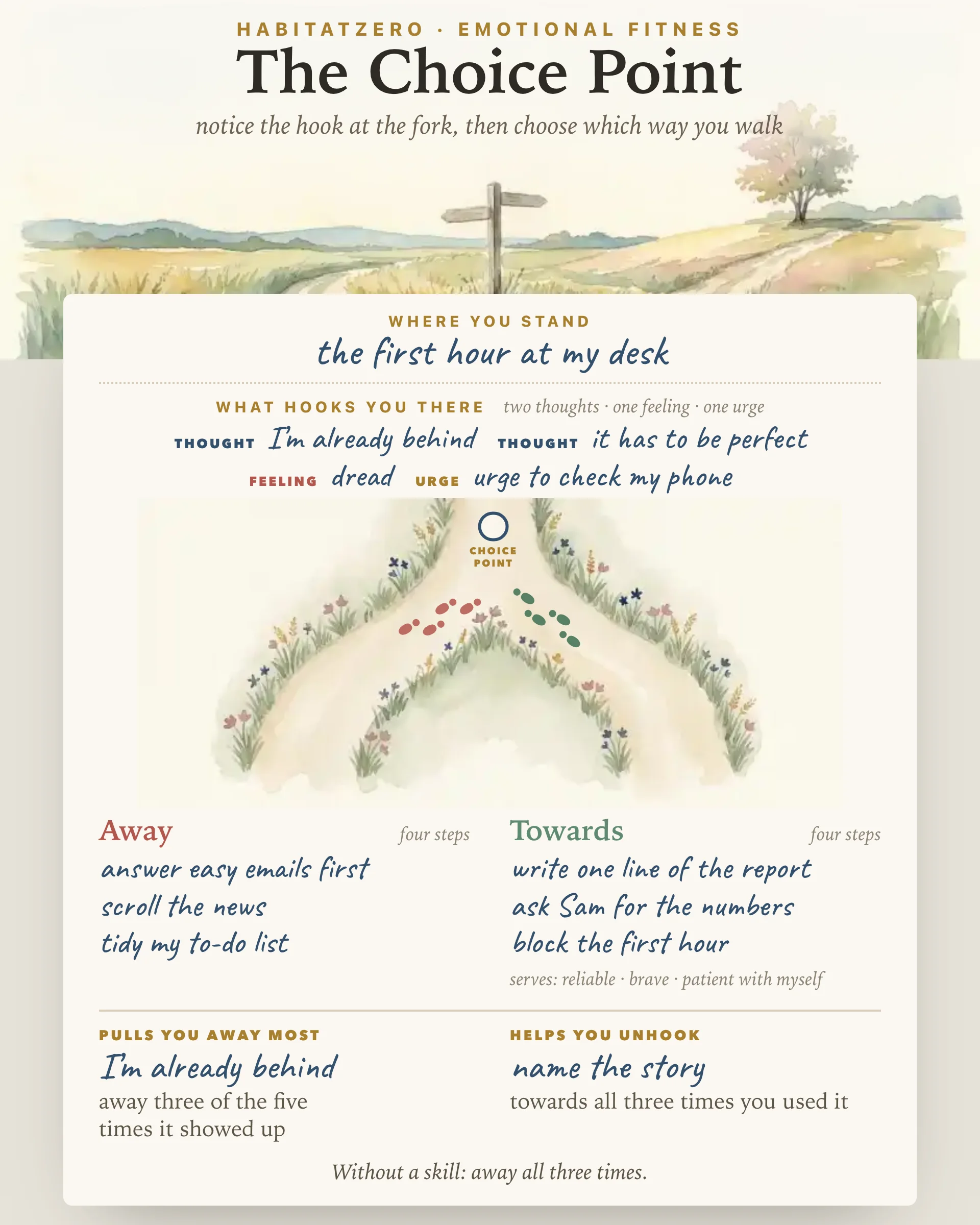
The sheet is painted as a fork in a footpath. At the top you write where you stand: one situation that keeps going the same way, like the first hour at your desk. Below it you name up to five hooks, each tagged as a thought, feeling, urge, sensation or memory.
Under the fork, the away branch holds what you do once hooked and the towards branch what you would do unhooked, plus the values those moves serve. The last list is your unhooking skills, such as naming the story or breathing and making room. Tap a suggestion or write a few words; every list has a limit, so the fork stays readable.
Then comes the part paper cannot do. Each time you meet the fork, mark a step the same day: what hooked you, what you did, and whether you used a skill. The step lands on the painted path as a footprint on the branch you took. While the trail has steps, the situation at the top stays fixed, so no footprint sits under words it was not earned for; a fresh trail frees it.
From the third step on, the sheet reads your trail back: the hook that pulled you away most often, the skill that most often came right before a towards step, and how your steps went with no skill at all. Twelve steps is the most the trail holds, and even that is a small sample, so read it as a hint about what to try first, not as proof.
The choice point teaches acceptance and commitment therapy, which has a reasonable evidence base. A meta-analysis of 39 randomized trials with 1,821 patients found that ACT outperformed waitlists, placebo conditions and usual care, and it did not differ significantly from established treatments such as cognitive behavioral therapy.
The skills you list have been studied one at a time as well. A meta-analysis of 66 laboratory studies found that acceptance, defusion, present-moment and values exercises each had measurable effects compared with inactive comparison tasks, and the effects were larger when people practiced through exercises and metaphors than when they only heard the reasoning. That argues for trying a skill in the moment, not just reading about it.
The diagram on its own has barely been tested. The closest study we found is a small pilot of a choice point program in residential substance use treatment: 47 people showed less psychological inflexibility and more values-based action over time, but there was no comparison group, and the authors ask readers to interpret the results with caution. Use the map because it shows you your pattern, not because the drawing itself is proven.
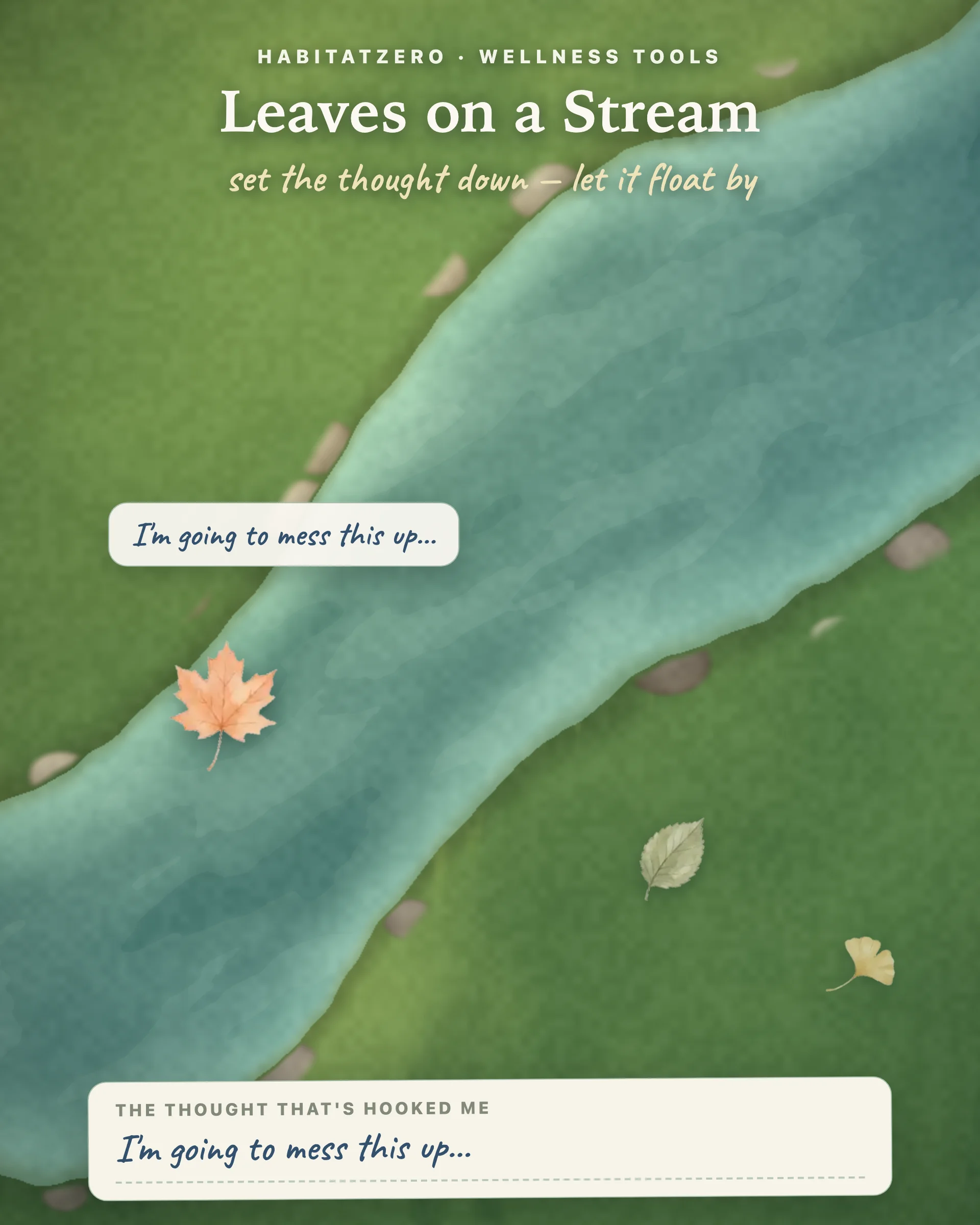
Pick a moment that repeats, map it on a calm day, and mark steps on the days you meet it. If a hook keeps winning even with a skill in hand, Dropping Anchor gives you Harris's steadier grounding routine for strong feelings, and Leaves on a Stream is slower practice for thoughts that stick.
This page is for practice, not therapy. If the same hooks win week after week, or the away moves are costing you your health, your work or the people close to you, take the map to a therapist who works with ACT. It is the kind of drawing they sketch with clients.
It is a small diagram from acceptance and commitment therapy for any moment when a hard situation brings up difficult thoughts and feelings. From that point you can make an away move, which takes you further from the person you want to be, or a towards move, which brings you closer. Russ Harris, Joseph Ciarrochi and Ann Bailey created it for their 2013 book The Weight Escape.
Towards moves are the things you do that fit the life you want and the way you want to treat yourself and others. Away moves pull you off that course, usually while a hook is doing the steering. Only you decide which side a move belongs on, and the same move can land on either side depending on what it is for that day.
They are ways to loosen the grip of a thought or feeling without arguing with it or waiting for it to leave. Harris groups them under defusion, acceptance and self-compassion, coming back to the present moment, and noticing the part of you that watches your thoughts. Naming the story, making room for a feeling and dropping anchor are everyday examples.
No. The choice point was created by Harris, Ciarrochi and Bailey, and Harris gives away his own diagrams and handouts on his ACT Mindfully website. This interactive sheet was built separately by Fabulous, and none of the three authors made it, reviewed it or endorse it.
The printable versions Harris shares are the place to go for a paper copy. The filled-in fork on this page is here to explore, and drawing your own, marking steps over the week and seeing what unhooks you happens in HabitatZero, free to use, with a print button once your fork is filled in.
By the team behind Fabulous, the science-based self-care app used by over 30 million people.